
Video Games
Top 20 Rarest and Most Expensive Video Games Ever Sold
From a $3 million copy of Super Mario Bros. to six-figure sales of Sonic, Resident Evil, Pokémon Red and GoldenEye 007, these are the highest verified recorded sale prices for 20 different video games. Each title appears only once, using its most valuable known sale.

19 minute readEstimated reading time
15 Sep 2026First published
15 Sep 2026Last updated
Video GamesEditorial topic
Display Armour / Collector Guide / Updated 2026
Top 20 Most Expensive Video Games Ever Sold (2026)
A factory-sealed game once meant one thing: somebody never got around to opening it. Today, exceptional early-production copies, competition cartridges and fragile packaging survivors can command six- or seven-figure prices. This guide ranks the highest verified recorded sale for 20 different video-game titles, from a rare “Left Bros.” box to the first sealed game publicly sold for $3 million (approx. £2.22 million).
Research update — 29 August 2026: The ranking includes Heritage’s August 2026 sales of Mario Bros., Super Mario Land and Mario Kart 64, plus its June 2026 $3 million (approx. £2.22 million) Super Mario Bros. result. Prices are reported in US dollars and include the buyer’s premium where the auction house reports an all-in realised price.
A record price describes one specific copy. It is not a valuation for every copy of that game, and it should not be treated as investment advice.
What is the most expensive video game ever sold?
The highest verified sale identified in our research is a sealed Super Mario Bros. for the NES, graded PSA 9.6 A++. Heritage Auctions sold the gloss-sticker, second-production copy for $3,000,000 (approx. £2.22 million) on 12 June 2026. Heritage described only three sealed examples of that production as known at the time of sale.
How this ranking works
One title, one record
This is not a list of the 20 most expensive individual cartridges. Each distinct game title appears once, represented by the highest verified recorded sale we found. That prevents early copies of Super Mario Bros. and The Legend of Zelda from occupying much of the table and gives a broader picture of the market.
Public auction-house records take priority. A private sale is included only when a credible platform documented it sufficiently. Where multiple titles share the cut-off price, the title that achieved that price first takes the final numbered position; the other equal-price records are disclosed below the table.
Values are shown in US dollars using reported sale prices, with approximate GBP equivalents provided for UK readers. GBP conversions are indicative and will vary with exchange rates.
The 20 most expensive video-game titles at a glance
Cut-off tie: Pokémon Red Version, Twisted Metal and Clu Clu Land also have verified $156,000 (approx. £115,000) Heritage sales. Super Mario Bros. 3 takes the final numbered place because it reached that figure first, on 20 November 2020. Contra’s $150,000 (approx. £111,000) result now sits immediately below the cut.
Protect / Display / Preserve
Armour your boxed-game collection
Purpose-built acrylic cases for classic Nintendo and Sega formats.
The record sales, from #1 to #20
#1 — Super Mario Bros. — $3,000,000 (approx. £2.22 million)
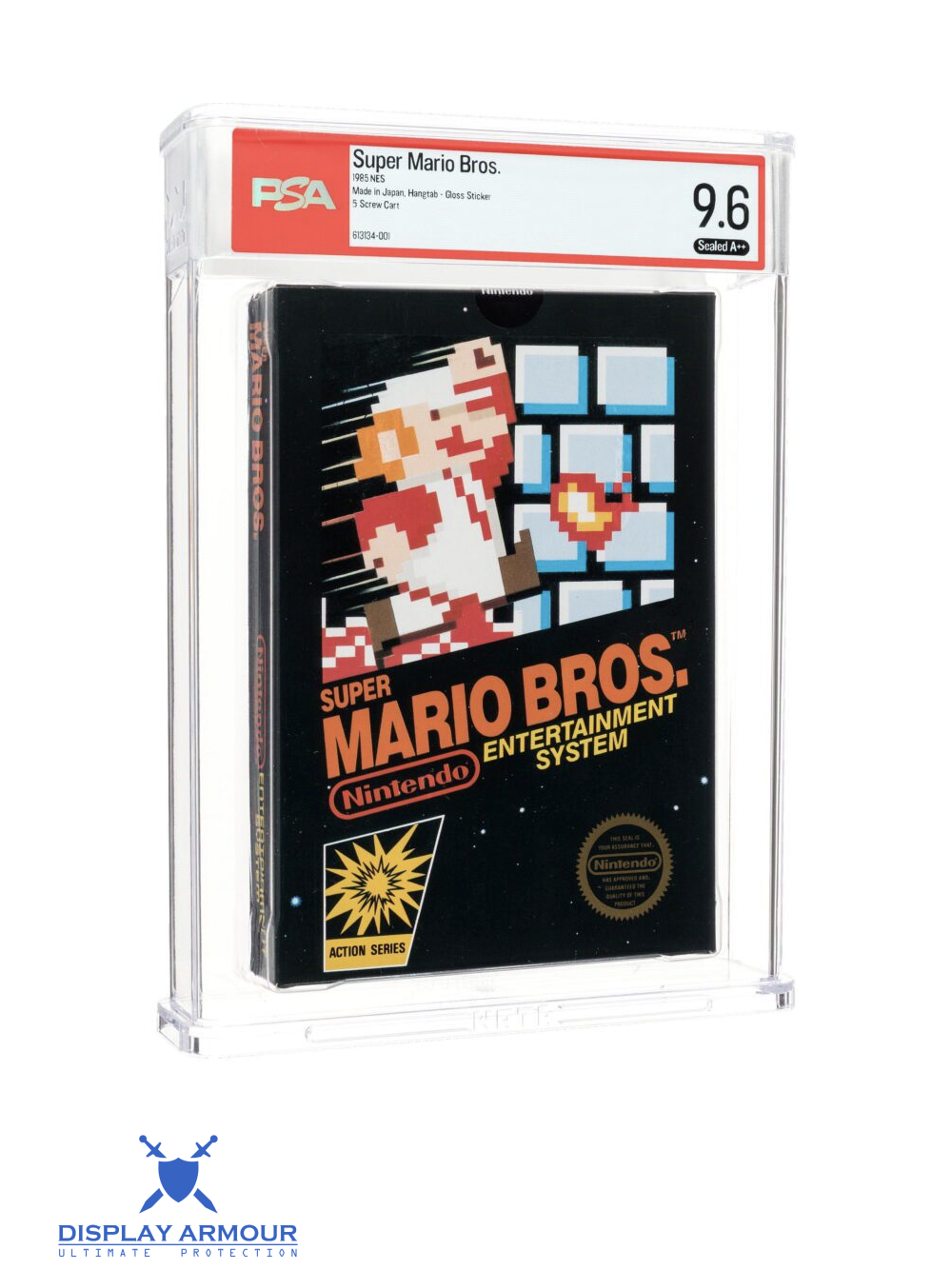
The record holder is not simply “an old Mario game”. Early NES copies pre-date the familiar shrinkwrap format and can be separated by sticker seals, hangtabs, box text and small production codes. This second-production copy used a glossy round sticker and retained the “Control Deck” packaging designation.
Heritage described it as the earliest confirmed sealed example and one of three sealed copies of the production known at the time. Its PSA 9.6 box and A++ seal combine landmark software, exceptionally early packaging and elite preservation—the three forces behind the $3 million (approx. £2.22 million) result.
#2 — Super Mario 64 — $1,560,000 (approx. £1.15 million)
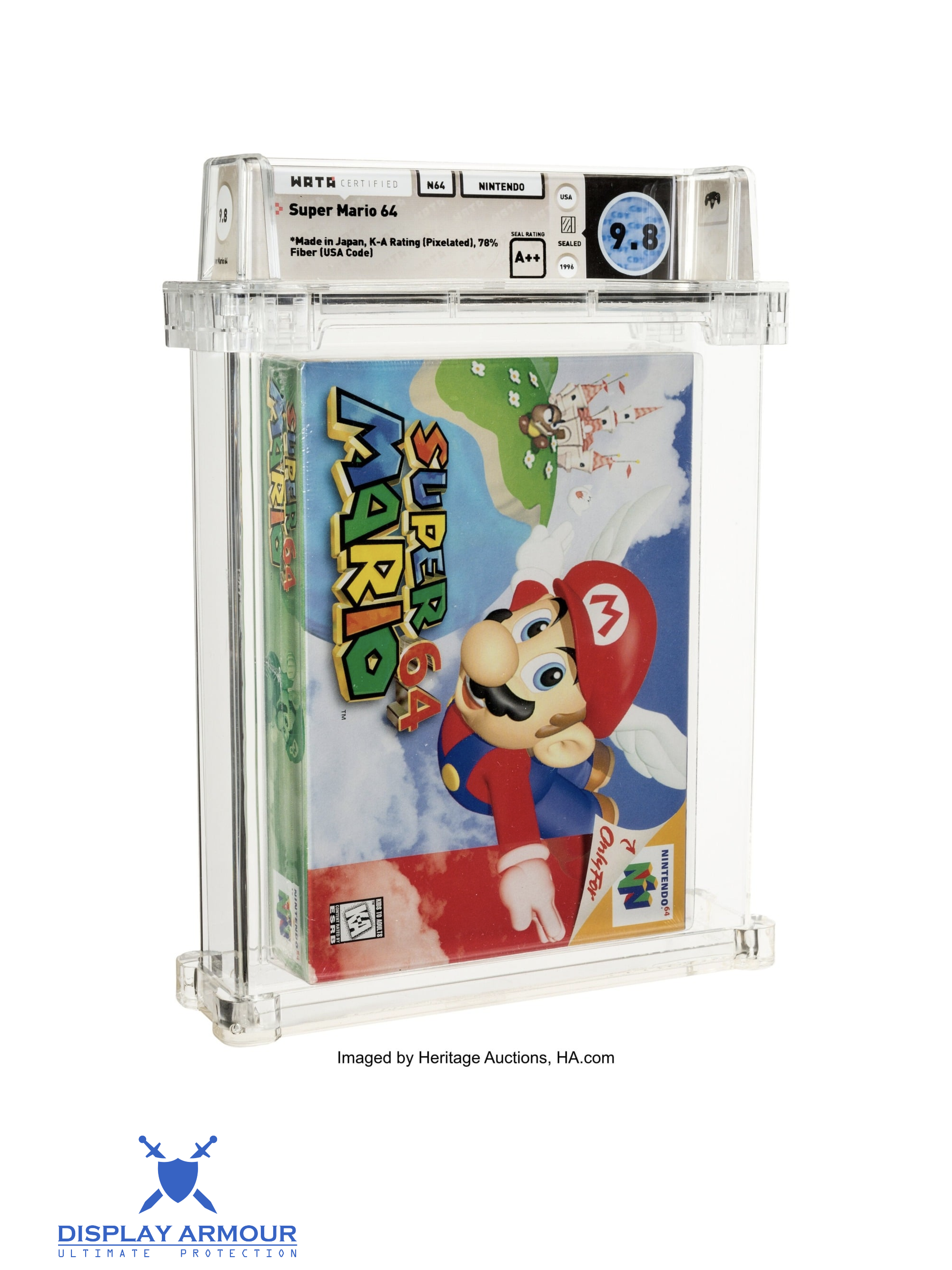
Super Mario 64 helped define how character movement and camera control could work in three dimensions. It was a major N64 release and a mass-market game—not an obscure cartridge with a tiny print run.
That is the lesson behind the $1.56 million (approx. £1.15 million) copy: rarity of a title is not the same as rarity of an elite-condition sealed example. A 9.8 box with A++ seal represented an almost untouched survivor of a game most owners opened immediately.
#3 — The Legend of Zelda — $870,000 (approx. £644,000)
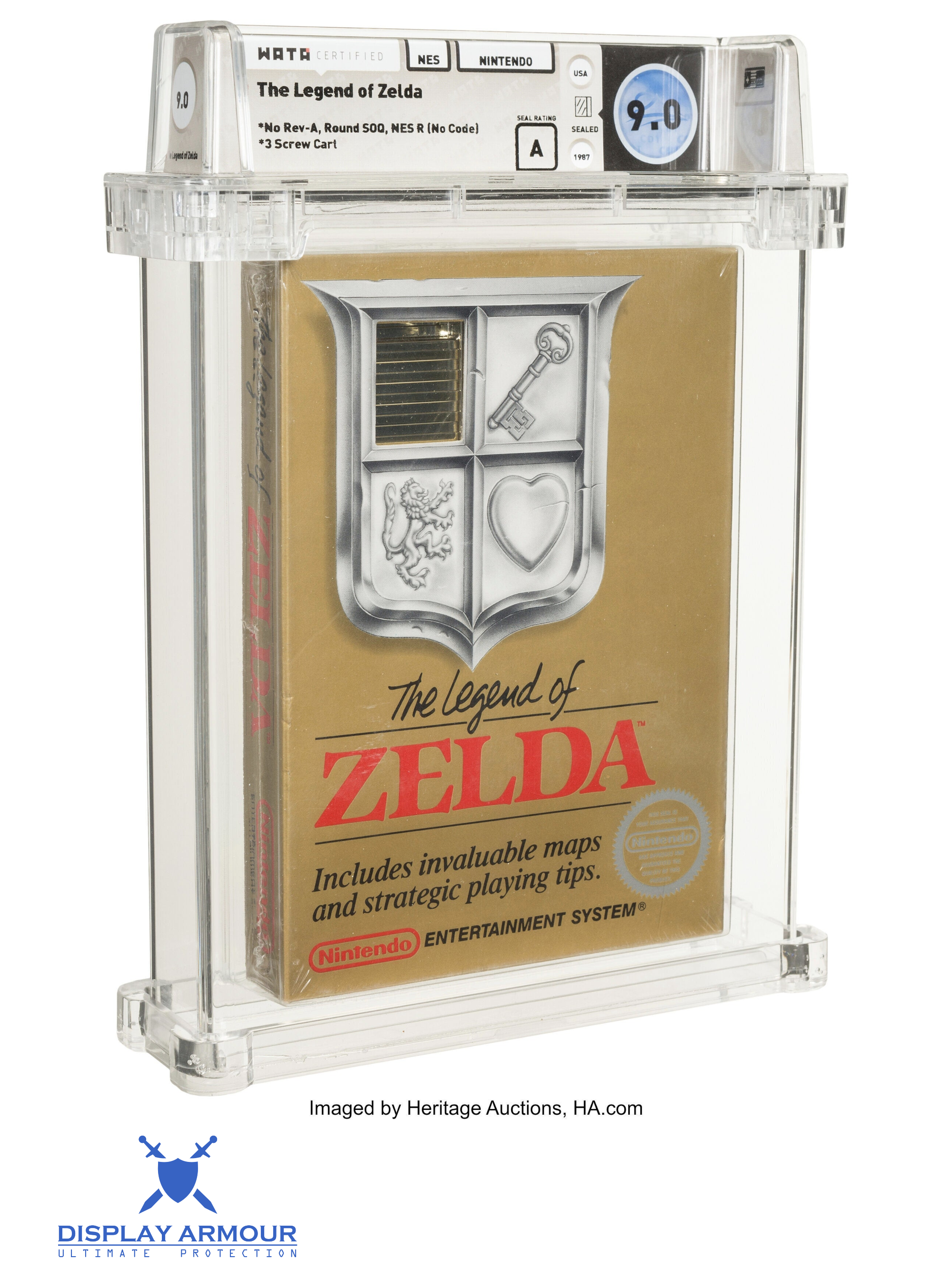
“No Rev-A” and the Round Seal of Quality are not decorative footnotes. They help locate this copy within Zelda’s early US production history. Heritage said the earlier “NES TM” first production was believed to be represented by only one sealed example, making this early-production version the earliest realistically obtainable sealed variant at the time.
Zelda’s importance as an adventure series supplies demand; the production details tell collectors exactly what survived. If duplicate titles were allowed, other early Zelda variants would also sit high in the ranking.
#4 — John Madden Football — $480,000 (approx. £355,000)
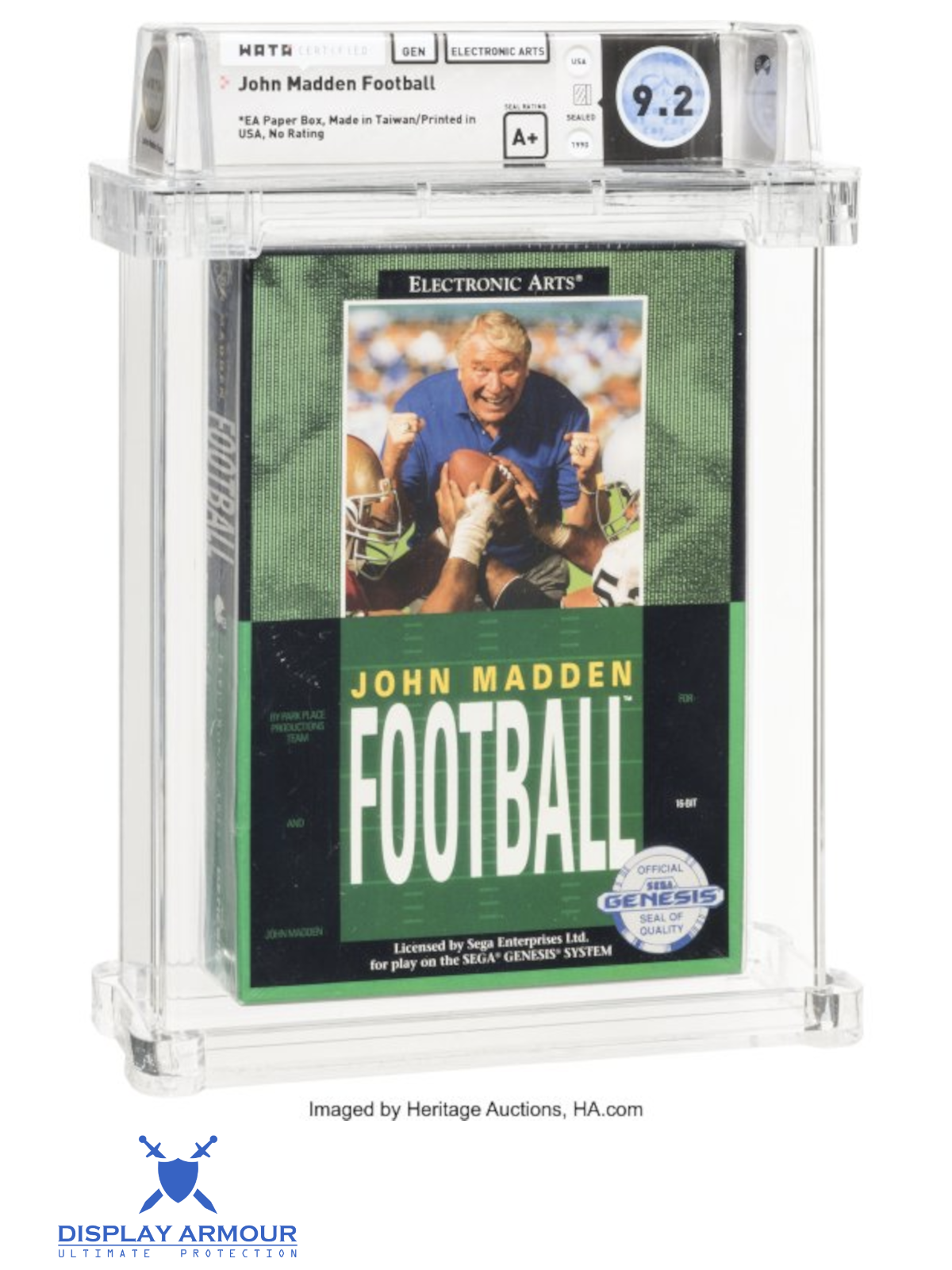
The sports-game anomaly is one of the best stories in the ranking. Sports titles were usually bought to play, updated annually and handled heavily, so pristine early sealed examples were rarely treated as future collectibles. Yet this release helped establish a series that became part of American sports culture.
The sold copy also carried direct provenance from John Madden’s office. Historical importance, survival and provenance allowed a sports simulation to challenge Mario, Zelda and Sonic—evidence that collector value is not restricted to traditional rarity or fantasy franchises.
Collector protection
Displaying a boxed NES classic?
Keep the artwork visible while adding rigid 4 mm acrylic protection.
#5 — Mario Bros. — $450,000 (approx. £333,000)
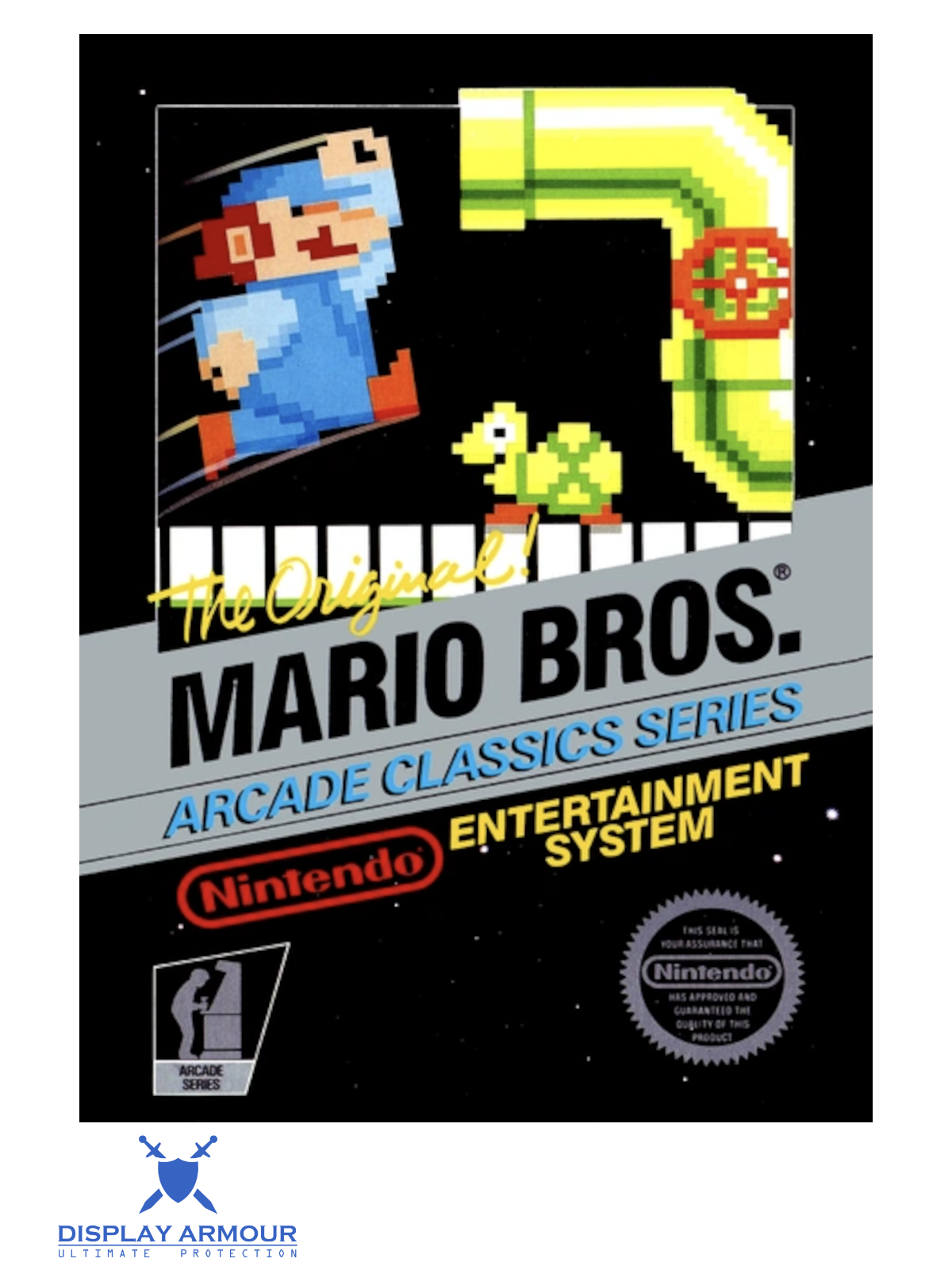
Do not confuse this with Super Mario Bros.. Mario Bros. is the arcade-rooted single-screen game featuring Mario and Luigi before the side-scrolling Mushroom Kingdom formula took over. Its NES black-box presentation ties it to Nintendo’s foundational US library.
Heritage described this Wisconsin Collection copy as the only certified sealed first-production example known at the time of sale. The coveted early gloss-sticker seal, 9.2 box grade and A++ seal grade helped it reach $450,000 (approx. £333,000)—superseding the title’s earlier $264,000 (approx. £195,000) record.
#6 — Sonic the Hedgehog — $430,500 (approx. £319,000)
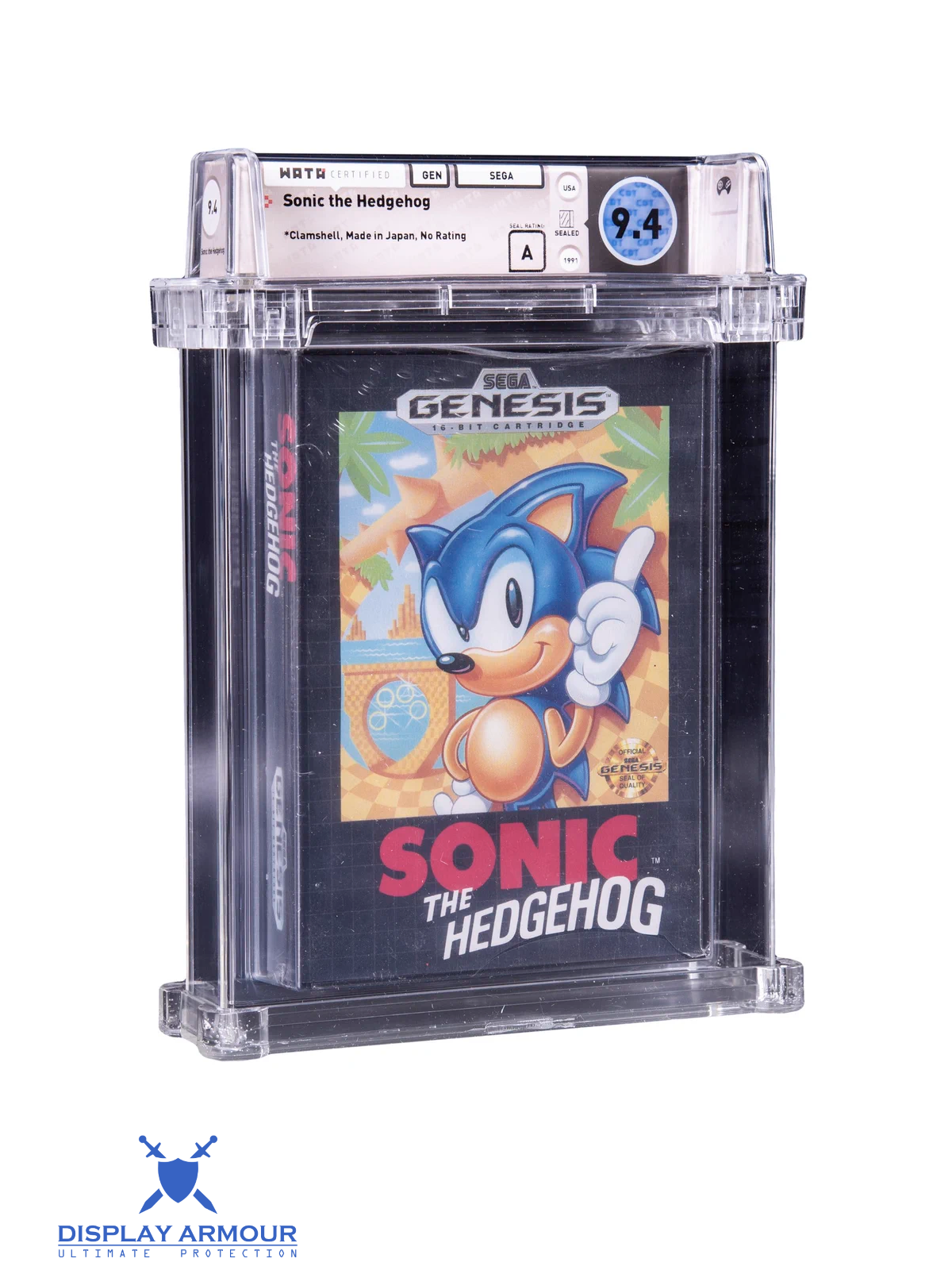
Sonic gave Sega a defining mascot and a fast, confident answer to Nintendo during the 16-bit console rivalry. It was also a Genesis pack-in in many homes, meaning copies were generally opened for immediate play.
Goldin’s $430,500 (approx. £319,000) result was widely reported as a record for the title. Because the original lot page is no longer readily accessible, we retain the contemporary reported sale but distinguish it from the directly accessible Heritage records used elsewhere.
#7 — Super Mario World — $360,000 (approx. £266,000)
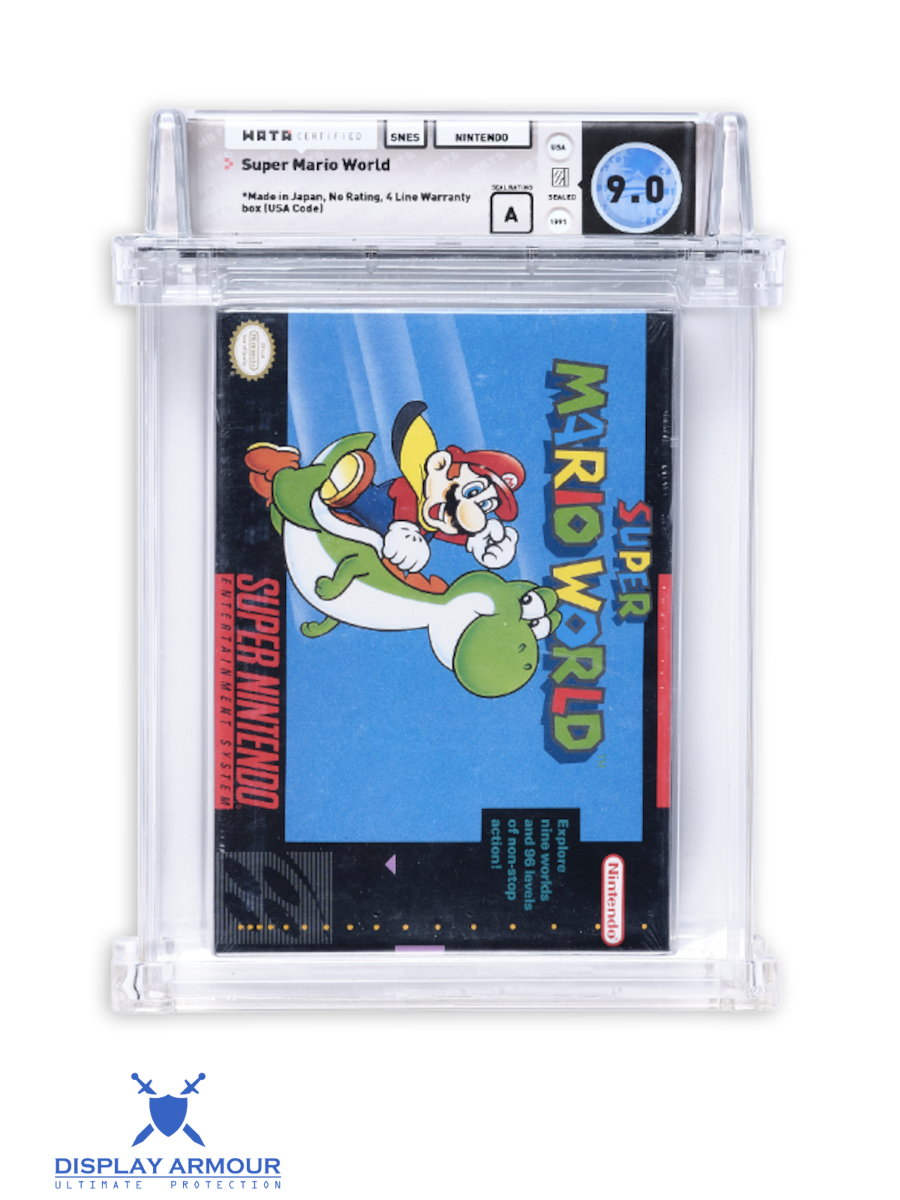
Super Mario World was closely associated with the launch of the SNES and was widely bundled with the console. Pack-in status creates a useful paradox: enormous numbers of people owned and played it, while comparatively few retail packages remained sealed and immaculate.
The $360,000 (approx. £266,000) copy combined launch-era nostalgia, a 9.4 box grade and A+ seal. It is another reminder that broad distribution can increase cultural demand while childhood use reduces the number of untouched survivors.
#8 — Super Mario Bros. 2 — $324,000 (approx. £240,000)
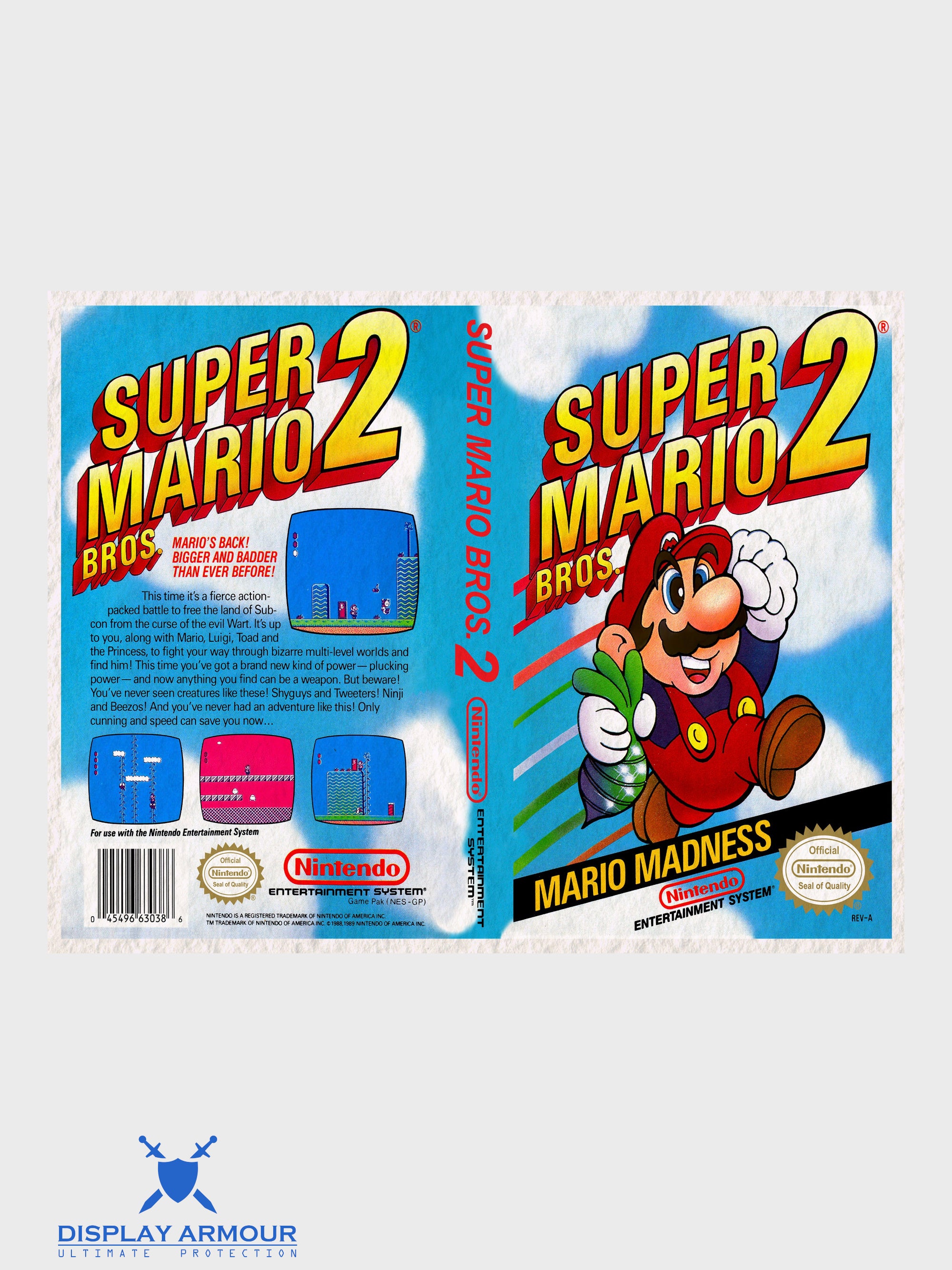
The American Super Mario Bros. 2 is unusual within the series, built from the foundations of Yume Kōjō: Doki Doki Panic. Its mechanics and character choices still became part of Mario’s wider vocabulary.
Heritage called this 9.8 A+ first-production copy the finest example of any variant it had offered at the time. The result belongs in a current title-by-title ranking even though it was absent from the initial working list.
#9 — Mike Tyson’s Punch-Out!! — $312,000 (approx. £231,000)
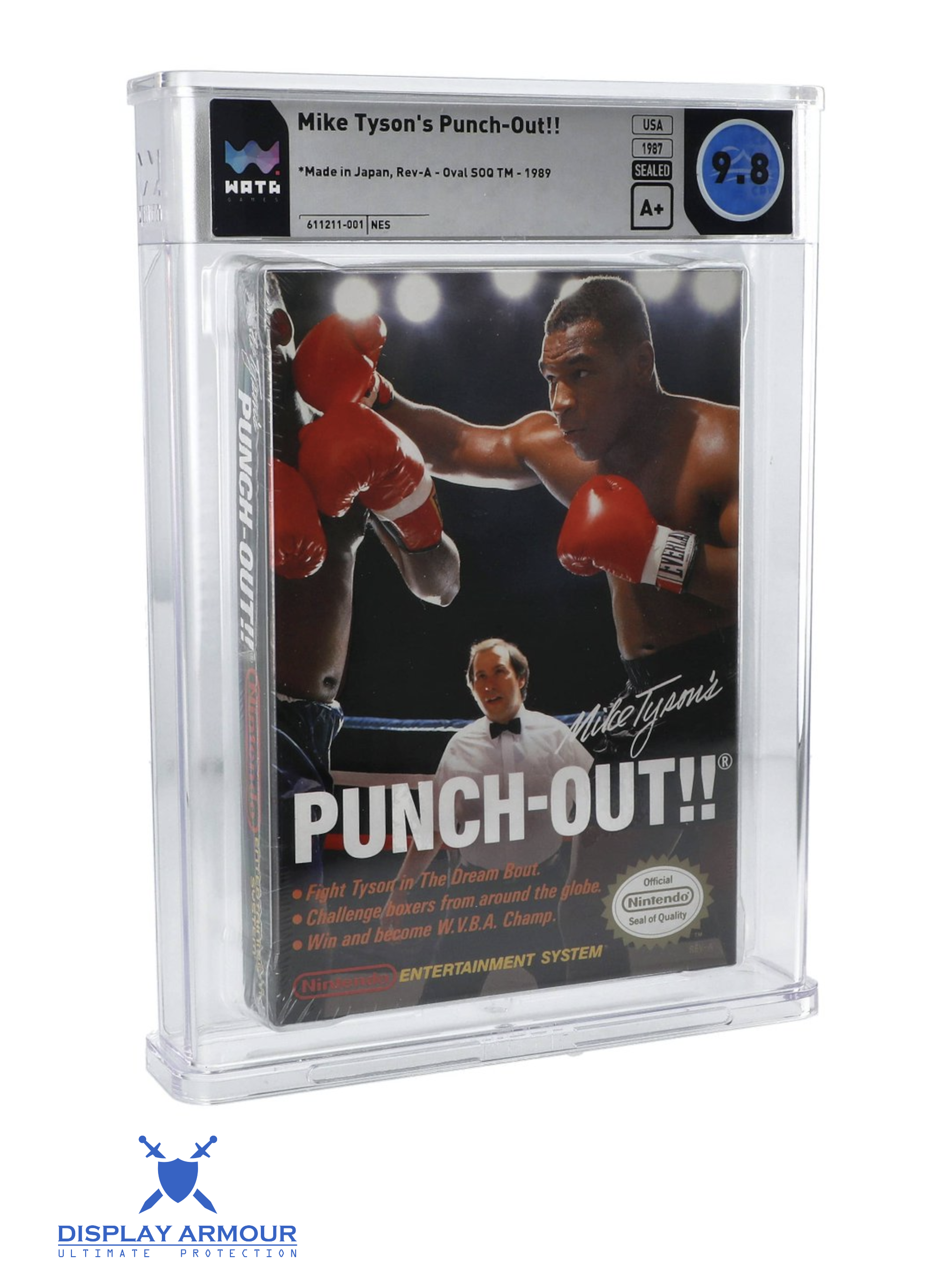
The Tyson-branded edition is the most instantly recognisable form of Nintendo’s boxing game. Its licensed cover, memorable final opponent and place in NES culture give it a distinct identity from later Punch-Out!! packaging.
Heritage said no other Wata 9.8 copy was known to have reached public auction when this 9.8 A++ example sold. The later-production designation did not prevent a record: at this level, the extraordinary condition and seal were decisive.
Cardboard deserves armour
Protect boxed Game Boy games
Clear, UV-protected acrylic designed around boxed Nintendo Game Boy releases.
#10 — Resident Evil — $264,000 (approx. £195,000)
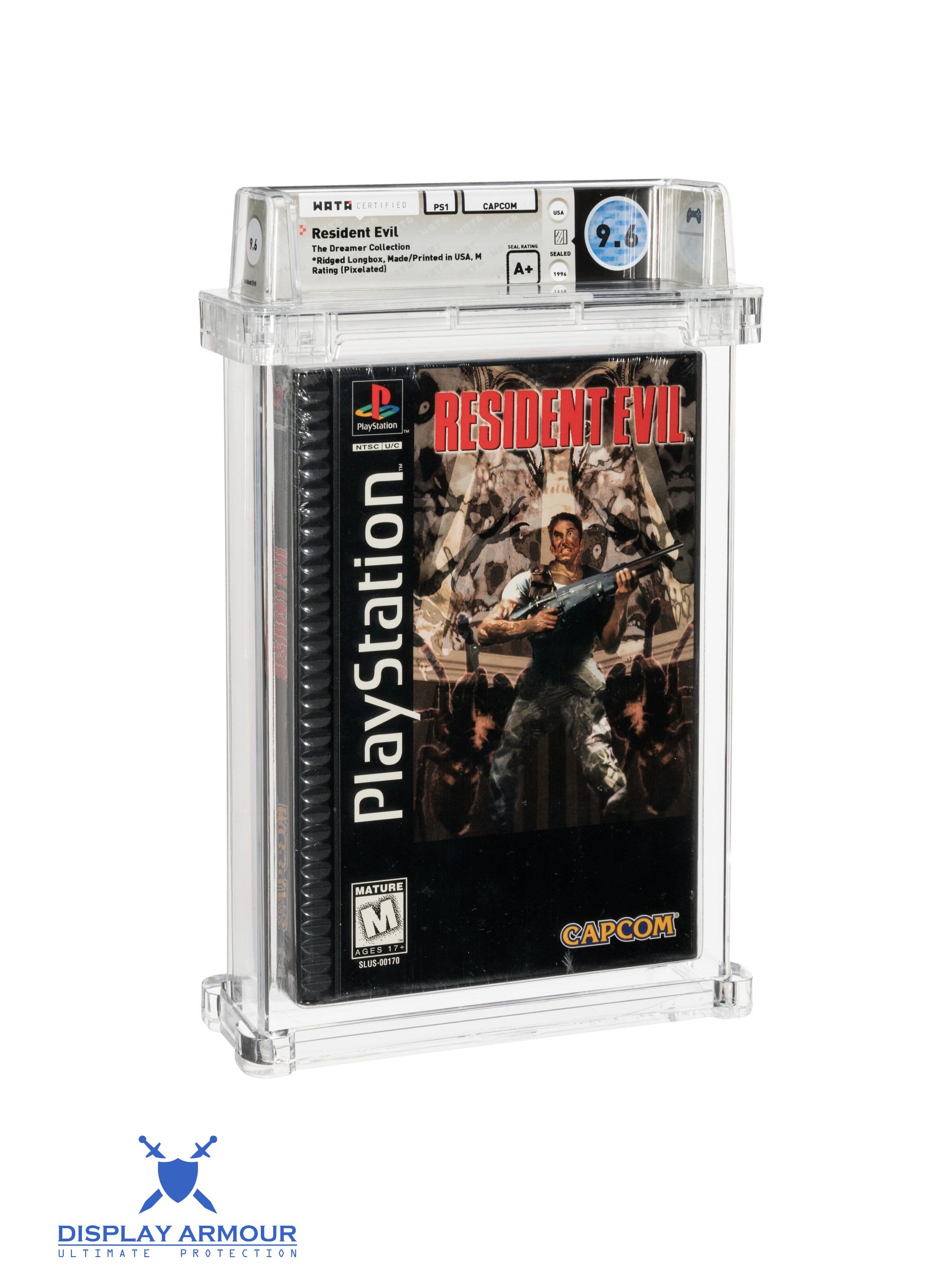
Early PlayStation releases used a tall longbox before standard jewel cases became dominant. The format is visually distinctive, but its broad surfaces, edges and mixed materials create more opportunities for wear than a compact plastic case.
This first-production ridged-longbox copy came from the Dreamer Collection and retained a 9.6 box grade with A+ seal. It also represents the beginning of a series central to survival horror, joining historically important software with difficult-to-preserve launch-era packaging.
#11 — Super Smash Bros. — $240,000 (approx. £178,000)
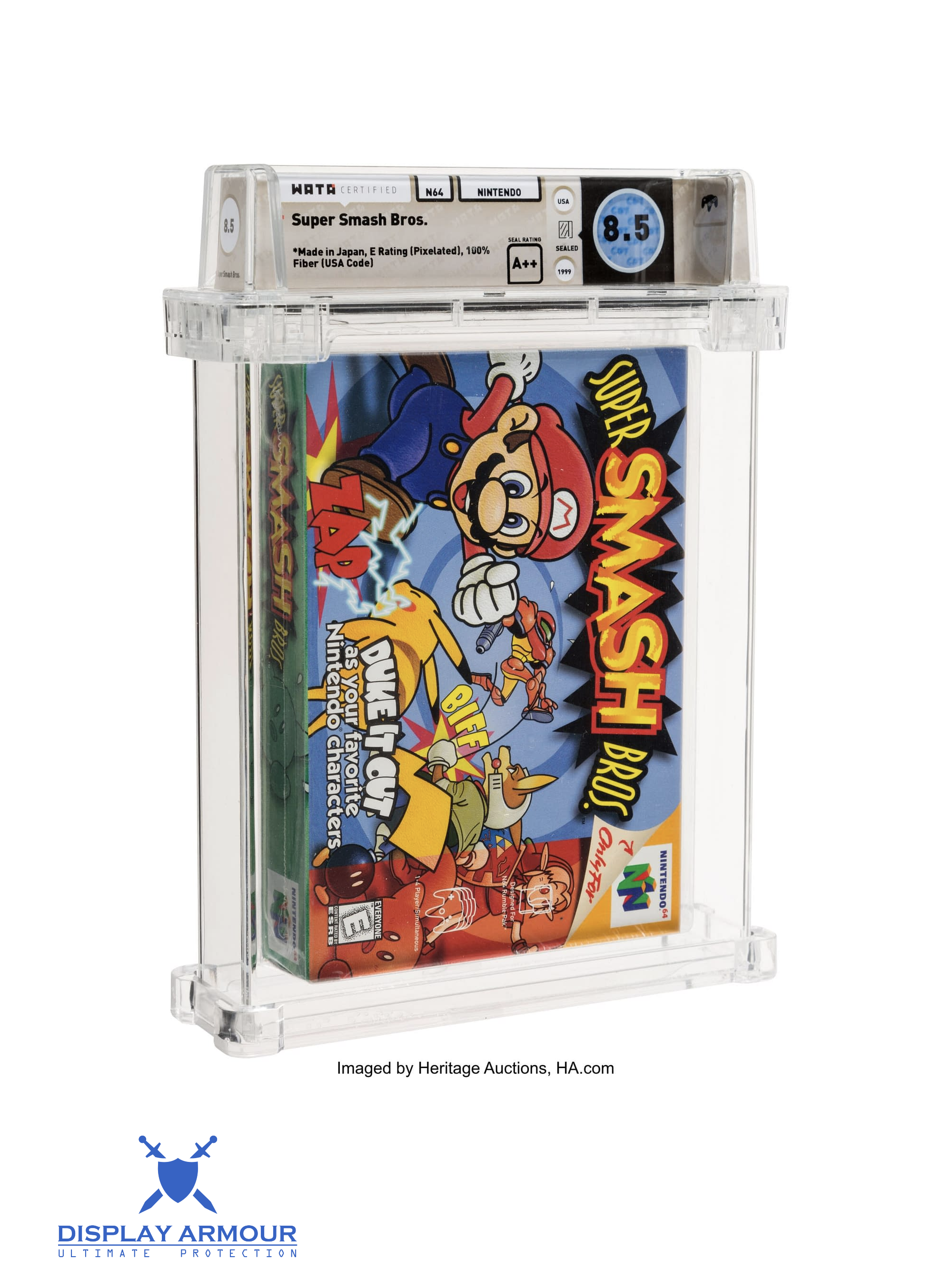
The original Super Smash Bros. is the modest N64 beginning of Nintendo’s enormous crossover fighting series. Loose copies are familiar; a 9.8 A++ sealed box is not. Heritage described this as the highest-graded example it had offered at that point.
The result shows why “the game was mass produced” is not the end of a valuation discussion. Supply must be considered at the exact variant, seal and condition level collectors are bidding on.
#12 — The Legend of Zelda: Ocarina of Time — $228,000 (approx. £169,000)
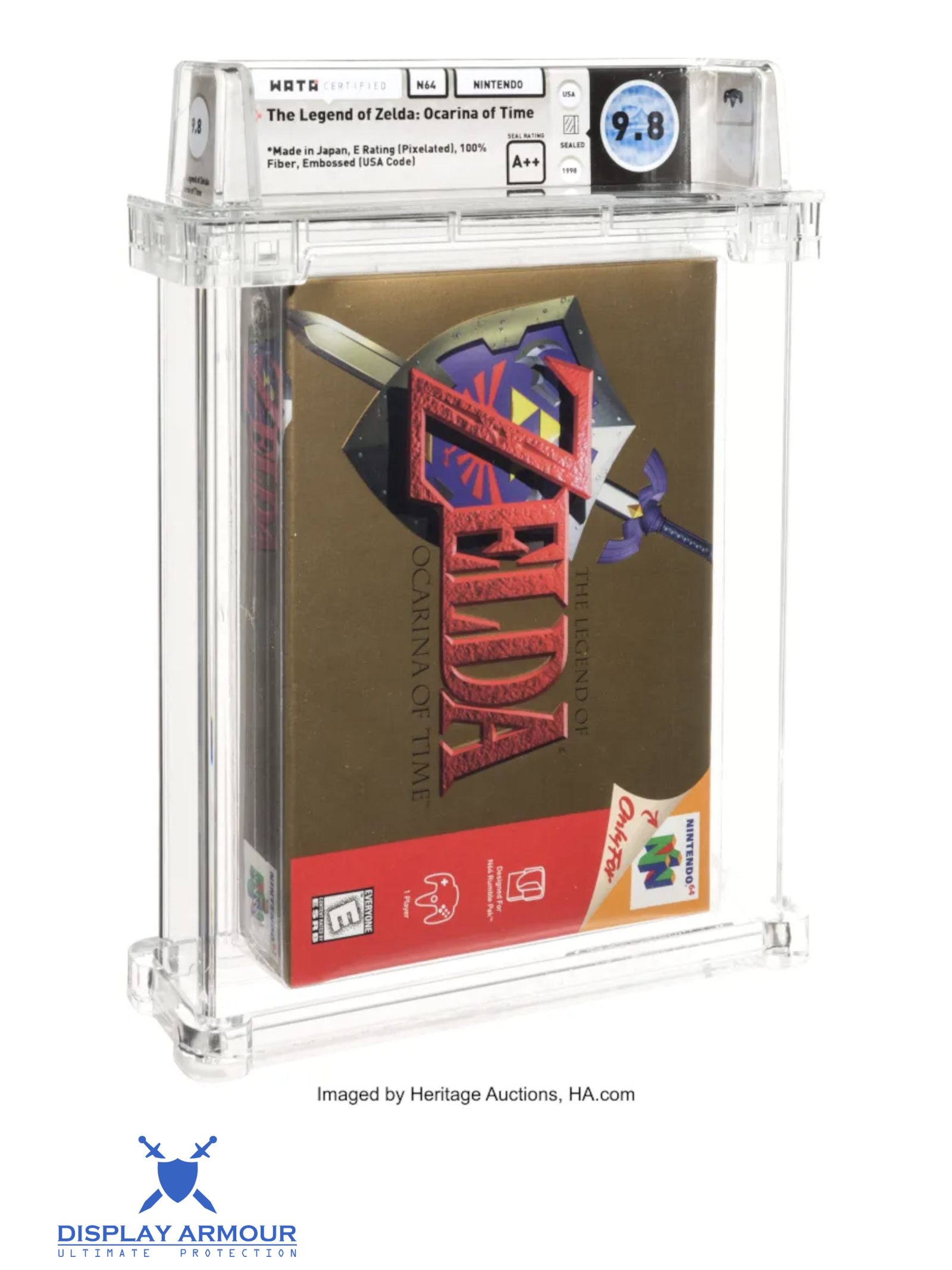
Ocarina of Time translated Zelda’s exploration, combat and puzzle design into 3D and became one of the N64’s most critically significant releases. Cultural stature does not guarantee a record price, but it creates sustained demand when an exceptional physical copy appears.
This standard-release example reached Wata 9.8 A++—an extraordinary combination of box and seal preservation for packaging that was normally opened immediately. It is a clear N64 example of condition rarity rather than title rarity.
Built for boxed classics
Give SNES artwork a clearer display
Premium acrylic protection made for boxed Super Nintendo games.
#13 — Final Fantasy — $204,000 (approx. £151,000)
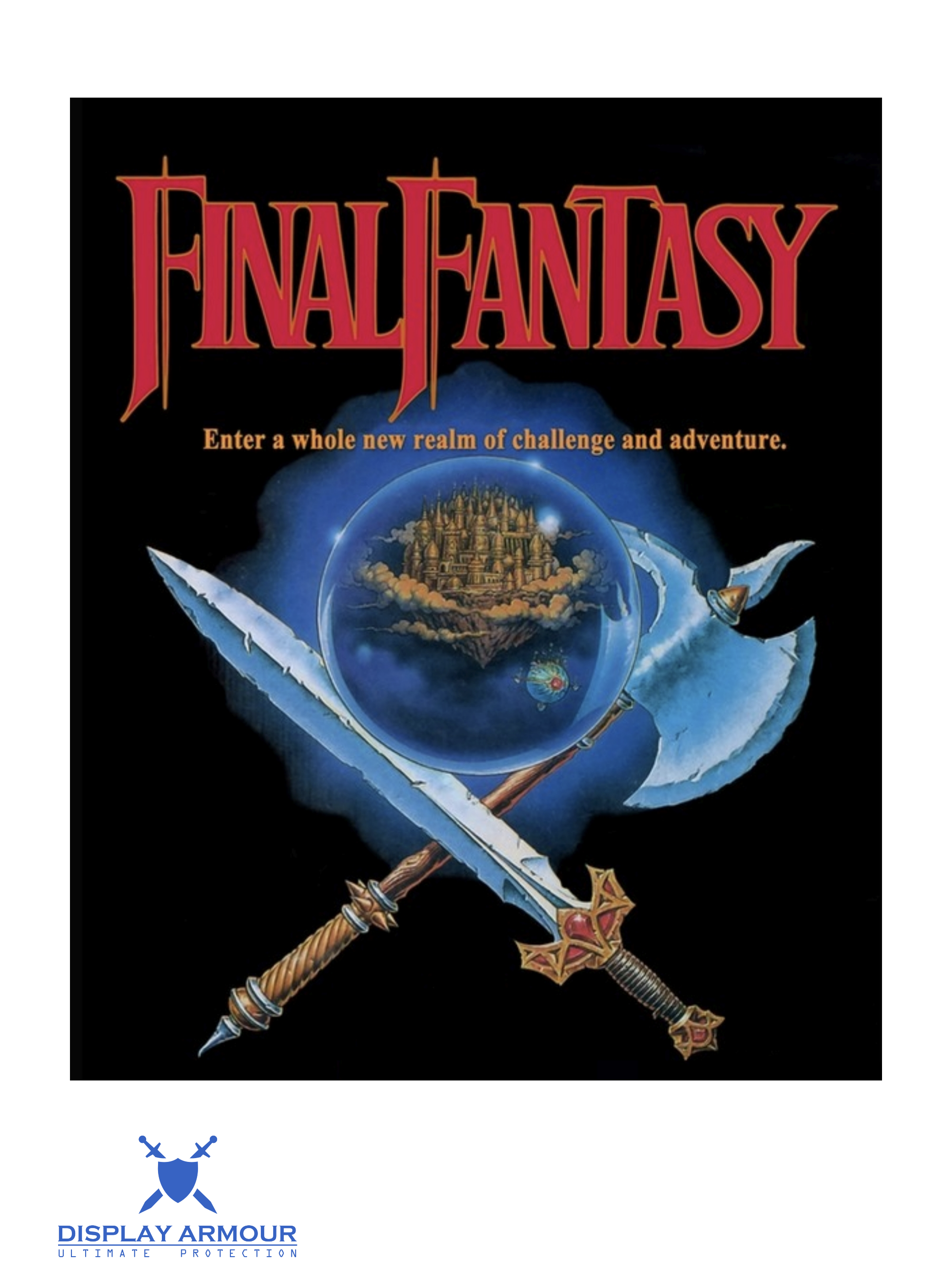
The US NES release anchors the North American collecting history of one of role-playing gaming’s defining series. Long play sessions and the game’s emphasis on progression meant retail copies were bought to be used, not stored untouched.
At 9.8 with an A++ seal, this example sat at the extreme end of sealed condition. Its price reflects both franchise importance and the difficulty of finding a thirty-year-old cardboard box and factory seal approaching pristine condition.
#14 — Super Mario Land — $200,000 (approx. £148,000)
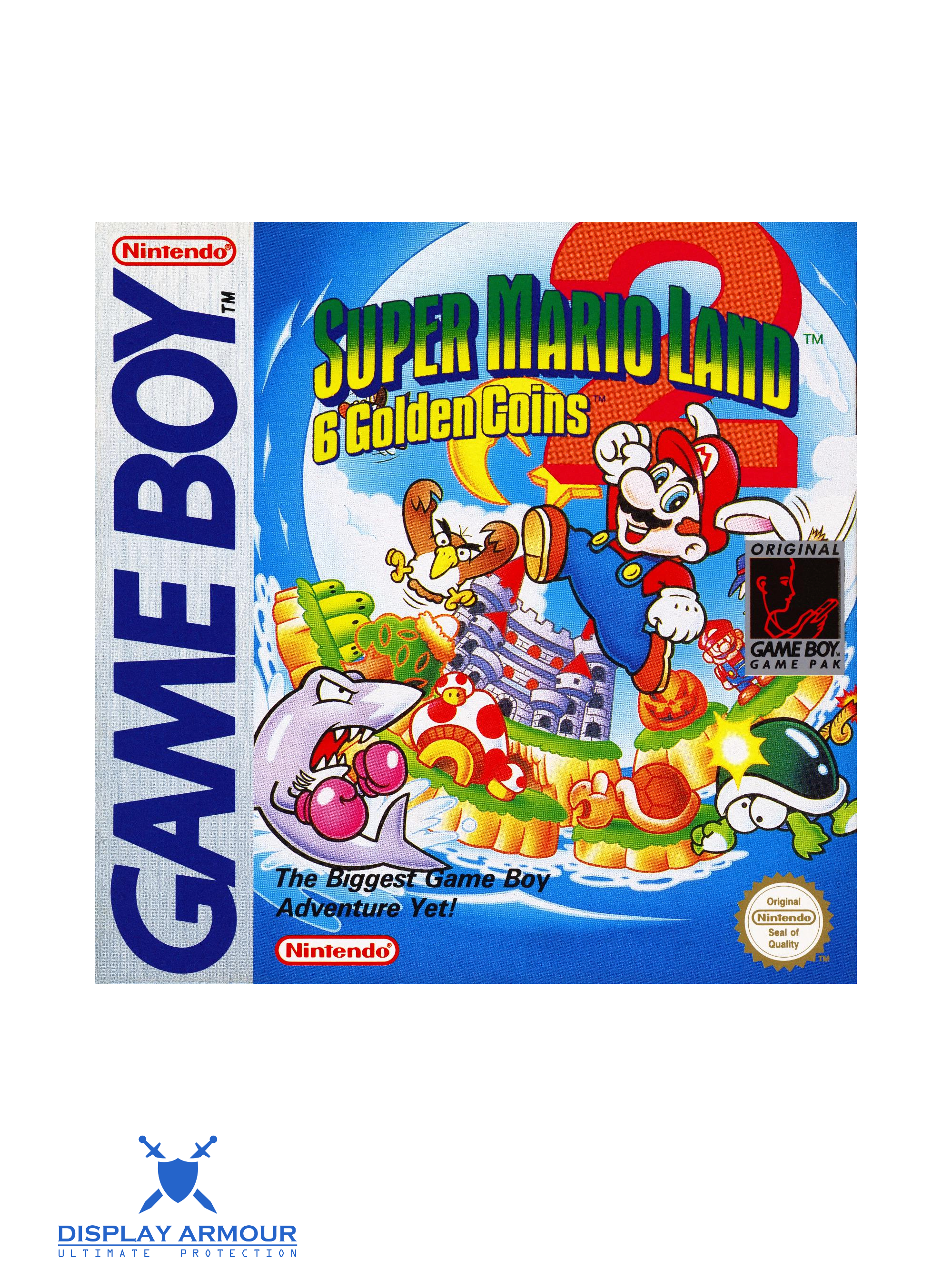
Mario’s first handheld adventure arrived alongside the Game Boy era in lightweight cardboard packaging. These small boxes were opened, flattened, discarded or carried in bags and drawers, so clean sealed survivors face a different preservation challenge from hard plastic cartridge cases.
The $200,000 (approx. £148,000) copy was identified by green screenshots and the absence of later “USA and Canada” text. Its first-production packaging and 9.8/A+ condition connect a mass-market handheld milestone to a very narrow survivor class.
#15 — GoldenEye 007 — $192,000 (approx. £142,000)
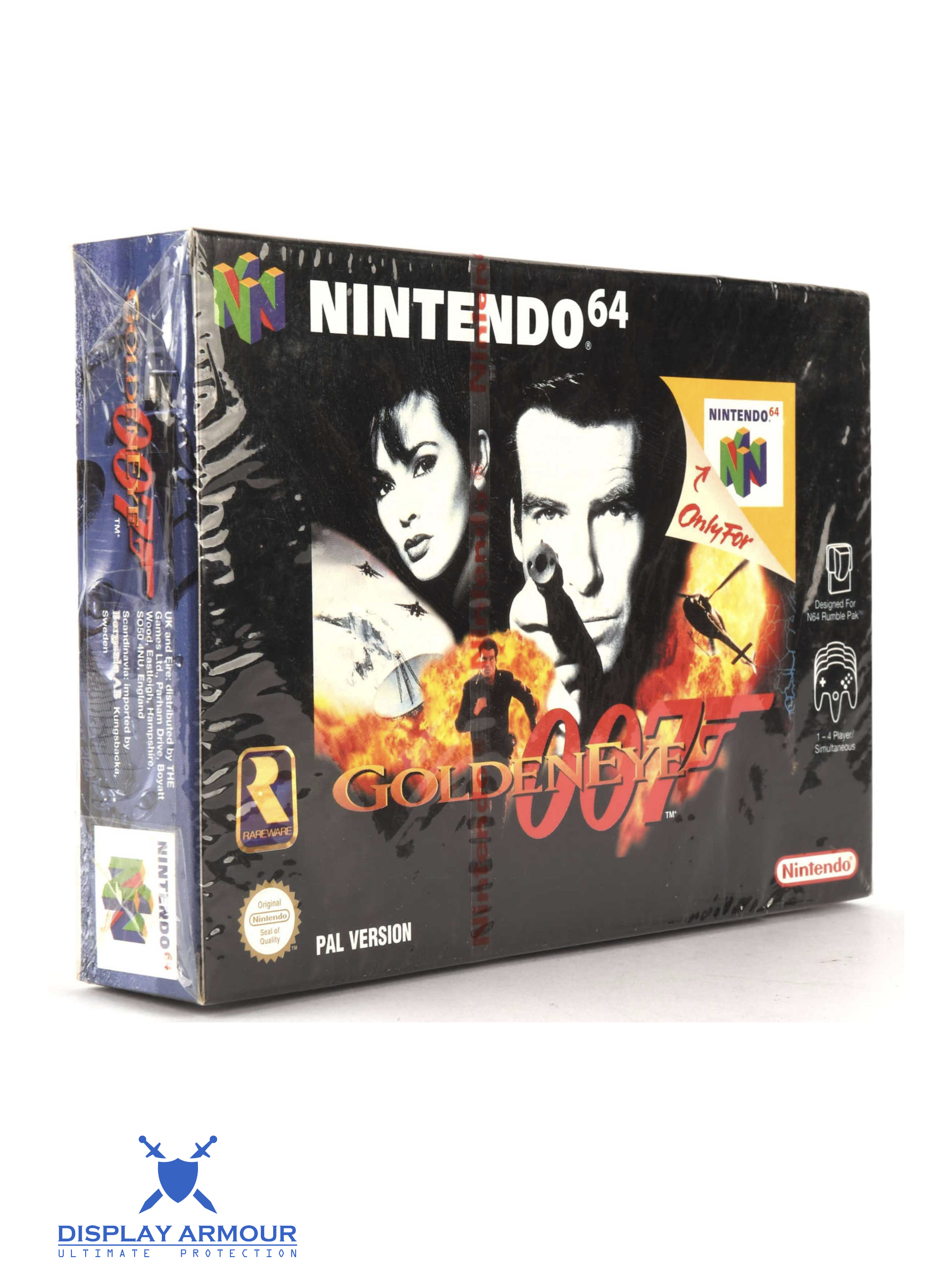
GoldenEye 007 was everywhere. Heritage cited sales of roughly eight million copies, while its split-screen multiplayer became part of the N64’s social identity. That ubiquity is exactly what makes an initial-production 9.8 A++ sealed copy so striking.
A common played cartridge and an exceptional untouched first-wave box are different collectibles. The $192,000 (approx. £142,000) result captures that distinction—and the unusual status of a film-licensed game that built a legacy far beyond an ordinary tie-in.
#16 — Mario Kart 64 — $187,500 (approx. £139,000)
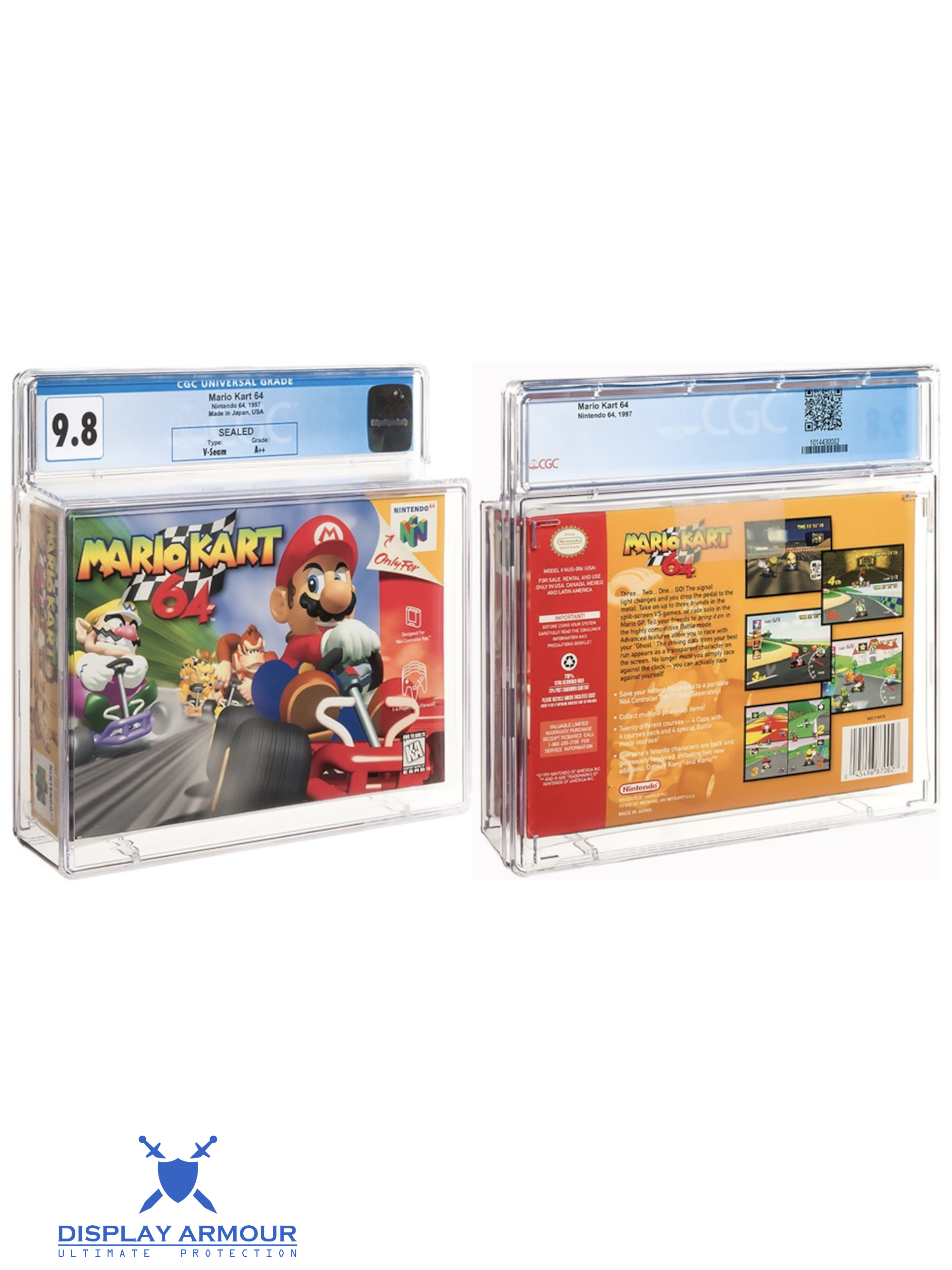
Mario Kart 64 turned Nintendo’s racing series into a defining four-player N64 experience. The record copy was not rare because the game lacked an audience—it was rare in the specific combination of original-print status, factory seal and an almost perfect 9.8/A++ assessment.
Heritage reported that PSA’s May 2026 population information showed only two 9.8 original-print examples. Population data can change as more games are graded, but the snapshot helps explain the competition for this copy.
Sega collection protection
Display your 8-bit and 16-bit Sega boxes
Choose the case designed for your original boxed format.
#17 — Nintendo World Championships 1990 — $180,000 (approx. £133,000)
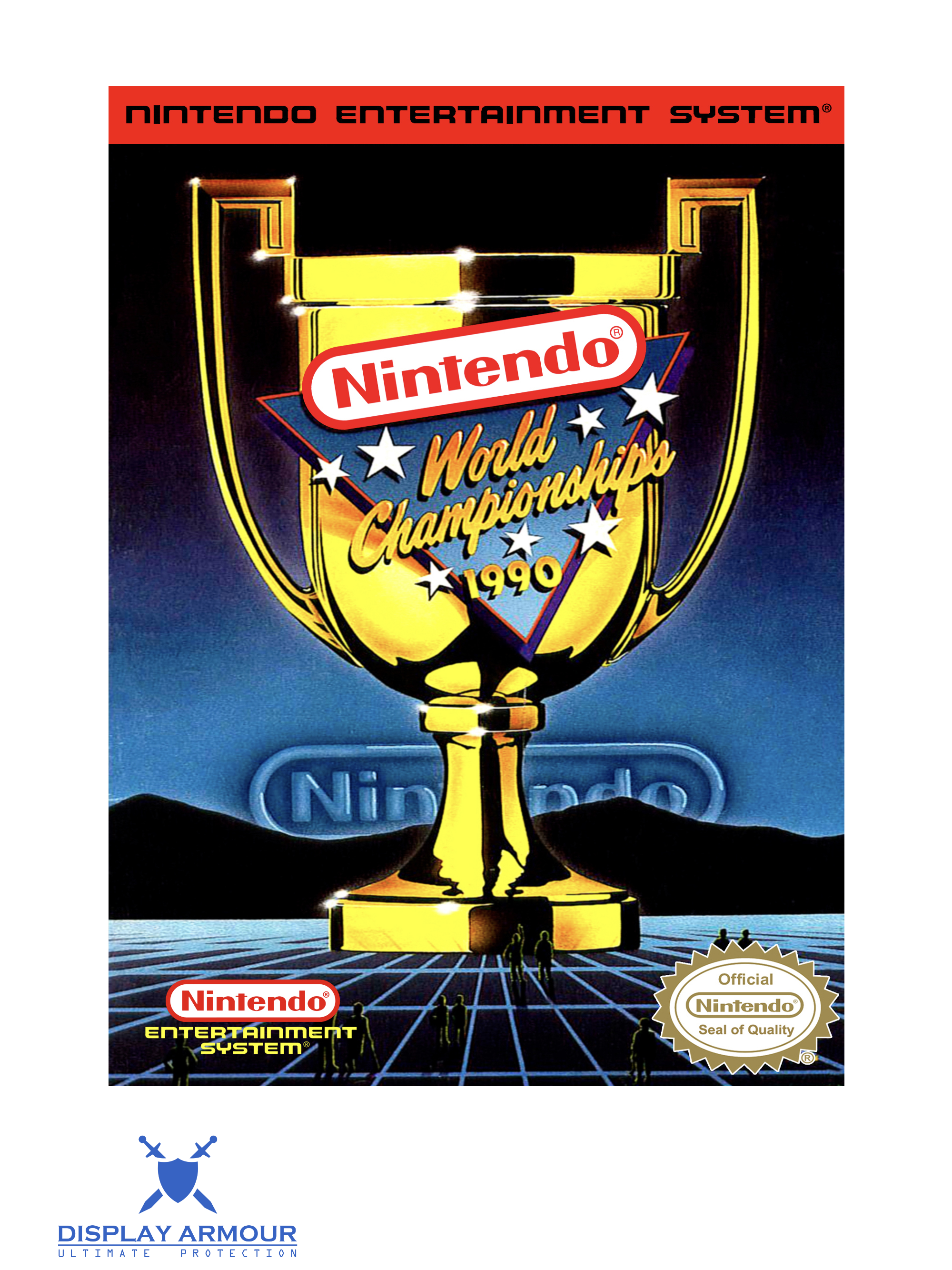
No box is required here because this was never a normal retail release. Nintendo created the cartridge for its 1990 touring competition, combining timed challenges from three games. The grey carts were used within that event ecosystem rather than placed on shop shelves.
Heritage estimated roughly 100 grey examples survive and noted the fragility of their labels. Most games on this list became valuable because nobody opened them; this one is valuable because almost nobody could own one in the first place.
#18 — ClayFighter: Sculptor’s Cut — $175,000 (approx. £130,000)
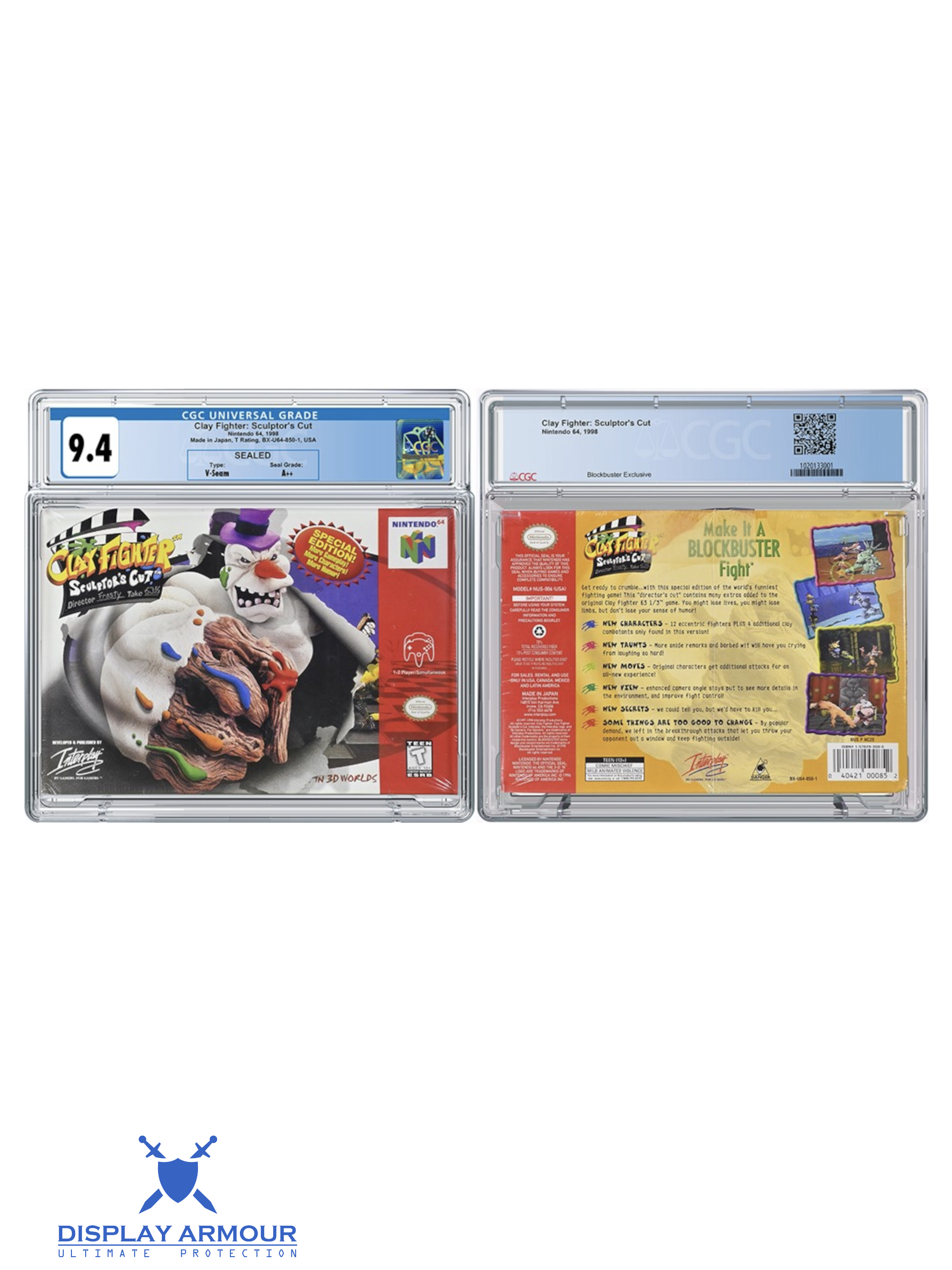
This is the Blockbuster unicorn. Sculptor’s Cut was a rental exclusive and was not sold directly to consumers. Copies were expected to be opened, stickered, circulated and handled by customer after customer—the precise opposite of the life required to remain factory sealed.
Heritage described the auctioned copy as one of three known unopened examples. That unusually specific survival story, rather than mainstream fame alone, explains why a niche fighting game can sit beside Nintendo’s defining releases.
#19 — Metroid — $168,000 (approx. £124,000)
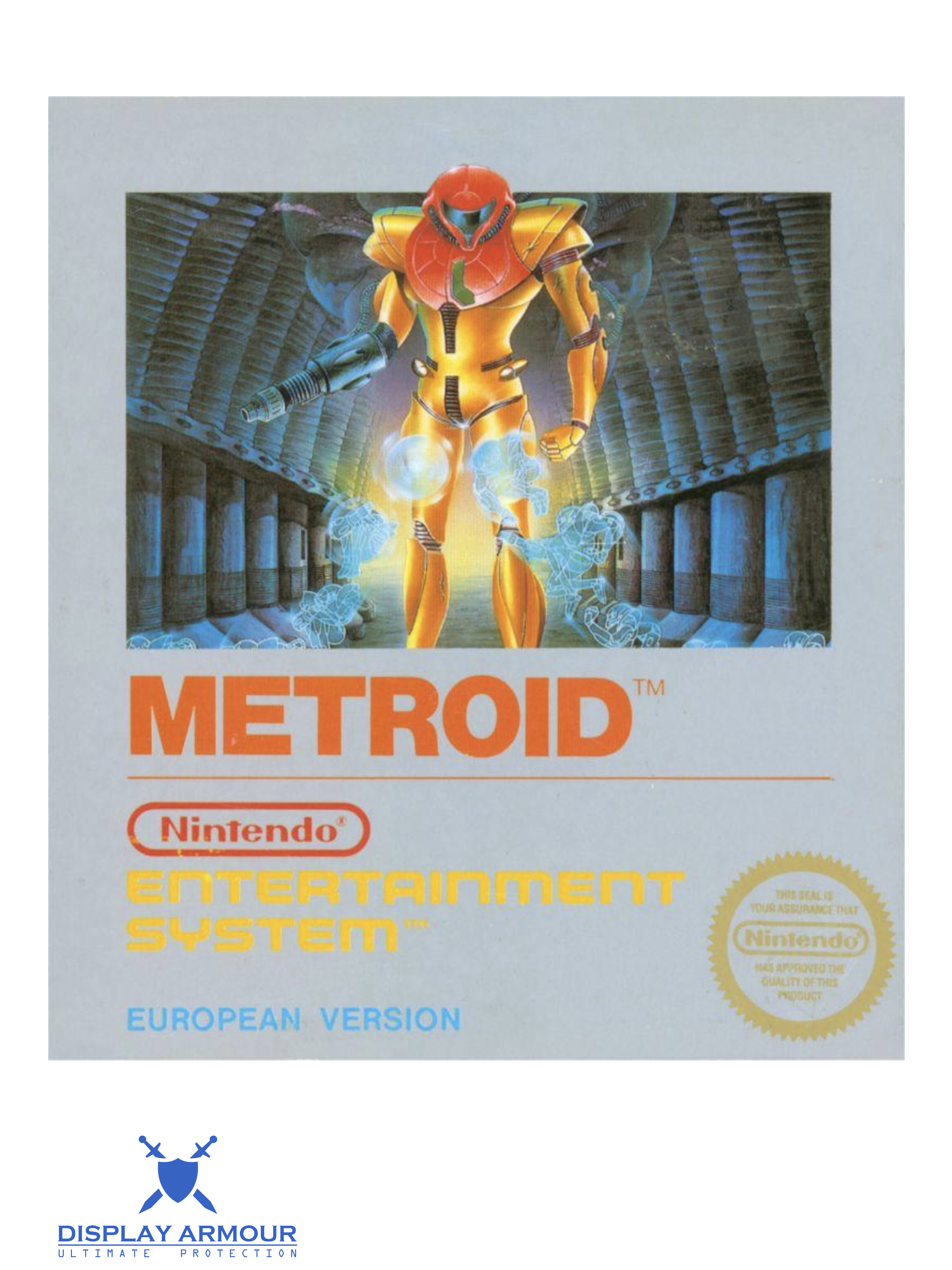
This copy combines a cornerstone Nintendo series with the packaging signals early NES specialists pursue: a hangtab box, no Rev-A mark and first-production status. Those details place it much nearer the beginning of the game’s US retail history than a later printing.
Most surviving copies were opened and played. An unopened example with a 9.4 box grade and A+ seal therefore occupies a much narrower condition tier than the title’s broad cultural familiarity might suggest.
#20 — Super Mario Bros. 3 — $156,000 (approx. £115,000)
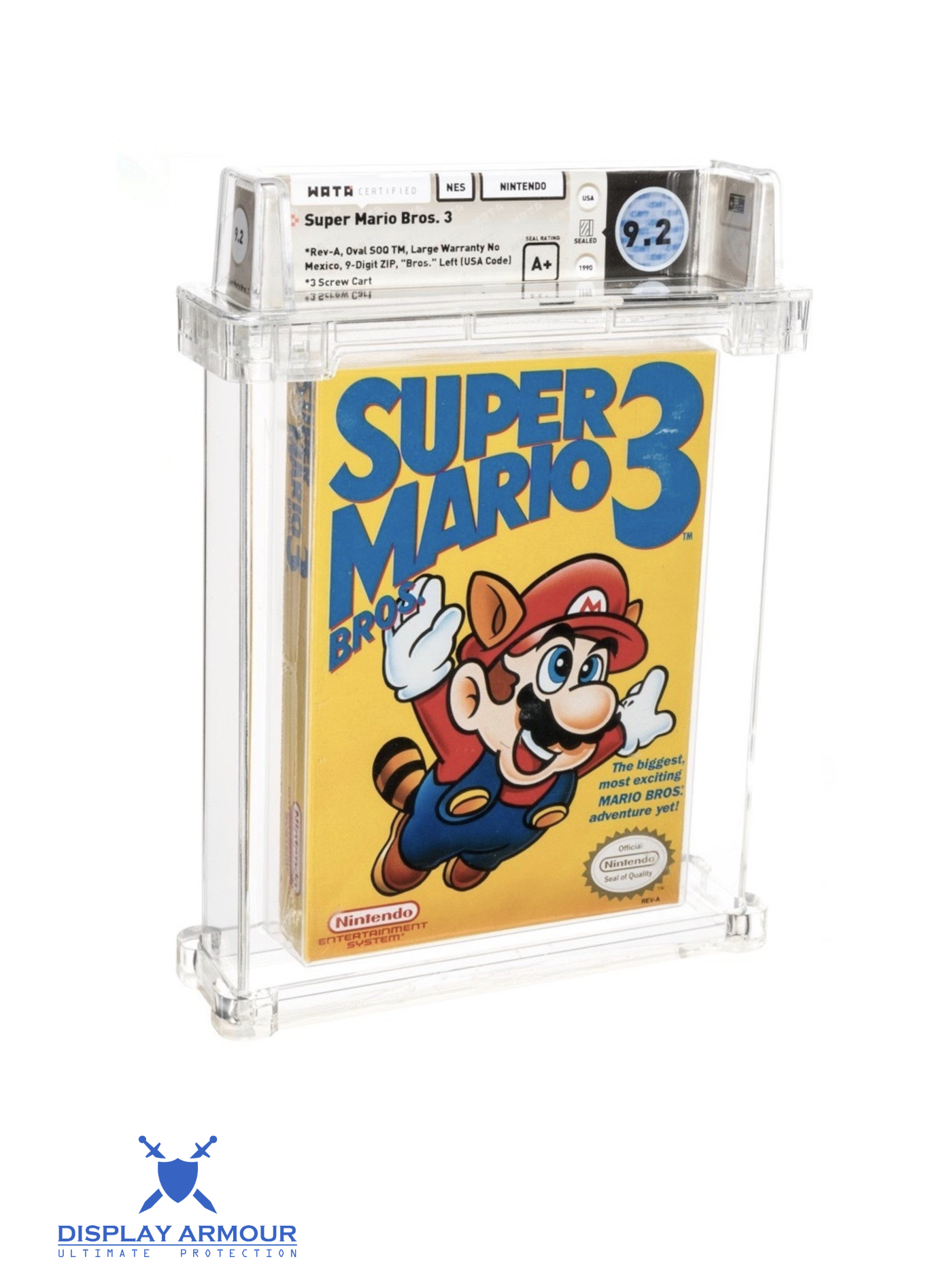
The tiny placement of one word made this copy exceptional. On the earliest box, “Bros.” sits to the left above Mario’s glove; later “Right Bros.” packaging is far more familiar. Heritage described sealed examples of the first-production layout as exceedingly rare. The $156,000 (approx. £115,000) result demonstrated how packaging chronology can matter as much as the game inside.
The title itself was a late-generation NES landmark, but collectors were bidding on more than popularity: elite condition, an intact factory seal and a visually identifiable first-production box all converged in one copy.
What actually makes an old video game valuable?
Age alone is not enough. Many old games remain affordable because large numbers survive. Record-level copies normally combine several attributes:
- Unopened condition: an intact original seal sharply narrows the pool.
- Production chronology: first prints, hangtabs, code variants and early seal styles can identify an earlier release.
- Packaging difficulty: cardboard Game Boy boxes and PlayStation longboxes are easily crushed, creased or scuffed.
- Condition grade: small differences at the top of the scale can separate already scarce survivors.
- Historical importance: a debut, technological turning point or competition-only object can deepen demand.
- Provenance and scarcity: a credible ownership history or documented tiny survivor pool can matter greatly.
- Collector demand: rarity without interested buyers does not guarantee a high price.
Most expensive video games: frequently asked questions
What is the most expensive video game ever sold?
A PSA 9.6 A++ sealed, gloss-sticker second-production copy of Super Mario Bros. sold through Heritage Auctions for $3,000,000 (approx. £2.22 million) on 12 June 2026—the highest verified result in this guide.
Why are sealed video games so expensive?
Only particular examples are. The highest prices usually require a desirable title, scarce production variant, intact original seal, elite condition and strong collector demand. Most sealed games are worth far less than the records shown here.
What does Wata 9.8 A++ mean?
The 9.8 is the numerical condition grade for the overall packaged game; A++ is the separate seal grade. Older auction records commonly use Wata labels. PSA announced the Wata-to-PSA branding transition in 2025, so newer games may appear in PSA holders.
Are old Nintendo games worth money?
Some are, but age and the Nintendo name do not guarantee value. Check the exact title, region, production markings, completeness, seal status, condition, provenance and recent comparable sales.
Why are early Super Mario Bros. variants valuable?
Small packaging features identify different production runs. Gloss-sticker seals, hangtabs and code variations can point to very early copies, and few survived unopened. Collectors therefore distinguish variants that look almost identical to casual observers.
What is the rarest Nintendo game?
There is no single answer because “rarest” can mean produced, surviving, sealed or publicly available. Nintendo World Championships competition carts are famously scarce; particular sealed early-production retail variants can be scarcer still.
Does grading increase a game’s value?
Grading can authenticate, describe condition and make comparisons easier, but it does not guarantee a higher price. The title, variant, seal, market demand and confidence in the grading record all remain important.
Are opened games still collectible?
Yes. Complete-in-box, cartridge-only, competition and provenance-rich games can all be desirable. Nintendo World Championships 1990 reached $180,000 (approx. £133,000) as a graded cartridge, not a sealed retail box.
A market measured in details
The biggest video-game prices do not belong to “old games” as one category. They belong to precisely identified objects: a gloss-sticker Mario, a No Rev-A Zelda, a ridged-longbox Resident Evil, a Blockbuster-only ClayFighter, or a competition cartridge that was never a retail game at all. Learning those distinctions is more useful than memorising a headline number—and it is the best defence against assuming every familiar childhood copy is equivalent to a record-setting one.
Built for collectors
Protect the boxes that survived
Explore premium acrylic protection for Nintendo and Sega collections.
Sources and research notes
Primary auction records were checked title by title. The most useful records are linked below; archive prices and descriptions can change presentation as auction platforms update their sites.
- Heritage: Super Mario Bros., PSA 9.6 A++, $3,000,000 (approx. £2.22 million)
- Heritage: Super Mario 64, $1,560,000 (approx. £1.15 million)
- Heritage: The Legend of Zelda, $870,000 (approx. £644,000)
- Heritage: John Madden Football, $480,000 (approx. £355,000)
- Heritage: Mario Bros., PSA 9.2 A++, $450,000 (approx. £333,000)
- Contemporary report: Goldin’s Sonic the Hedgehog sale
- Heritage: Super Mario World, $360,000 (approx. £266,000)
- Heritage: Super Mario Bros. 2, Mike Tyson’s Punch-Out!!, Resident Evil, Pokémon Red and GoldenEye 007
- Heritage: Mike Tyson’s Punch-Out!!, $312,000 (approx. £231,000)
- Heritage: Resident Evil, $264,000 (approx. £195,000)
- Heritage: Super Smash Bros., $240,000 (approx. £178,000)
- Heritage: Ocarina of Time and Final Fantasy
- Heritage: Super Mario Land, $200,000 (approx. £148,000)
- Heritage: Mario Kart 64, $187,500 (approx. £139,000)
- Heritage: Nintendo World Championships 1990, $180,000 (approx. £133,000)
- Heritage: ClayFighter: Sculptor’s Cut, $175,000 (approx. £130,000)
- Heritage: Metroid, $168,000 (approx. £124,000)
- Heritage: Super Mario Bros. 3 “Left Bros.”, $156,000 (approx. £115,000)
- PSA: Wata is becoming PSA
- PSA: current video-game grading services
CONTINUE THE RESEARCH


COLLECTOR DISCUSSION
Leave a comment
Share your experience or add to the collector discussion.