
Pokemon
100 Most Valuable Pokémon Cards Ever (2026 Guide)
Explore the 100 most valuable Pokémon cards, ranked using documented completed sales. From Pikachu Illustrator and rare Trophy cards to Base Set Charizard, Gold Stars, Crystal Pokémon and modern grails, updated for 2026 with high-end values, rarity insights and collector history.

82 minute readEstimated reading time
02 Apr 2026First published
08 Oct 2026Last updated
PokemonEditorial topic
Display Armour / Collector Guide / Updated 2026
100 Most Valuable Pokémon Cards: The Rarest & Most Expensive Cards in 2026
Pokémon has grown from a 1990s card-game phenomenon into one of the world’s largest collecting markets. The highest end now includes tournament trophies, contest prizes, prototypes, test prints, vintage holos, Gold Stars, Crystals and modern chase cards. This collector-first guide ranks 100 distinct cards and variants in strict descending order using documented completed sales and clearly identified auction or grading-company records.
October 2026 update — reviewed 5 October: Expanded from 70 to 100 following a fresh review of public auctions. September’s Art Academy results include Fujishima’s Raincoat Pikachu at $8,400,000 and Daisuke Ochiai’s Mudkip at $3,720,000, both PSA 10, through Fanatics Collect. Exact sale links and premium information appear with each entry.
Prices depend on grade, condition, language, provenance, population, rarity and buyer demand. These are exceptional-copy benchmarks, not ordinary raw-card prices.
What is the most valuable Pokémon card?
Pikachu Illustrator leads the ranking. Goldin reported $16,492,000 for Logan Paul’s PSA 10 example in February 2026. This is an auction-lot total: it included a custom diamond necklace and personal delivery as well as the card. Illustrator is a Japanese illustration-contest prize, not a retail booster pull. Goldin’s completed lot documents the exact terms.
Ranking methodology
We rank notable documented completed sales for exact variants and grades, preferring auction evidence to general market estimates. A grading-company auction record or the auction platform’s own sale announcement is identified where it supplies the evidence. This is a researched high-end ranking, not a claim that every figure is the highest sale ever made privately. Unsold asking prices, modelled valuations and unverified private-sale reports are excluded.
Values apply to the specific grade, copy and provenance shown. Different languages, editions, foil treatments and trophy tournaments are separate collectibles; separate grades of the same issue are not separate entries. Lot extras are disclosed. Buyer’s premiums are included where the source explicitly says so; otherwise we use its displayed realised total without adding an assumed fee. Taxes and shipping are not added.
USD is the transaction basis. All approximate GBP figures use the ECB reference rates dated 2 October 2026: €1 = $1.1225 and £0.85033, giving $1 ≈ £0.757532. GBP amounts are rounded to the nearest £100, or £1,000 above £1 million.
What makes a Pokémon card rare and valuable?
A Pokémon card can become rare and valuable because of a combination of scarcity, demand, condition, grading and collector significance. Some of the rarest Pokémon cards were distributed as tournament prizes, competition awards or limited Japanese promos, while others are valuable because very few high-grade examples survive. Cards such as Pikachu Illustrator, rare Trophy cards, Gold Stars and iconic vintage releases can command exceptional prices when rarity, condition and collector demand all align.
Sealed collector guide
Collecting Sealed Pokémon Instead?
Looking beyond individual cards? Explore 10 modern Pokémon sets with strong long-term collector potential, including Pokémon 151, Prismatic Evolutions, Crown Zenith and Destined Rivals.
100 Most Valuable Pokémon Cards at a Glance
The 100 Most Valuable Pokémon Cards Ranked
01. Pikachu Illustrator — 1998 CoroCoro Promo
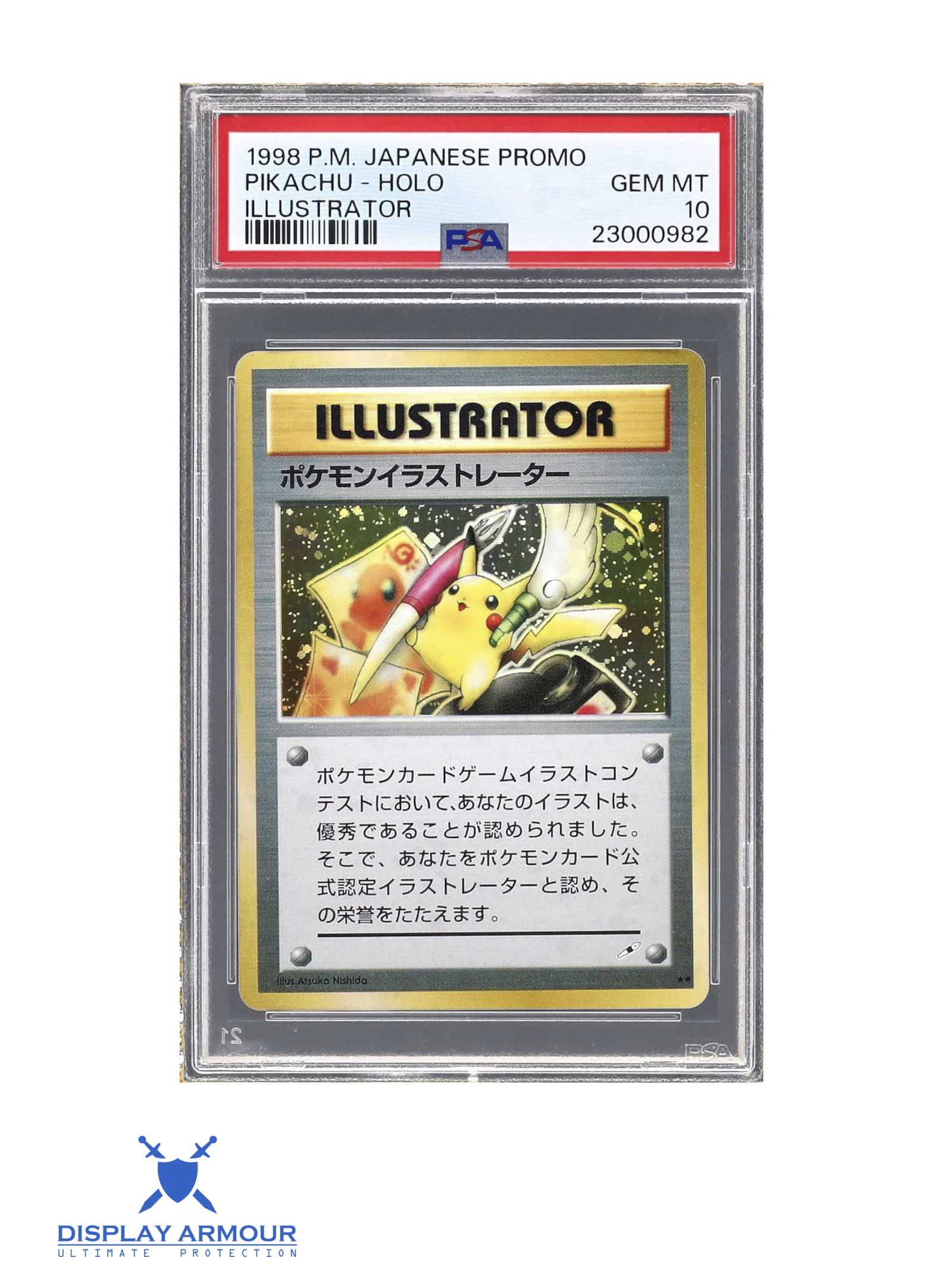
Pikachu Illustrator was awarded to winners of illustration competitions run through Japan’s CoroCoro Comic. It was never sold in booster packs. The card replaces the familiar “Trainer” heading with “Illustrator”, carries a crossed-pen symbol and features Atsuko Nishida’s cheerful Pikachu artwork. Those details, plus its direct connection to the creative roots of Pokémon, make it more than simply a scarce promo.
The PSA 10 example became internationally known through Logan Paul’s earlier private acquisition. It later sold through Goldin on 16 February 2026 for $16,492,000 (approx. £12,493,000), establishing the record auction-lot total associated with a Pokémon card; the lot also included a custom diamond necklace and personal delivery. That price belongs to one exceptional copy with exceptional grade and provenance; lower-graded Illustrators should not be valued by simply applying the same figure. For collectors, authentication, certification and a documented ownership trail are fundamental because the difference between a genuine contest prize and an imitation is enormous.
$16,492,000 (approx. £12,493,000) is the documented PSA 10 benchmark reported by Goldin on 16 February 2026. The lot included a custom diamond necklace and hand-delivery by Logan Paul; the total cannot be attributed to the bare card alone. Primary sale evidence — Goldin.
02. Fujishima “Raincoat Pikachu” — Art Academy — 2015 Japanese Art Academy contest
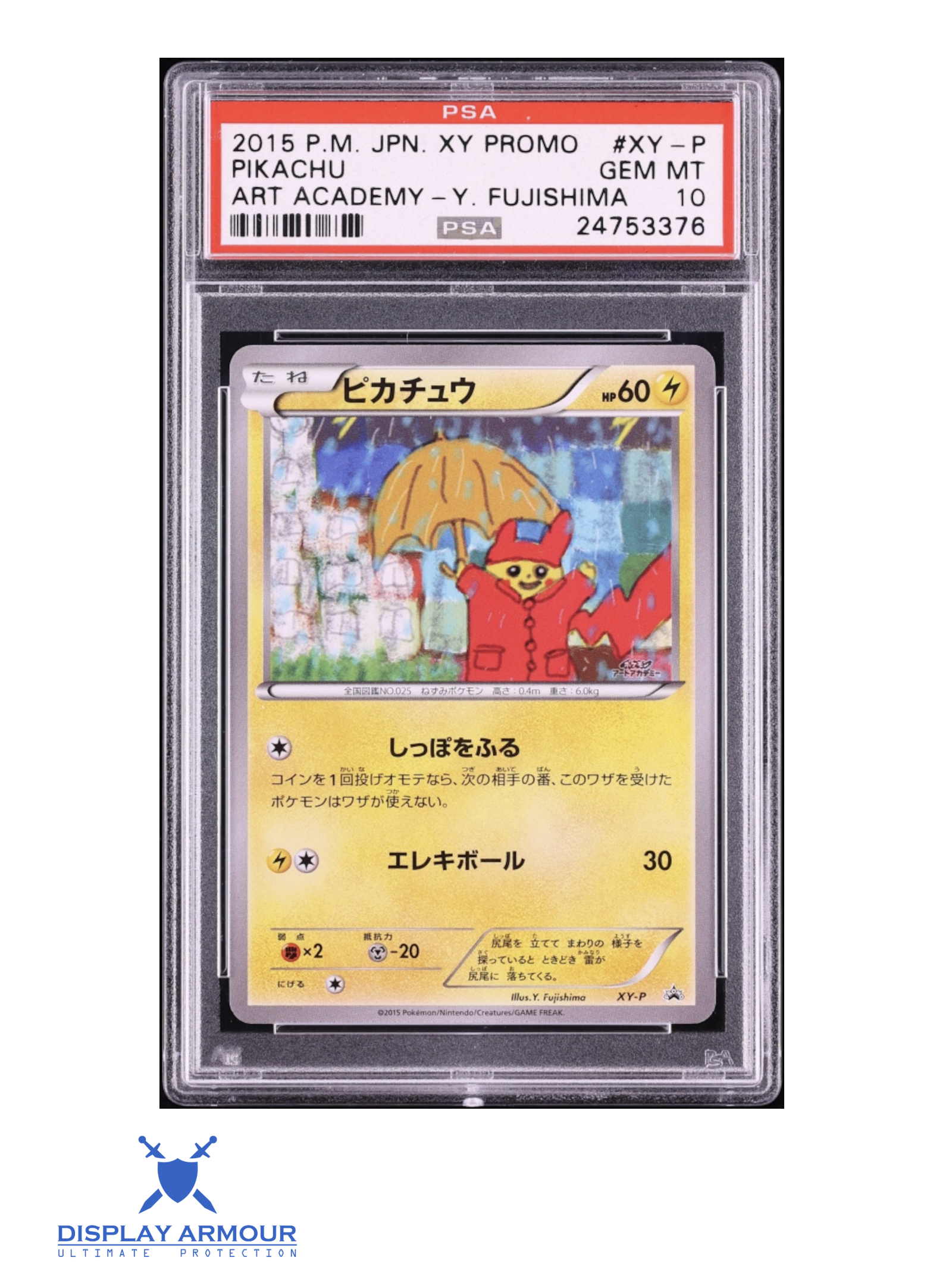
Fujishima’s raincoat-clad Pikachu turned a winning Art Academy submission into an official prize card. The appeal is the connection between a fan’s artwork and the finished collectible, rather than a difficult booster pull. The contest identity and artist credit distinguish it from the other Art Academy Pikachu designs.
$8,400,000 (approx. £6,363,000) is the documented PSA 10 benchmark reported by Fanatics Collect on 28 September 2026. The PSA 10 auction result is specific to this winning design and copy. Other Art Academy prizes do not inherit its price. Primary sale evidence — Fanatics Collect.
03. Daisuke Ochiai Mudkip — Art Academy — 2015 Japanese Art Academy contest
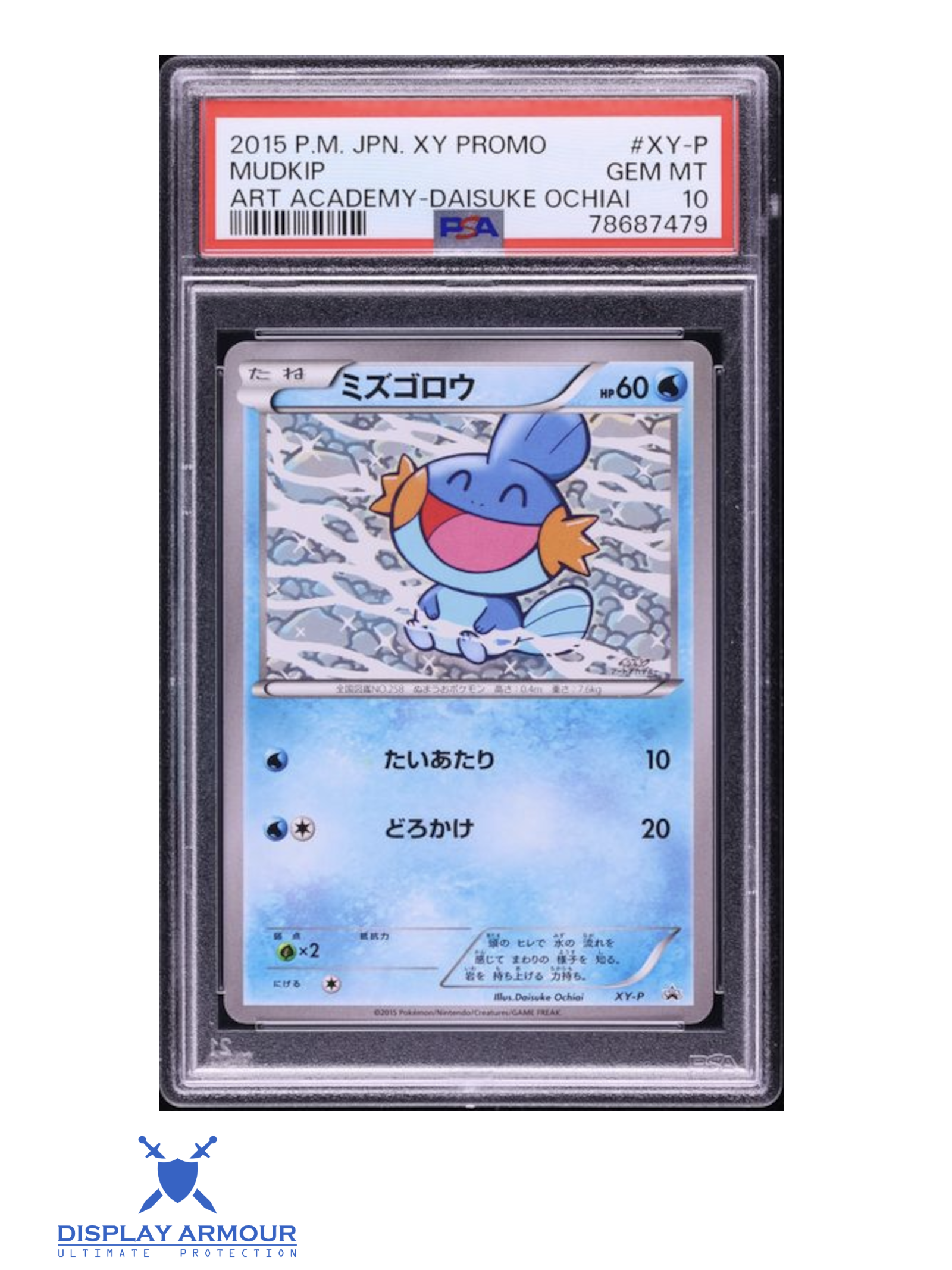
Daisuke Ochiai’s Mudkip comes from the Art Academy illustration competition, a route outside ordinary expansion collecting. The named winning artwork gives the card a personal creative history. It must be separated from Gold Star Mudkip: the shared Pokémon subject disguises completely different origins, numbering and artwork.
$3,720,000 (approx. £2,818,000) is the documented PSA 10 benchmark reported by Fanatics Collect on 25 September 2026. The PSA 10 contest prize, rather than a retail Mudkip or another winning Art Academy design, is the subject of this Premier auction. Primary sale evidence — Fanatics Collect.
04. Torchic Gold Star — 2004 EX Team Rocket Returns
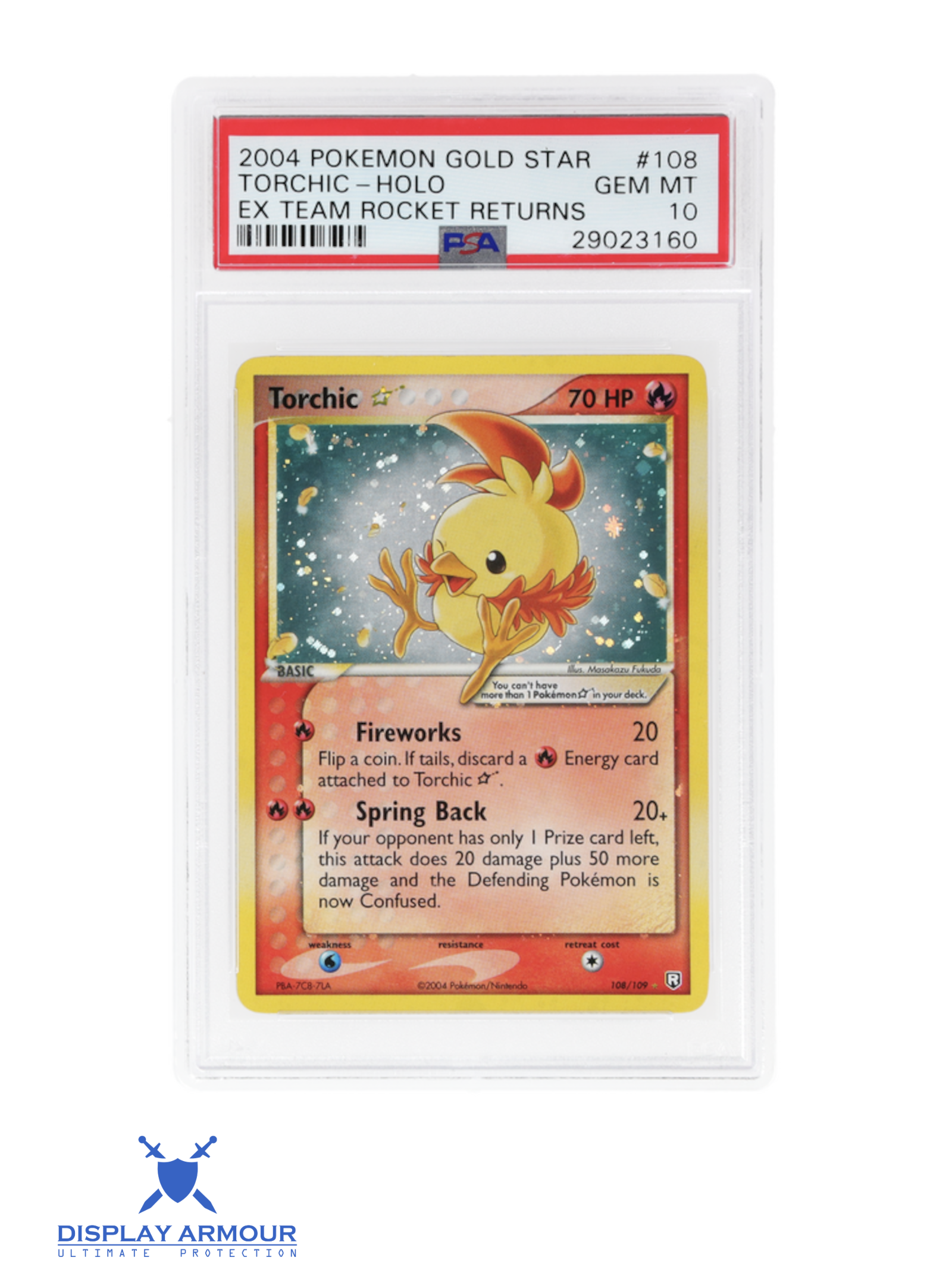
Torchic Gold Star 108/109 is one of three Gold Stars in EX Team Rocket Returns. The playful shiny artwork contrasts with the card’s severe condition challenge: foil wear, edges and centering all matter. Its $2,700,000 (approx. £2,045,000) benchmark is attached to a PSA 10, so cross-company grade comparisons should be made cautiously rather than treated as automatic equivalents.
$2,700,000 (approx. £2,045,000) is the documented PSA 10 benchmark reported by Alt on 10 September 2026. Primary sale evidence — Alt.
05. Bronze Trophy Pikachu No. 3 Trainer — Third Tournament — 1998 Third Tournament / Kamex Mega Battle
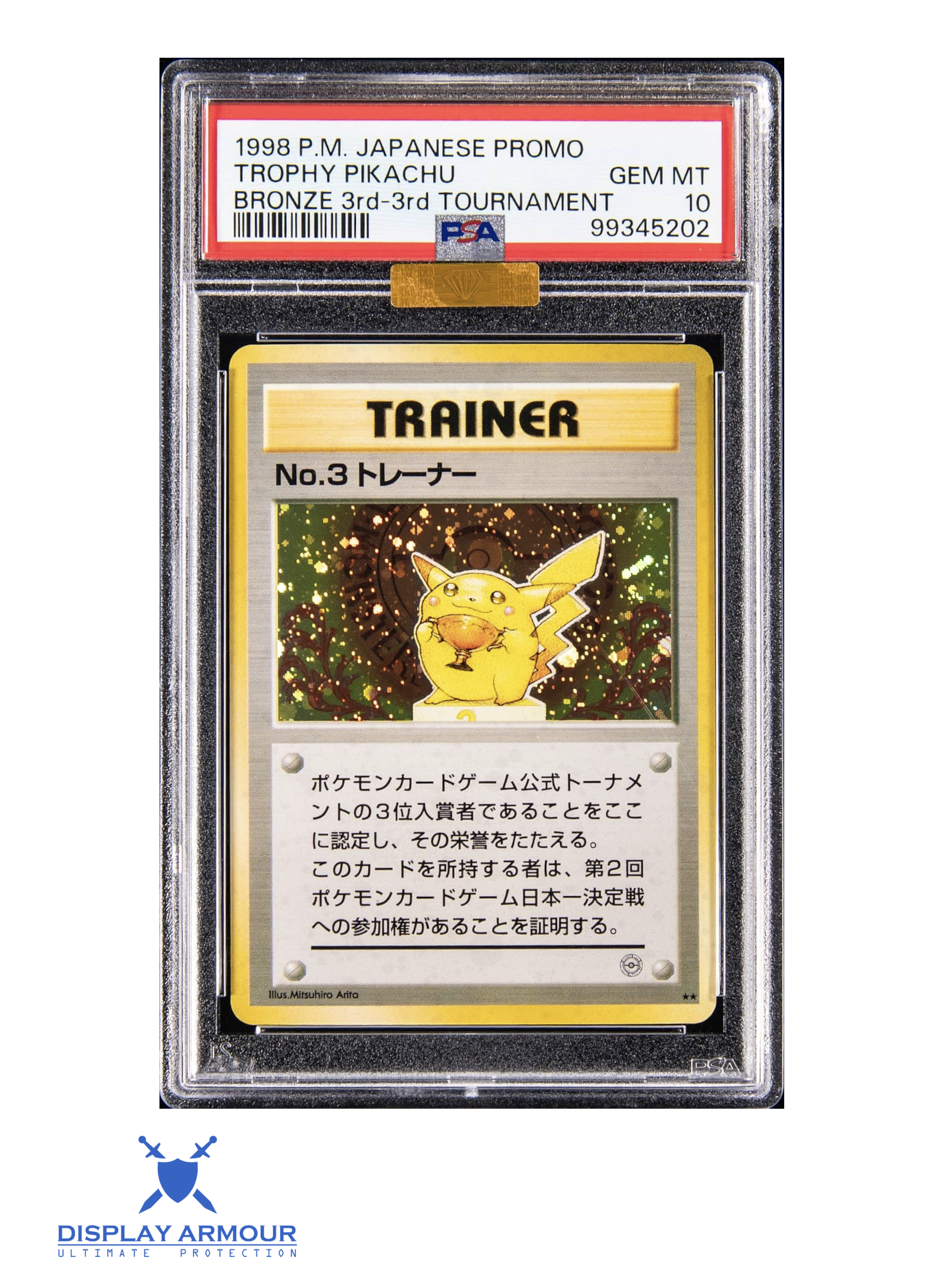
The bronze No. 3 Trainer was awarded to third-place finishers at the 1998 Kamex Mega Battle, an early Japanese competitive event named for Blastoise. Its Pikachu artwork shows the character holding a bronze trophy, making the card’s placing immediately recognisable. Unlike a rare retail card, every surviving copy began as an achievement prize handed directly to a successful player.
A PSA 10 example sold through Goldin in May 2026 for $1,769,000 (approx. £1,340,000). PSA’s published data at the time showed only a tiny graded population and a single PSA 10, explaining why the grade matters so strongly. Early trophy cards were handled, transported and often kept before modern preservation habits existed, so clean surfaces, sharp corners and stable provenance are unusually difficult to combine. Collectors should also distinguish this 1998 No. 3 Trainer from similarly named Pikachu trophies issued for other years, placements and events.
$1,769,000 (approx. £1,340,000) is the documented PSA 10 benchmark reported by Goldin on 18 May 2026. Primary sale evidence — Goldin.
06. Japanese Base Set Charizard — No Rarity — 1996 Base Set
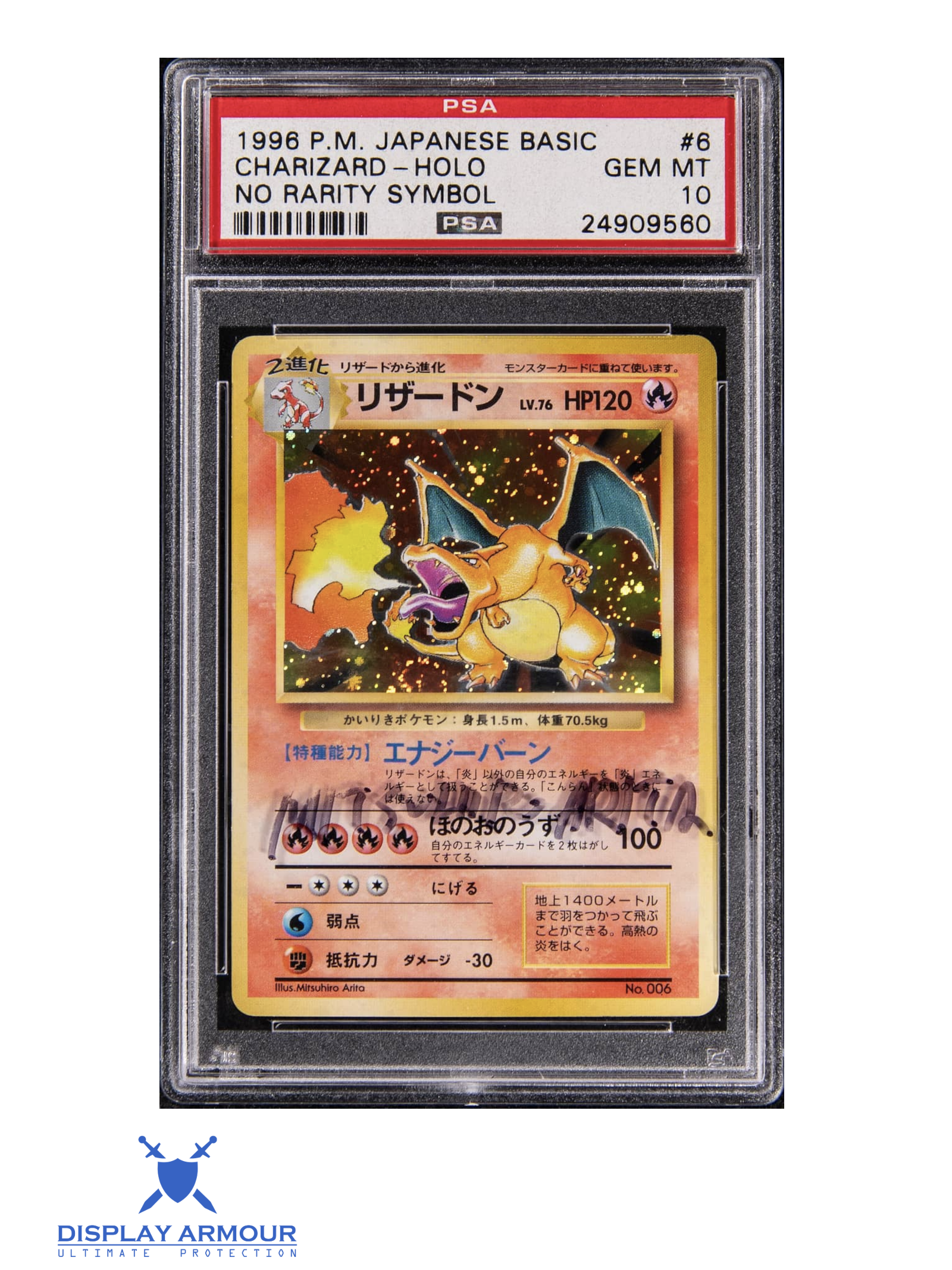
The earliest Japanese Base Set printing can be identified by the absence of the rarity symbol found on later cards. Charizard combines that first-print characteristic with Mitsuhiro Arita’s foundational artwork and the franchise’s most consistently demanded character. It is not the same release as the 1999 English First Edition Shadowless Charizard, even though both represent the earliest form of their respective Base Sets.
A PSA 10 no-rarity Charizard sold through Goldin in 2026 for $1,232,200 (approx. £933,400). Japanese card stock and printing differ from the English release, but clean copies still face surface, edge and centering scrutiny. The “no rarity” designation must be visible and appropriate to the card; an ordinary rarity-symbol copy is a different variant. At the top of the market, label accuracy and clear front-and-back images are essential before any comparison is made.
$1,232,200 (approx. £933,400) is the documented PSA 10; holder signed by Mitsuhiro Arita benchmark reported by Goldin on 8 March 2026. The slab holder was signed by Mitsuhiro Arita. This additional provenance belongs to the sold object, not every No Rarity Charizard. Primary sale evidence — Goldin.
07. Mudkip Gold Star — EX Team Rocket Returns — 2004 EX Team Rocket Returns — 107/109
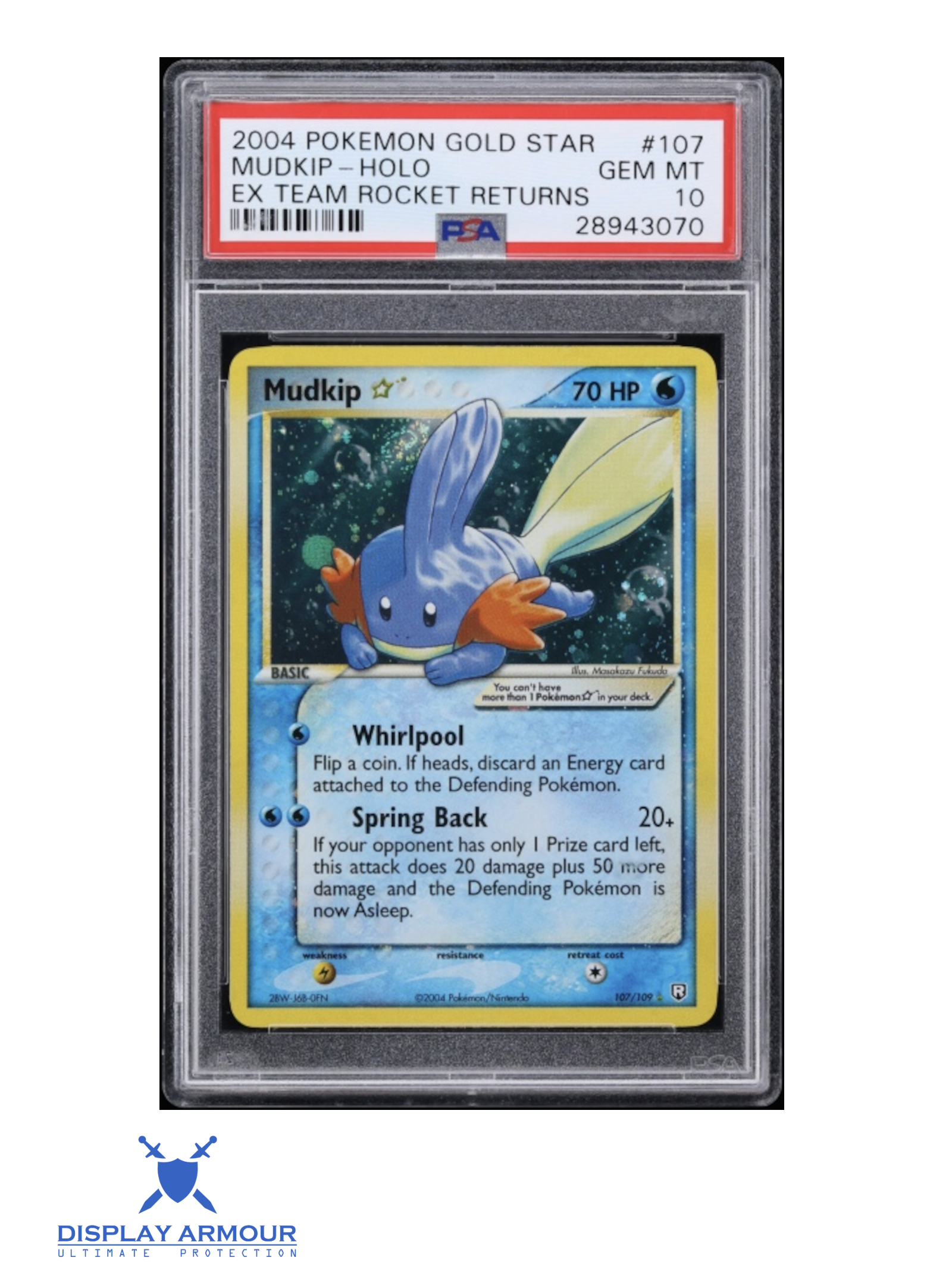
Mudkip joins Torchic and Treecko in Team Rocket Returns’ Gold Star trio. Its shiny colourway and artwork breaking beyond the frame connect it to one of the EX era’s defining collecting groups. The foil, corners and dark reverse require careful inspection when comparing raw copies with top-grade examples.
$1,020,000 (approx. £772,700) is the documented PSA 10 benchmark reported by Fanatics Collect on 21 September 2026. This million-dollar PSA 10 result is a sale for the English Gold Star, not Art Academy Mudkip or the Japanese Rocket Gang issue. Primary sale evidence — Fanatics Collect.
08. Rayquaza Gold Star — 2005 EX Deoxys
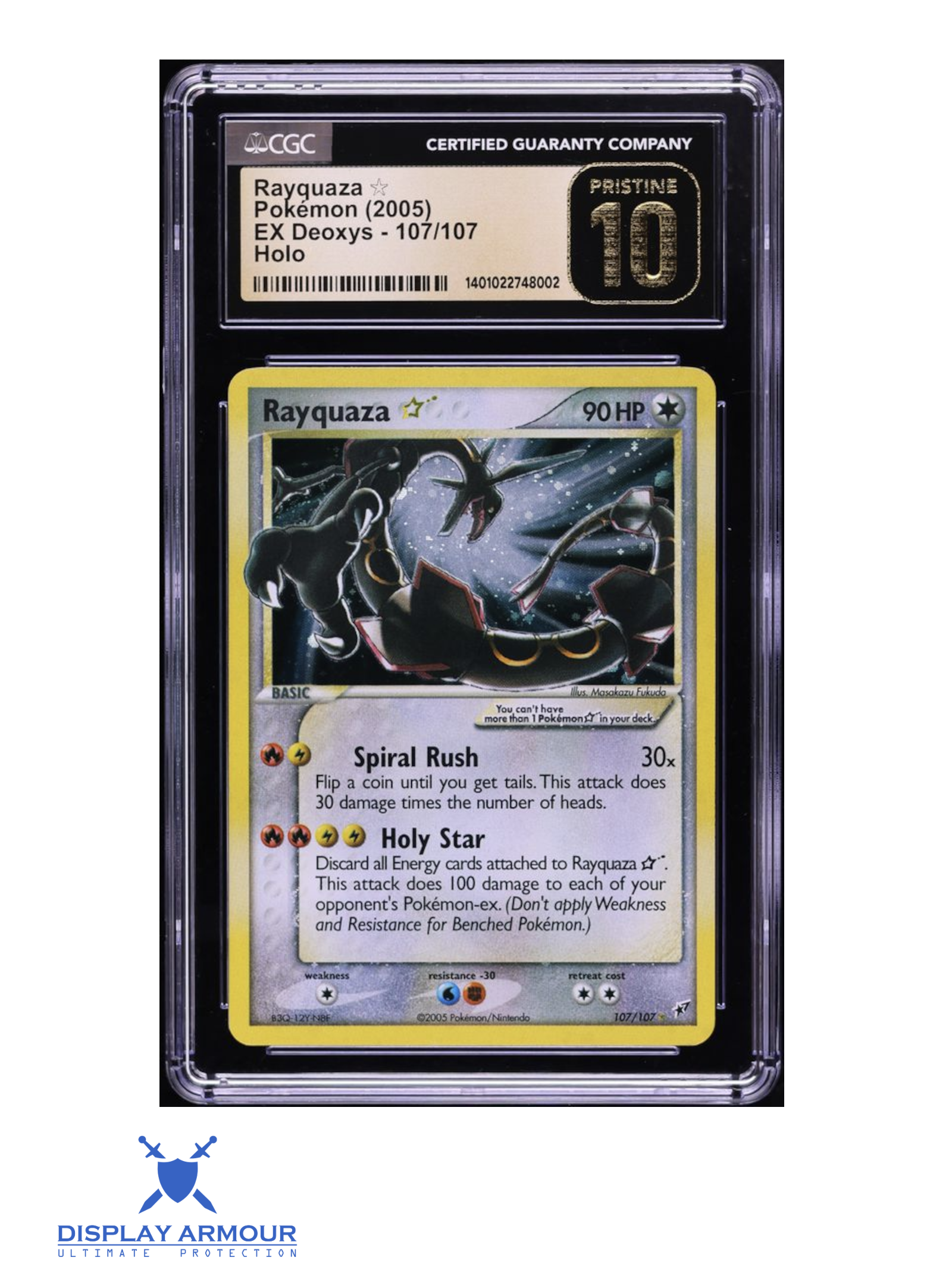
Rayquaza Gold Star 107/107 is the secret rare at the end of EX Deoxys. Its shiny black coloration, dynamic Masakazu Fukuda artwork and status as a legendary Pokémon make it a flagship Gold Star. The $1,020,000 (approx. £772,700) CGC 10 Pristine benchmark reflects both scarcity and condition sensitivity; the holo, borders and dark reverse readily expose wear.
$1,020,000 (approx. £772,700) is the documented CGC 10 Pristine benchmark reported by Fanatics Collect on 28 August 2026. Primary sale evidence — Fanatics Collect.
09. Gold Trophy Pikachu No. 1 Trainer — First Tournament — 1997 First Tournament trophy
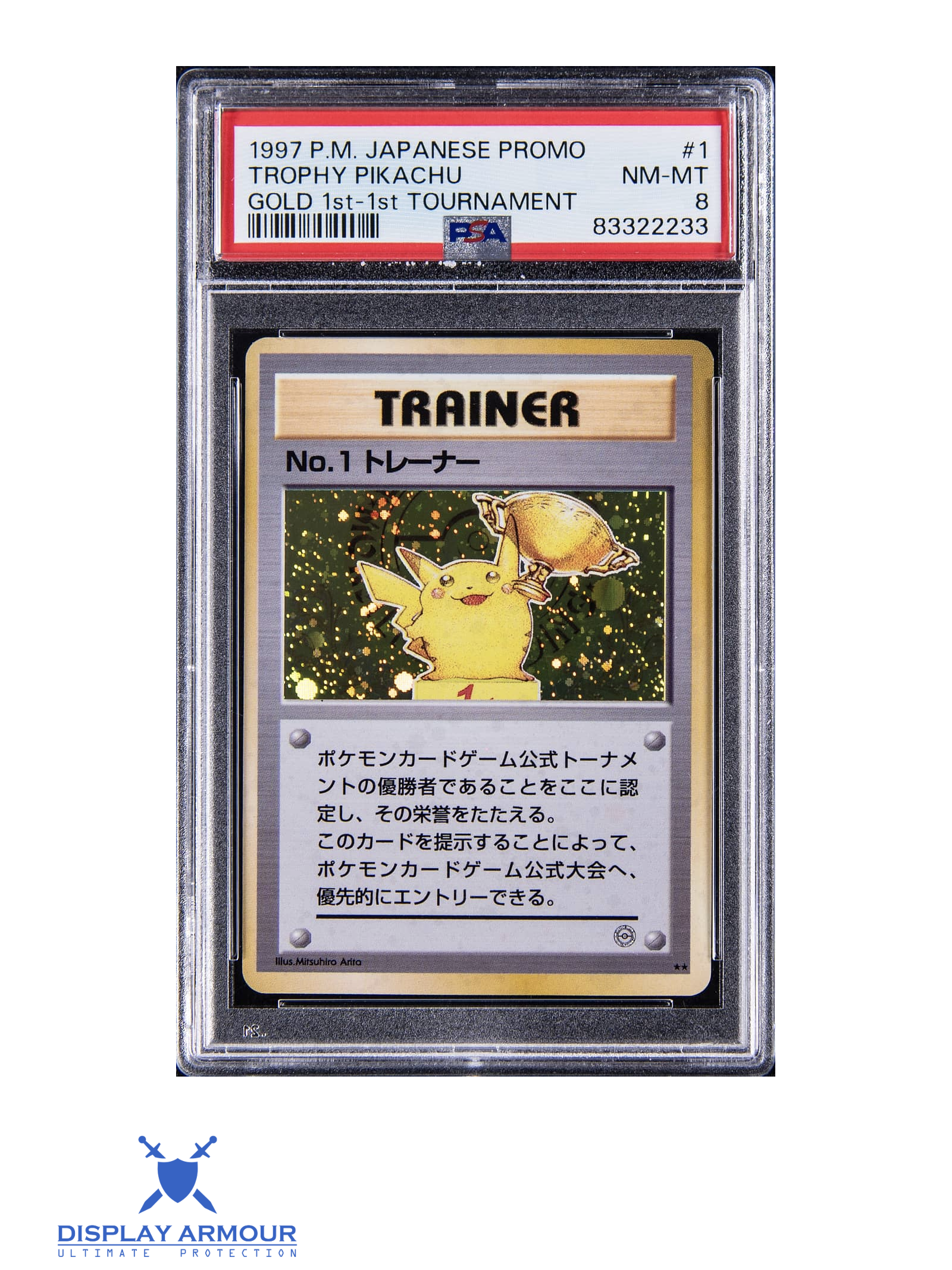
The gold No. 1 Trainer belongs to Pokémon’s earliest family of placement trophies. It was created for winning players rather than shops, which gives it a documented event function that ordinary set cards cannot replicate. Pikachu holding the gold trophy is both an instantly readable symbol of victory and an important piece of the TCG’s competitive history.
A PSA 8 copy sold through Goldin in March 2026 for $982,100 (approx. £744,000). That result is especially notable because it was not a Gem Mint 10; scarcity and historical importance outweighed the absence of a top numerical grade. Each trophy issue must be identified precisely by event, placement and printing, and values cannot be carried across from one version to another. On cards at this level, original distribution evidence, label accuracy and an unbroken provenance file can be as important as centering or surface condition.
$982,100 (approx. £744,000) is the documented PSA 8 benchmark reported by Goldin on 8 March 2026. Primary sale evidence — Goldin.
10. Charizard 1st Edition Shadowless — 1999 Base Set
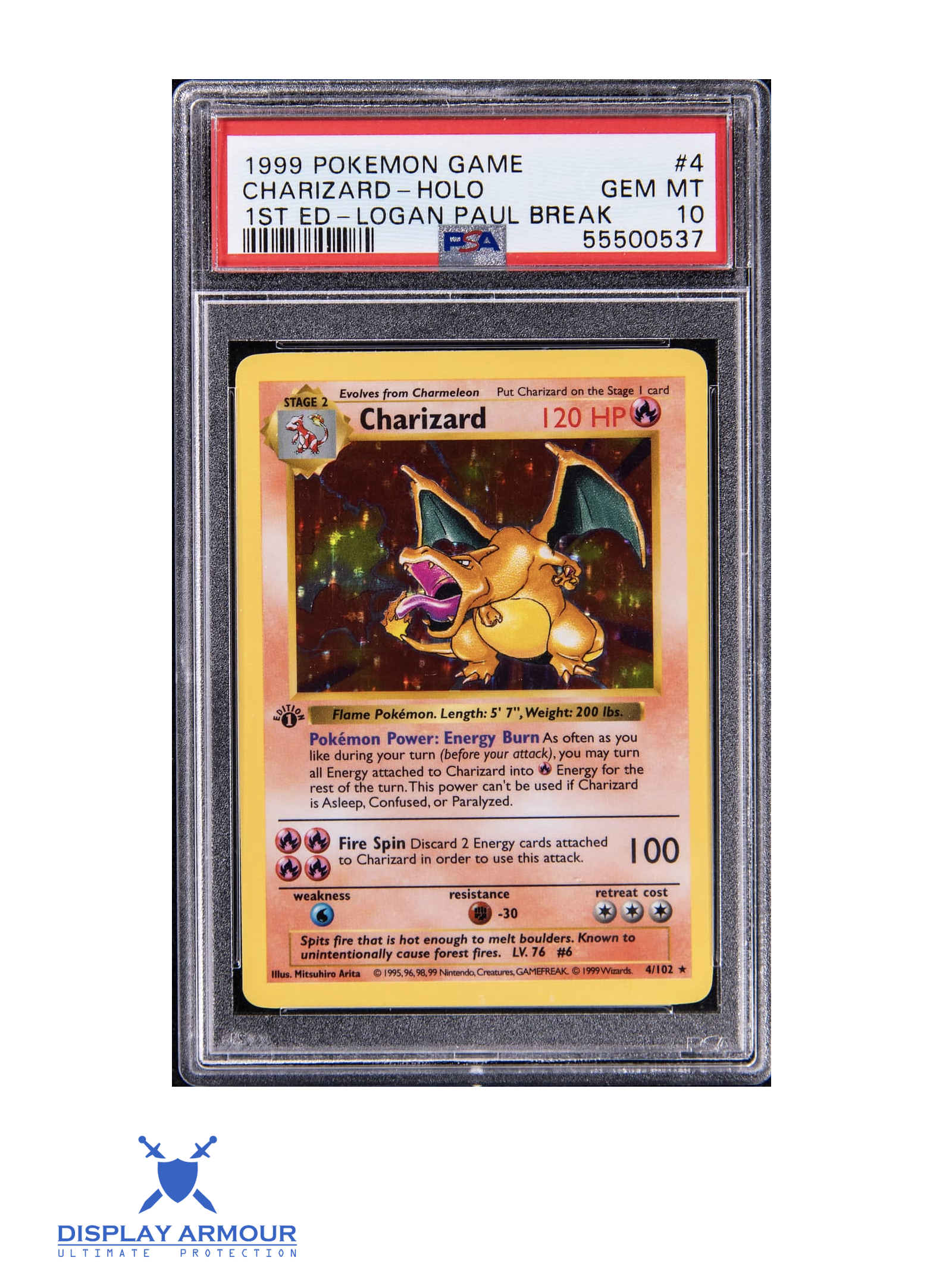
Charizard 4/102 is the defining English-language Pokémon card. First Edition copies carry the stamp to the left of the artwork, while “shadowless” describes the early Base Set layout without the later drop shadow around the picture frame. The holo surface, dark edges and mass childhood handling make genuinely clean examples difficult, and Charizard’s enduring popularity creates demand far beyond set completion.
The $954,800 (approx. £723,300) benchmark is tied to an exceptional PSA 10 sale with unusual provenance and should not be read as the ordinary market price of every PSA 10—still less an ungraded copy. Buyers should confirm the First Edition stamp, shadowless layout, card number, language and certification before comparing results. Whitening, silvering, print lines, surface scratches and centering can all separate a top-grade copy from an otherwise attractive card. This is the card most often used as shorthand for valuable Pokémon, but its exact variant is everything.
$954,800 (approx. £723,300) is the documented PSA 10 benchmark reported by Goldin on 16 February 2026. The PSA 10 copy has Logan Paul box-break provenance; this is not a typical price for every PSA 10. Primary sale evidence — Goldin.
11. Garchomp LV.X — Majestic Dawn — 2008 Majestic Dawn — 97/100
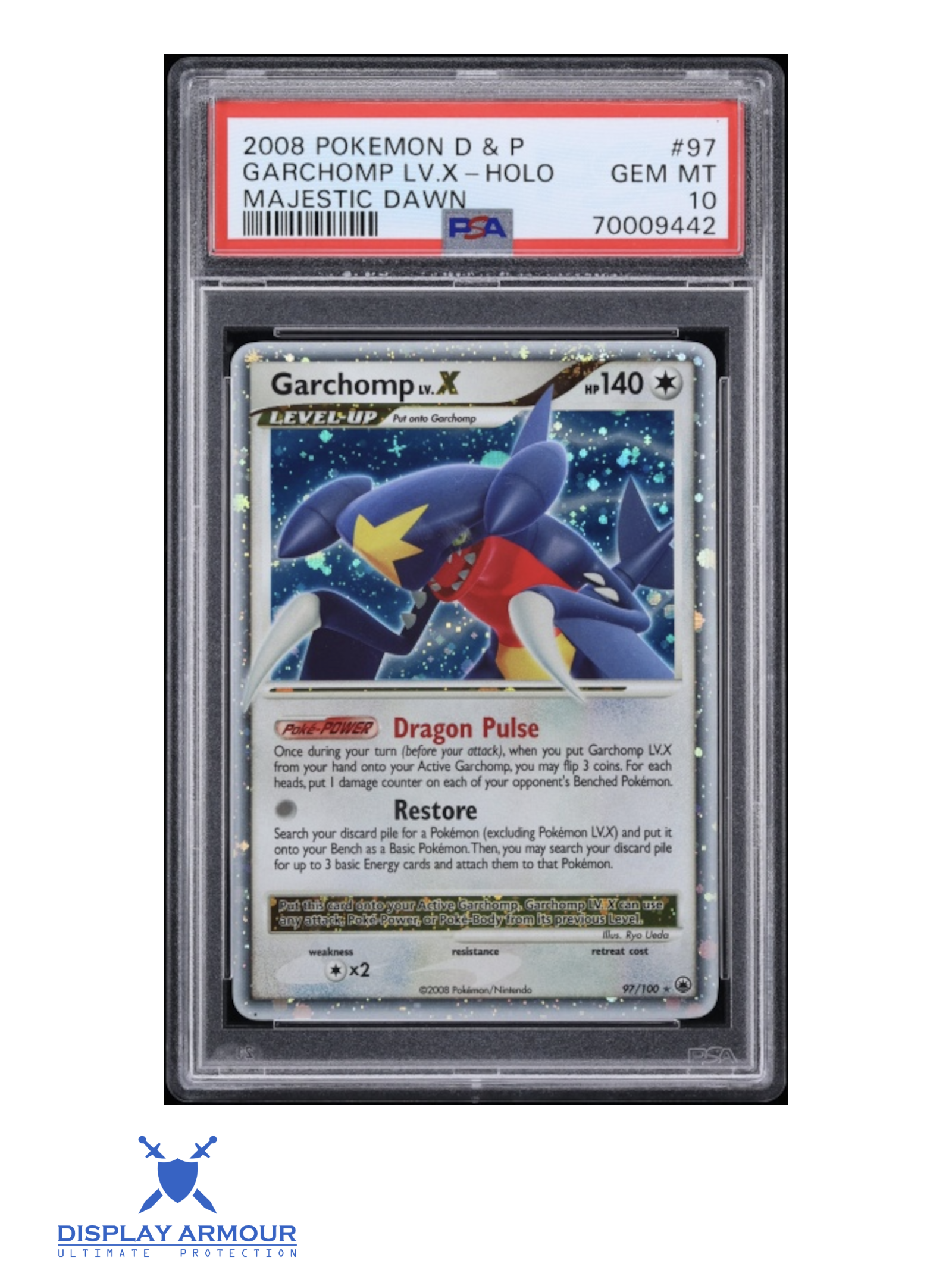
Garchomp LV.X belongs to the Diamond & Pearl era’s level-up chase cards. The foil-heavy design and pale edges are important condition surfaces, but the expansion card must first be separated from the later Garchomp C LV.X promo. Similar names conceal different mechanics, artwork and distribution.
$900,000 (approx. £681,800) is the documented PSA 10 benchmark reported by Fanatics Collect on 21 September 2026. The exceptional PSA 10 Majestic Dawn result is not a price for the more familiar Garchomp C tin promo. Primary sale evidence — Fanatics Collect.
12. Pokémon Snap Bulbasaur — 1999 Snap Contest Promo
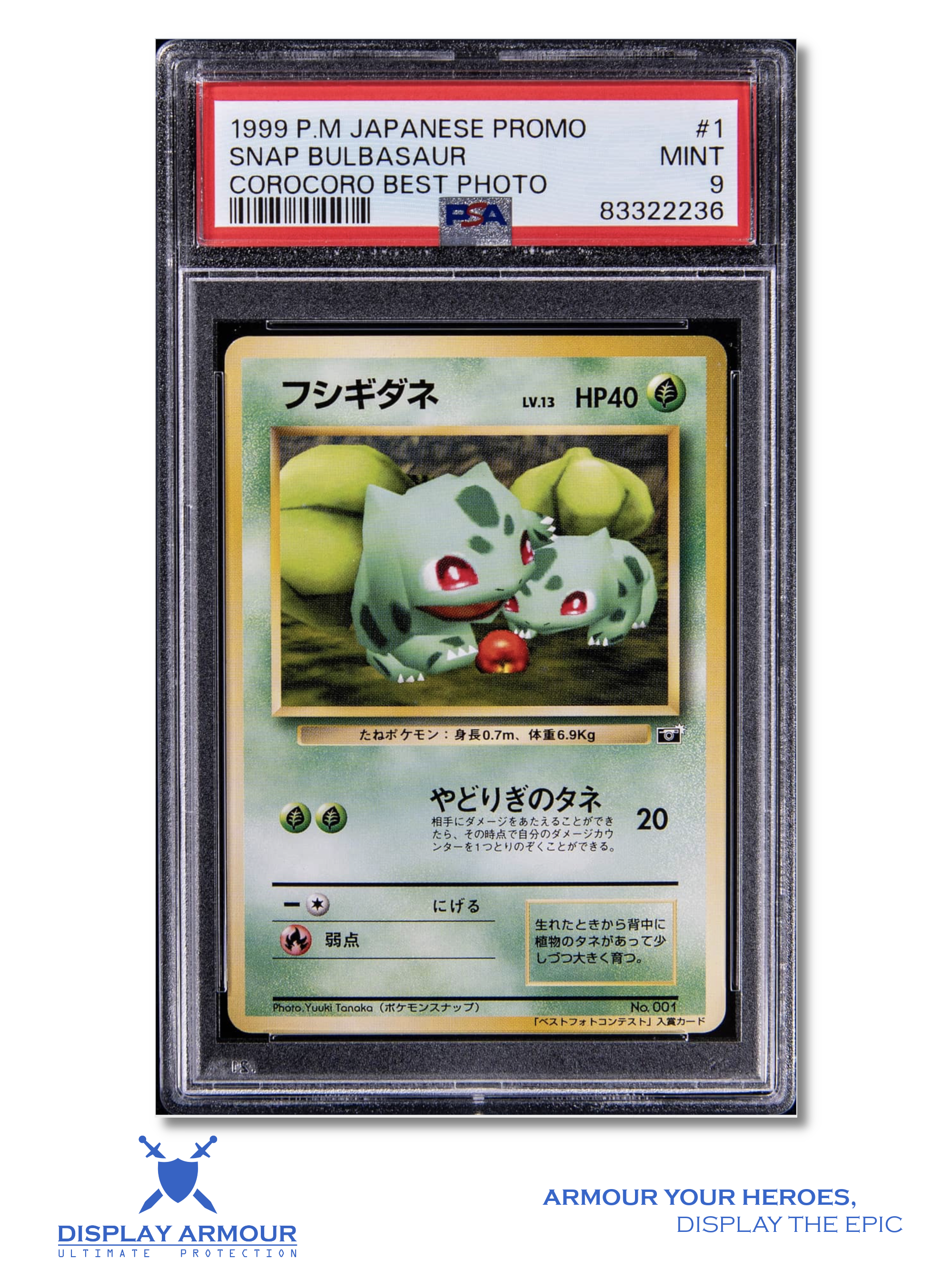
Snap Bulbasaur uses a winning in-game photograph from the Nintendo 64 title Pokémon Snap. The contest transformed player-created photographs into genuine Pokémon cards, giving each winner a uniquely personal connection to the finished promo. These cards were awarded rather than distributed through retail, and individual subjects surface publicly only rarely.
The $809,943 (approx. £613,600) PSA 8 result demonstrates how trophy-like distribution can outweigh a grade below Gem Mint. The artwork should not be confused with conventional illustrated Bulbasaur cards: the photographic scene and contest attribution are central to identification. Because so few comparable sales exist, a single auction can reset the visible benchmark dramatically. Authentication and provenance therefore matter more than broad price-guide averages, and collectors should resist applying the record to unverified copies or different Snap promotions.
$809,943 (approx. £613,600) is the documented PSA 8 benchmark reported by Goldin on 10 August 2026. Primary sale evidence — Goldin.
13. Pikachu Reverse Holo — Legendary Collection — 2002 Legendary Collection — 86/110
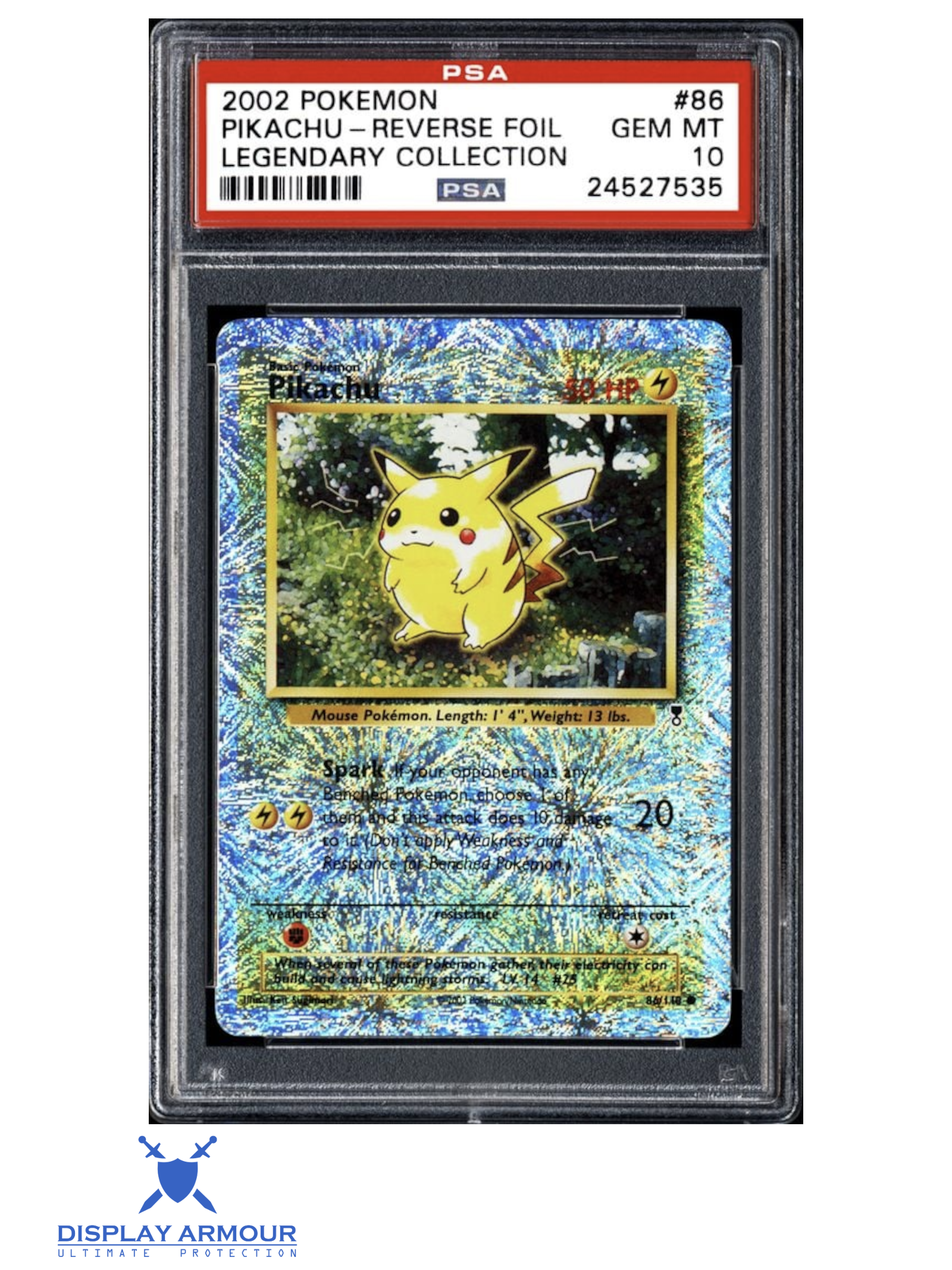
Legendary Collection’s reverse-holo pattern transforms a familiar Pikachu into a surface-intensive collector card. The foil spreads beyond the small artwork window, exposing scratches and print flaws across much of the face. Mascot demand meets the condition challenge of preserving that unusually extensive finish.
$780,000 (approx. £590,900) is the documented PSA 10 benchmark reported by Fanatics Collect on 28 September 2026. The PSA 10 reverse holo is the priced variant; the regular non-holo Pikachu from the set is a different collectible. Primary sale evidence — Fanatics Collect.
14. Gengar Legendary Collection Reverse Holo — 2002 Legendary Collection
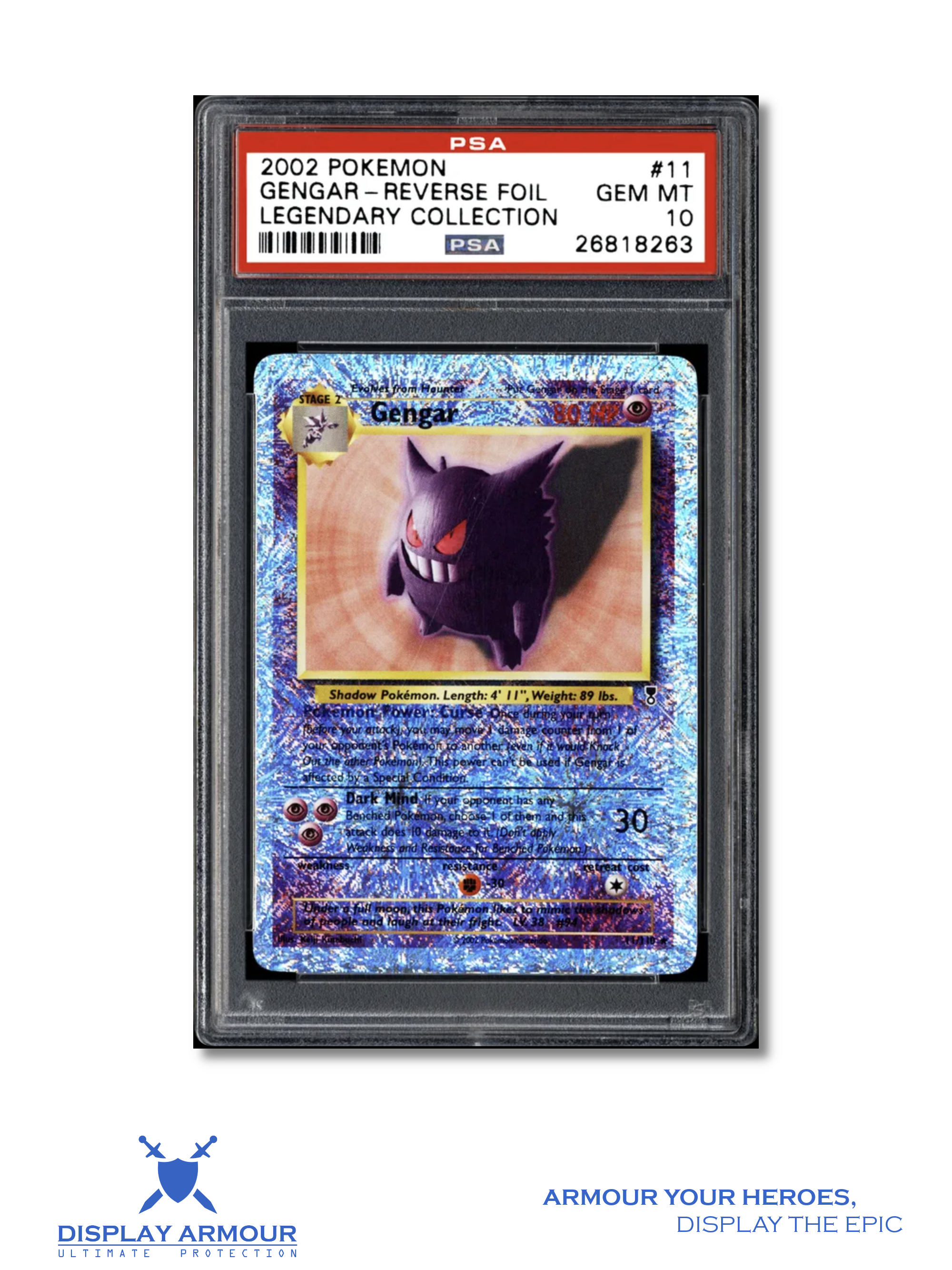
Legendary Collection introduced one of the hobby’s most recognisable reverse-holo treatments: a bright, firework-like foil across almost the entire card face. Gengar’s popularity and dark artwork amplify the effect, while the expansive foil area readily shows scratches and print imperfections. The $705,000 (approx. £534,100) PSA 10 sale is an exceptional high-end result for a very condition-sensitive card, not the value of ordinary raw or lower-grade examples.
$705,000 (approx. £534,100) is the documented PSA 10 benchmark reported by Alt (September 2026; company announcement). The auction-platform company announced this completed sale; the announcement does not state the exact closing day. Primary sale evidence — Alt.
15. Lugia 1st Edition Holo — 2000 Neo Genesis
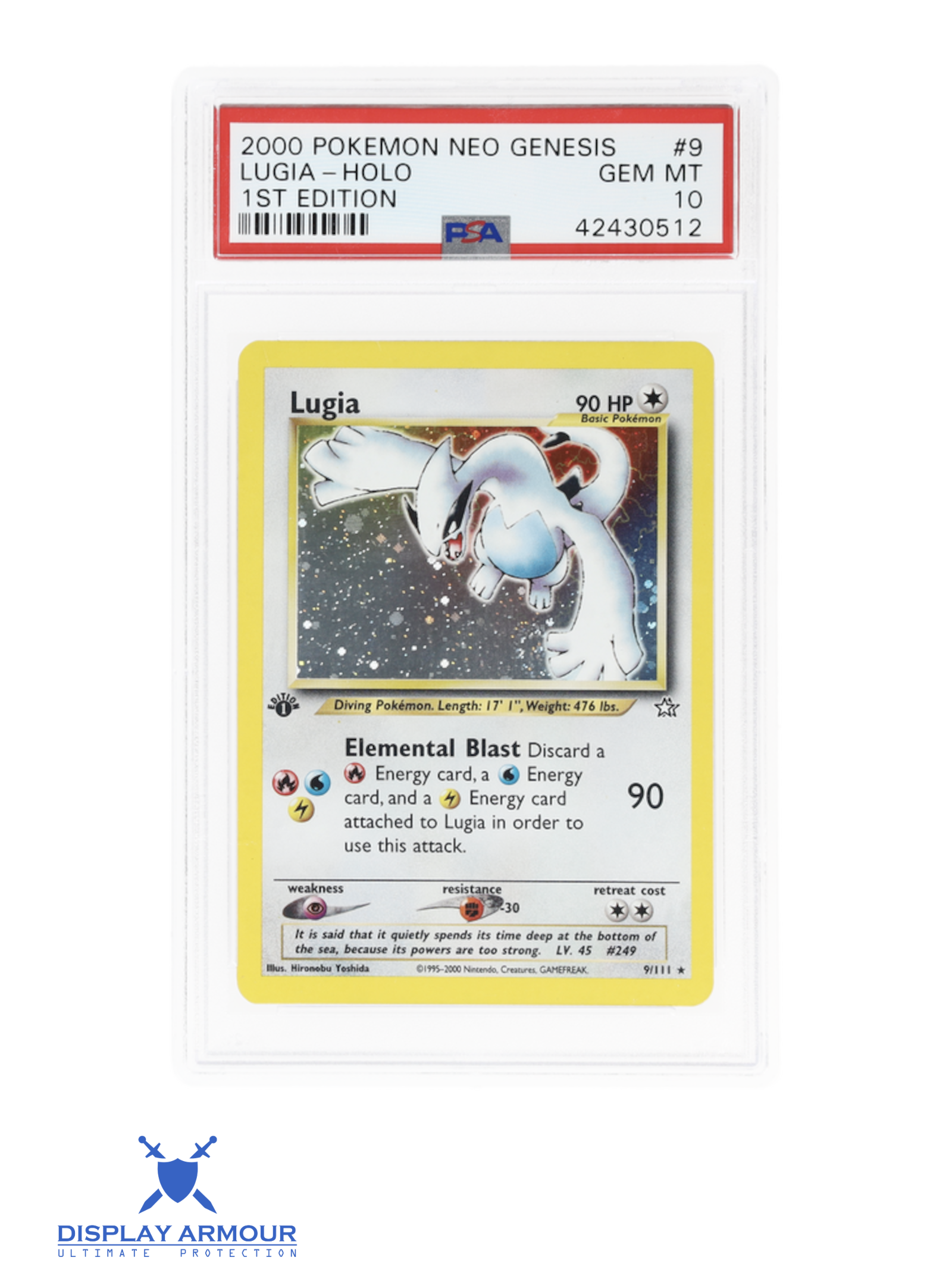
Lugia 9/111 is Neo Genesis’s signature holo and one of the defining cards of Pokémon’s second generation. The large pale holo field is unforgiving of print lines, scratches and centering problems, contributing to the $654,000 (approx. £495,400) PSA 10 benchmark. Verify the First Edition stamp: unlimited copies share the artwork but occupy a different market.
$654,000 (approx. £495,400) is the documented PSA 10 benchmark reported by Alt on 24 September 2026. Primary sale evidence — Alt.
16. Kangaskhan Parent/Child Family Event — 1998 Trophy Promo
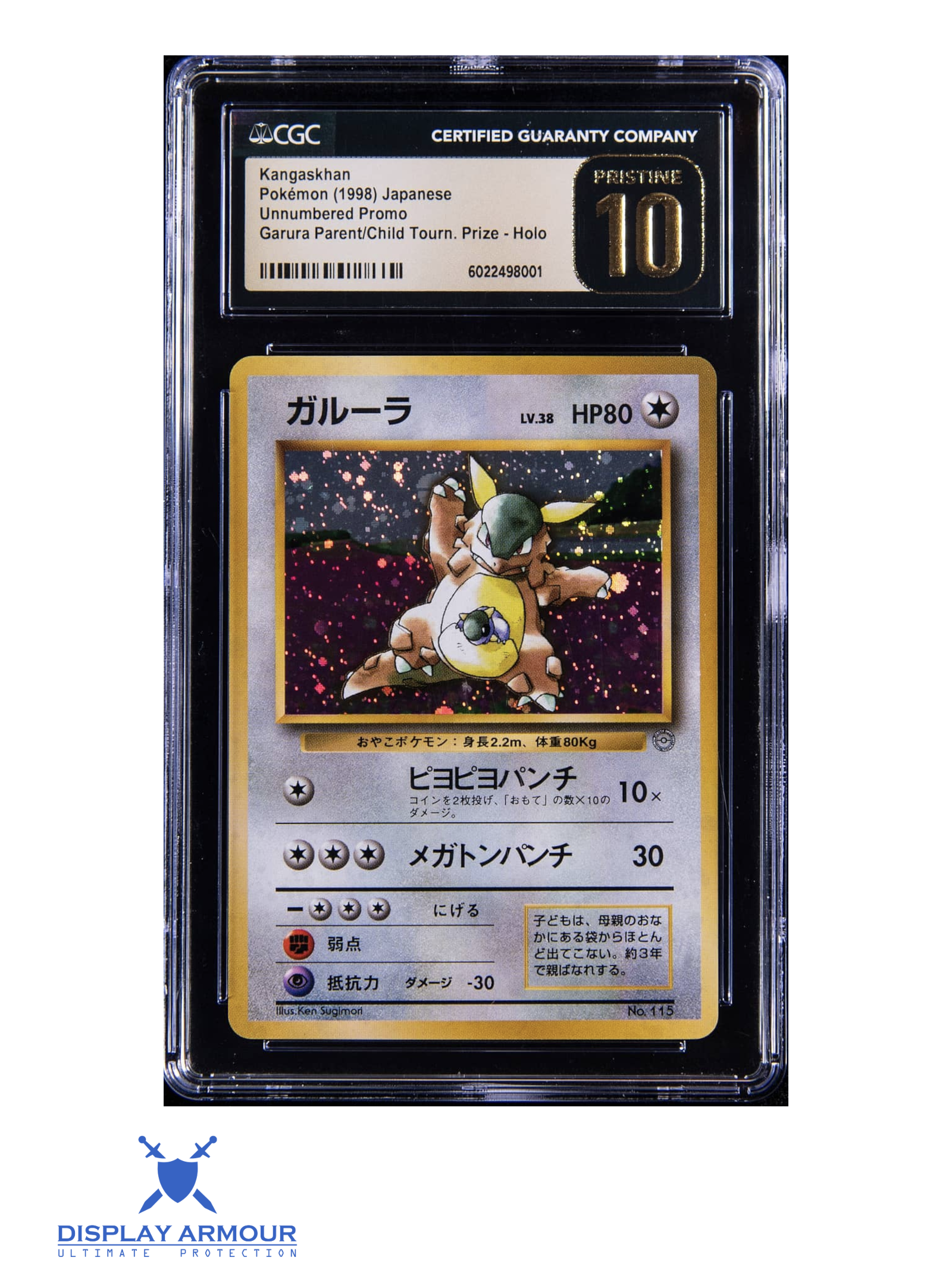
Kangaskhan was awarded through a Japanese parent-and-child tournament format, making the subject unusually appropriate to the event. Its early trophy status, family-focused origin and distinctive Pocket Monsters card-back era place it firmly among the hobby’s historic prizes. The $640,507 (approx. £485,200) CGC 10 Pristine benchmark shows the premium attached to strong condition without implying that every certified copy reaches the same level.
$640,507 (approx. £485,200) is the documented CGC 10 Pristine benchmark reported by Goldin on 9 March 2026. Primary sale evidence — Goldin.
17. Pokémon Snap Charmander — 1999 64 Mario Stadium Promo
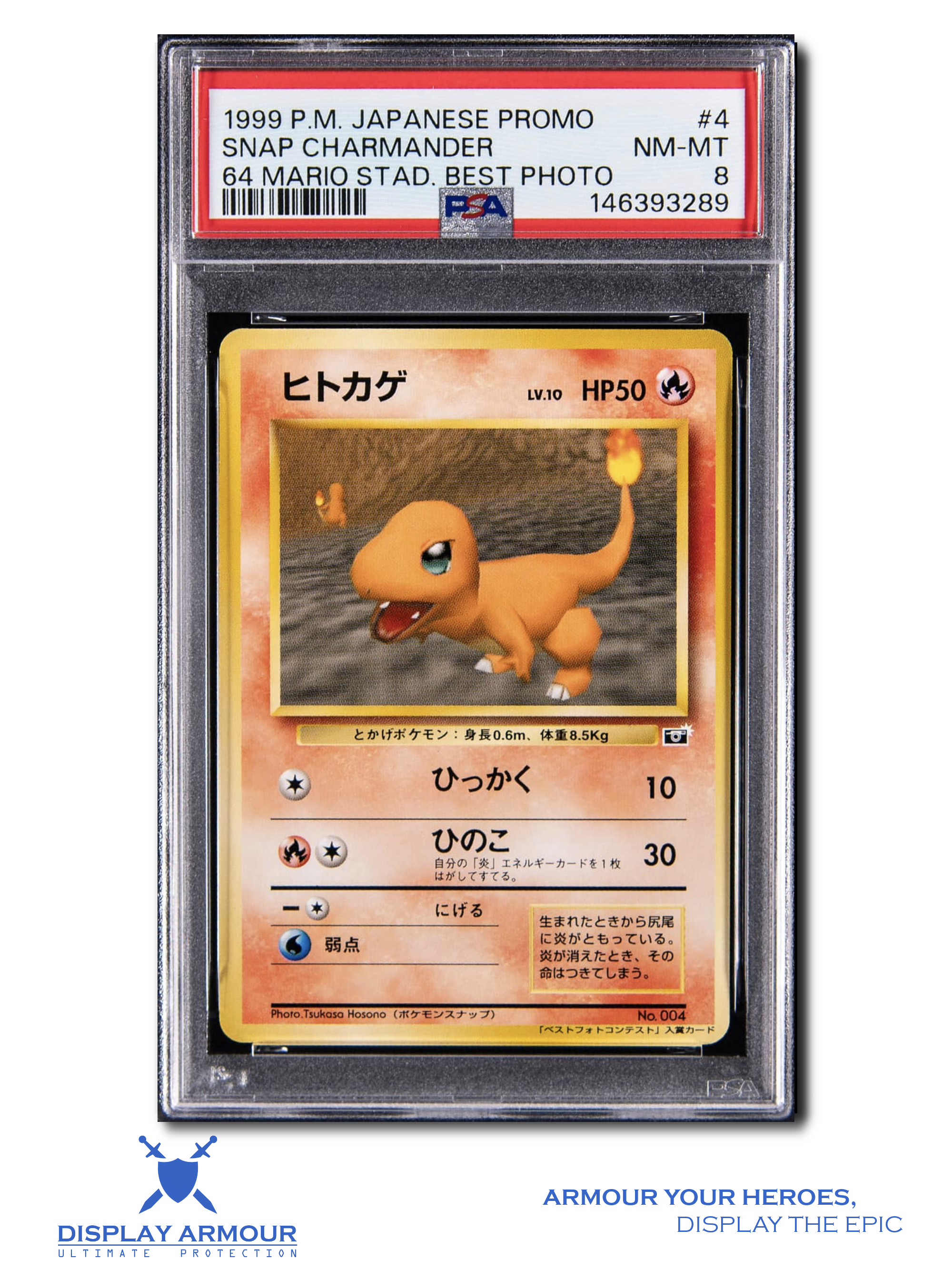
Charmander’s Snap card came from the Japanese contest ecosystem built around Pokémon Snap and the television programme 64 Mario Stadium. The image is an in-game photograph selected from a player entry, so the card documents an early moment when Pokémon crossed video games, television, fan participation and the TCG.
The PSA 8 copy behind the $640,500 (approx. £485,200) benchmark is an award card, not a mass-produced set issue. Individual Snap subjects have different known populations and sale histories, which is why “a Snap card” is not a sufficient description for valuation. The exact Pokémon, winning photograph, authentication and provenance must align. With only isolated public transactions, these cards can be highly illiquid and their headline values should be treated as records for specific copies.
$640,500 (approx. £485,200) is the documented PSA 8 benchmark reported by Goldin on 10 August 2026. Primary sale evidence — Goldin.
18. Prerelease Raichu — 1999 WOTC Error
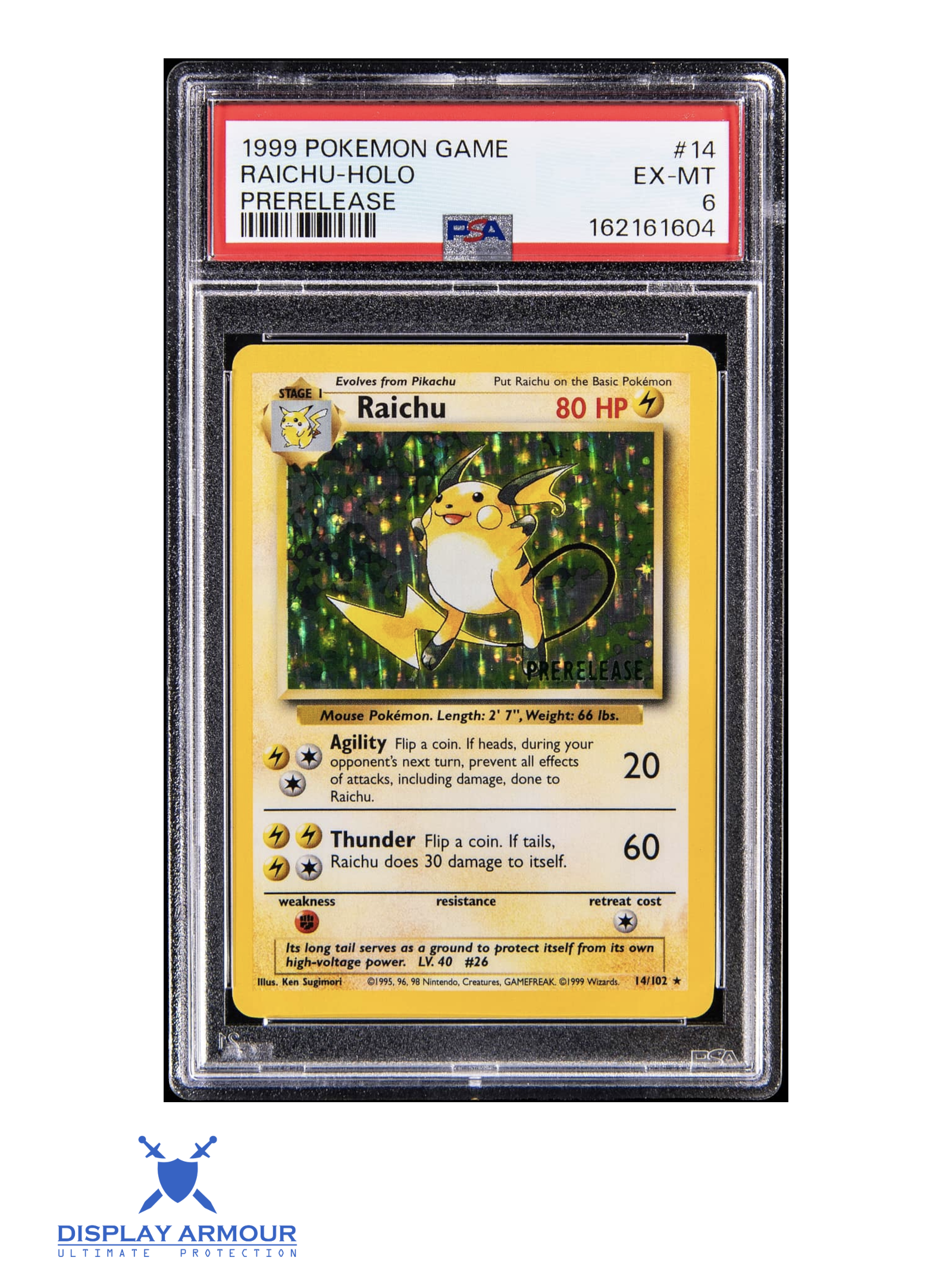
For years, Prerelease Raichu occupied a near-mythical place in the hobby. It is a Base Set Raichu carrying a “PRERELEASE” stamp associated with promotional preparation, despite Raichu not being the intended prerelease card. Public authentication and auction documentation have moved the conversation beyond folklore, but it remains a production anomaly rather than a conventional release.
A PSA 6 example sold through Goldin in August 2026 for $640,500 (approx. £485,200). The result applies to the authenticated error card and should not be confused with an ordinary Base Set Raichu or an aftermarket stamp. Because the story involves WOTC production history and an extremely small known supply, collectors need specialist authentication, high-resolution inspection and strong provenance. This is one case where buying the label without understanding the underlying diagnostics would be especially risky.
$640,500 (approx. £485,200) is the documented PSA 6 benchmark reported by Goldin on 10 August 2026. Primary sale evidence — Goldin.
19. Charizard Reverse Holo — 2002 Legendary Collection
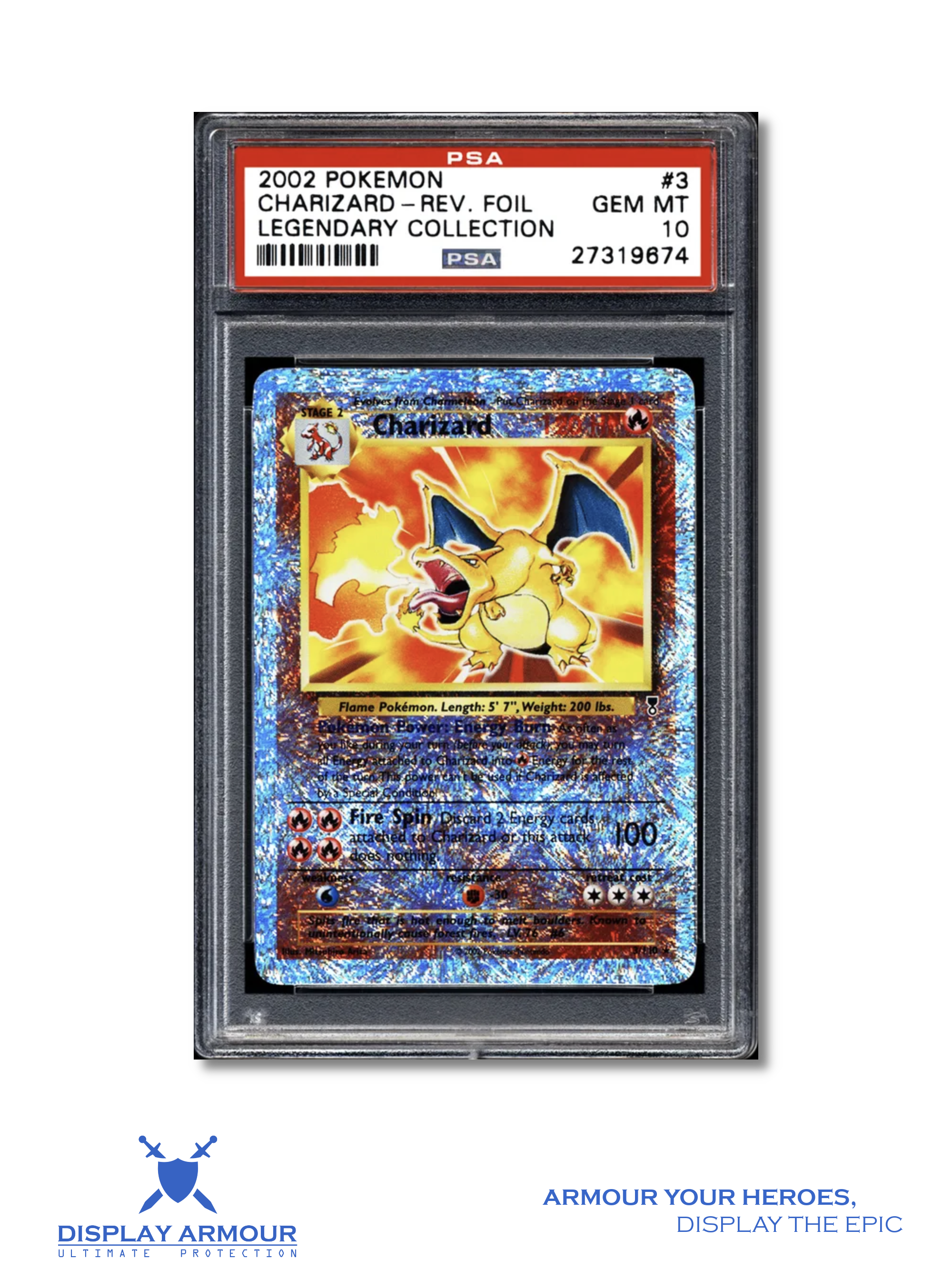
Legendary Collection Charizard 3/110 reworks the iconic Base Set pose with the set’s explosive reverse-holo pattern. Almost the entire face can reveal scratches, print lines and edge wear, making PSA 10 examples difficult. The $575,000 (approx. £435,600) benchmark is tied to that reverse-holo variant; the regular holo from the same set and Base Set Charizards are different cards.
$575,000 (approx. £435,600) is the documented PSA 10 benchmark reported by Heritage on 18 September 2026. Primary sale evidence — Heritage.
20. Pokémon Snap Squirtle — 1999 64 Mario Stadium Promo
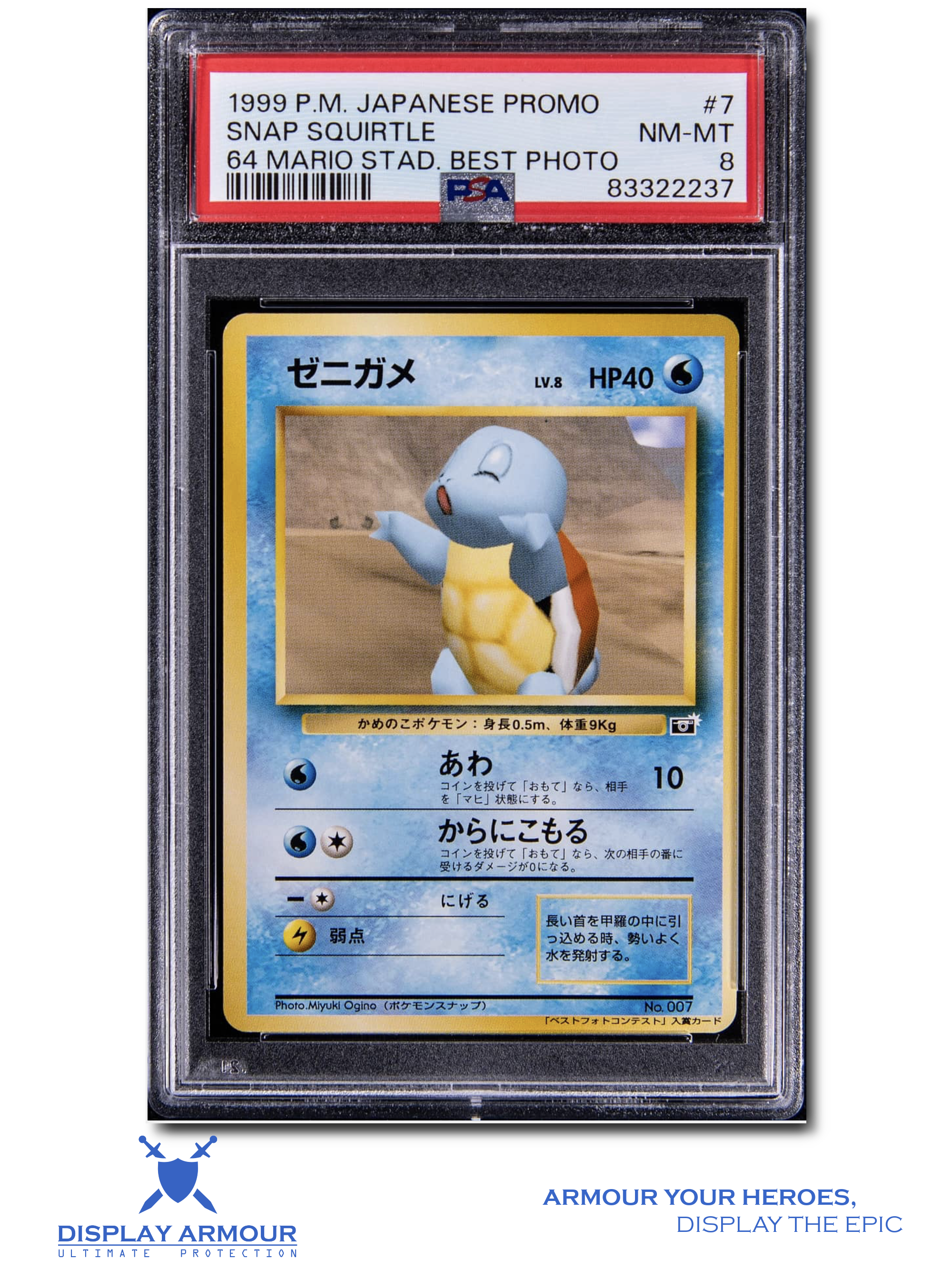
Snap Squirtle is another winning-photo promo from the Nintendo 64 contest programme. Its value comes from more than starter-Pokémon popularity: it is a physical record of a specific competition entry, produced outside normal booster-pack distribution and with very few public opportunities to buy an authenticated copy.
A PSA 6 example reached $555,100 (approx. £420,500), showing how event rarity can dominate conventional grade expectations. On a mass-market holo, collectors might insist on a much higher numerical grade; on a Snap prize, the chance to own any certified example can be the greater constraint. Condition still matters, but provenance, correct identification and confidence in authenticity are indispensable. Comparisons should be made with the same Squirtle promo, not other Squirtle cards or unrelated Snap subjects.
$555,100 (approx. £420,500) is the documented PSA 6 benchmark reported by Goldin on 10 August 2026. Primary sale evidence — Goldin.
21. Charizard Holo — Japanese Base Set (Rarity Symbol) — 1996 Japanese Base Set
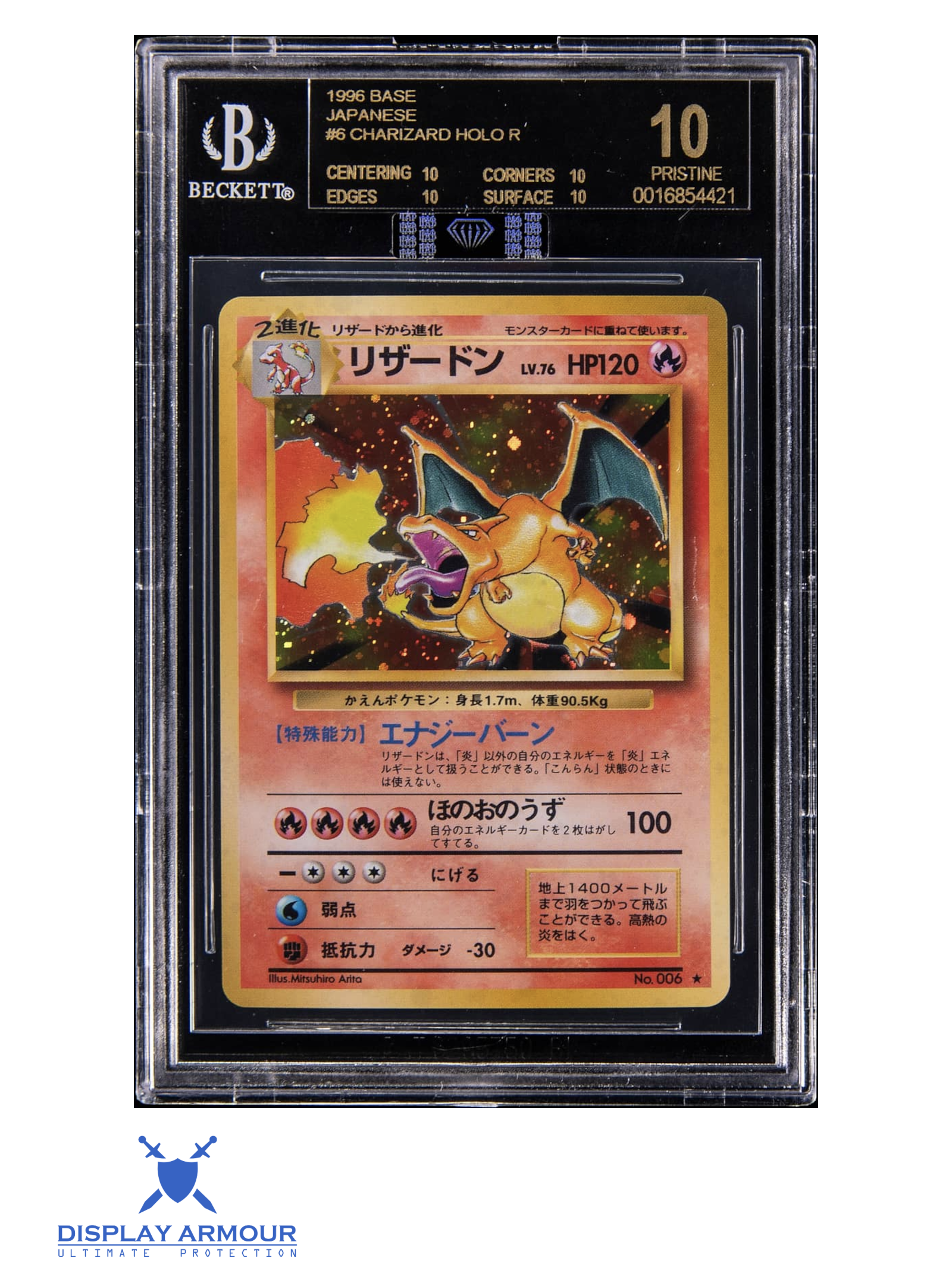
Charizard’s original Japanese Base Set artwork connects this card to the beginning of the TCG. The normal rarity-symbol printing remains a separate collectible from the earlier no-rarity issue, even though their pictures are almost identical. The border, foil and reverse deserve inspection before any comparison with the first printing.
$518,500 (approx. £392,800) is the documented BGS PRISTINE/Black Label 10 - MBA Black Diamond Certified benchmark reported by Goldin on 10 August 2026. This result is for a BGS Black Label copy; the label and presence of the rarity symbol both matter. Primary sale evidence — Goldin.
22. Charizard Topsun Blue Back — 1997 Topsun — unnumbered blue back
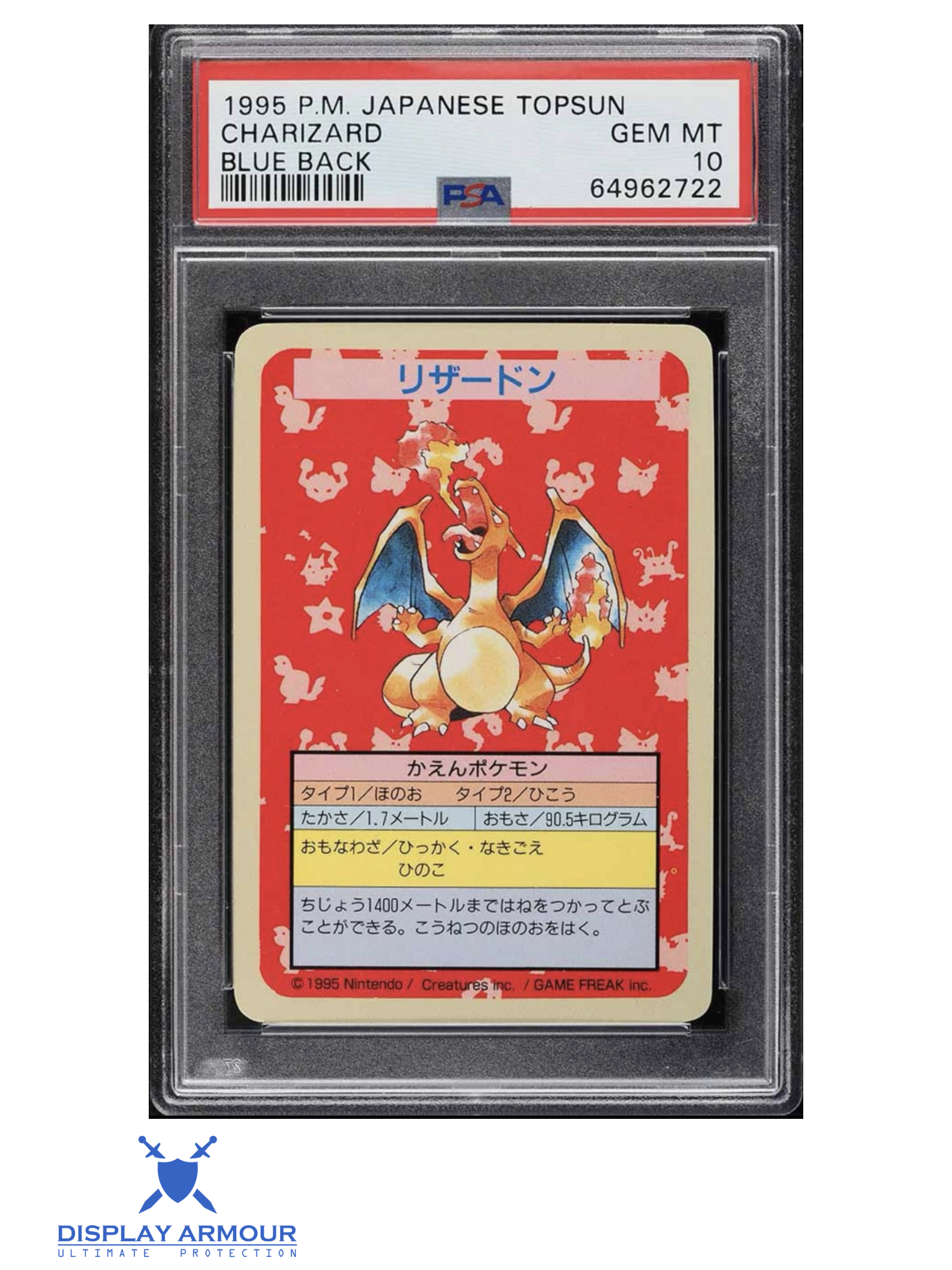
Topsun cards were packaged with gum in Japan and sit outside the conventional Pokémon TCG set lineage. The blue-back Charizard is prized for its early date, simple character presentation and connection to Pokémon’s formative merchandising period. Pack handling and age make clean backs, corners and surfaces difficult. The $493,230 (approx. £373,600) PSA 10 result is a top-grade benchmark for the unnumbered blue-back variant; green-back and numbered variations require separate identification.
$493,230 (approx. £373,600) is the documented PSA 10; unnumbered blue back benchmark reported by Goldin / PSA auction record on 31 January 2021. Primary sale evidence — Goldin / PSA auction record.
23. Pokémon Snap Chansey — 1999 64 Mario Stadium Promo
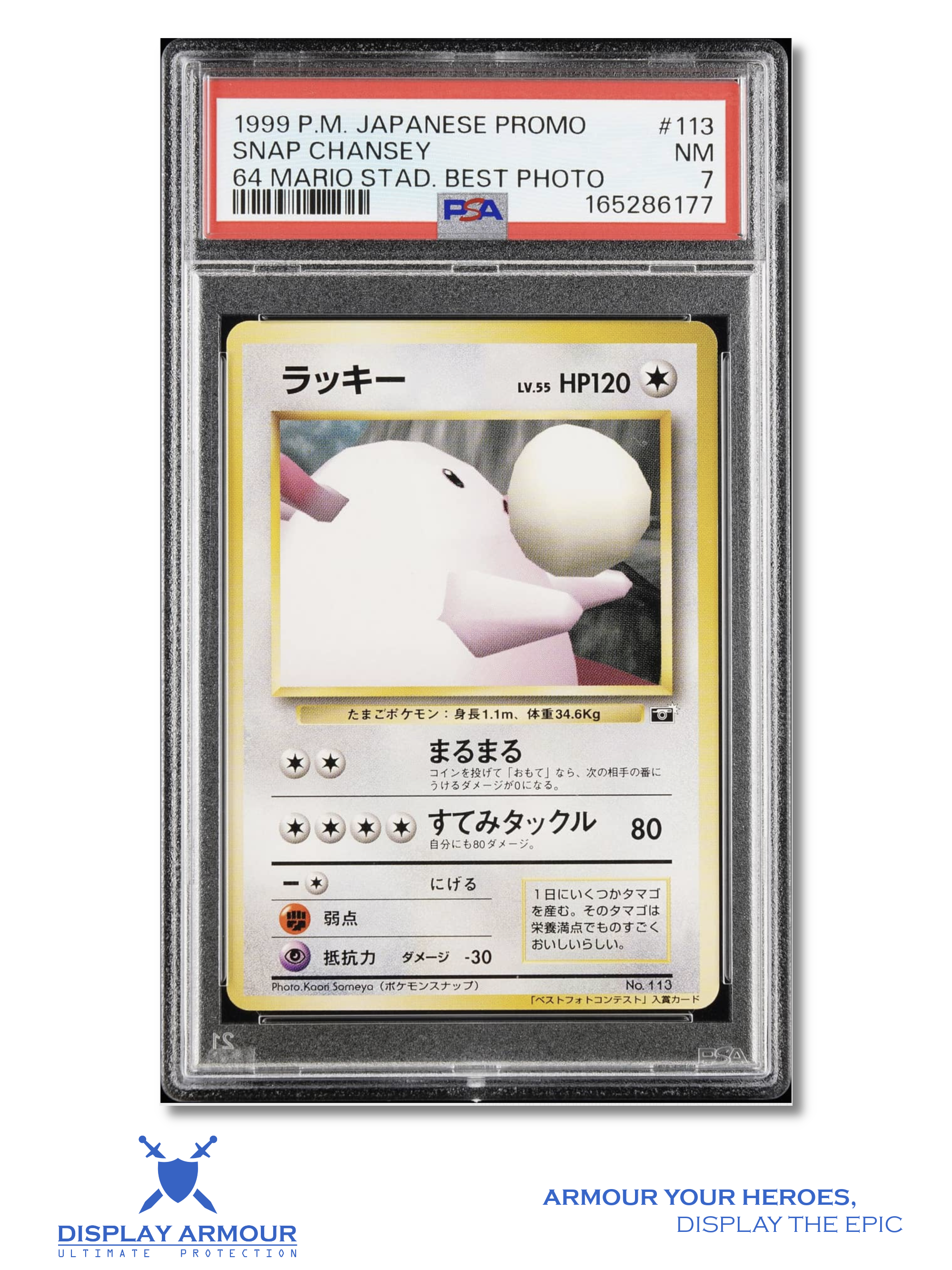
Snap Chansey is another photographic prize card, but its appeal is distinct from the starter-Pokémon examples. The winning image captures Chansey inside the game, and the finished card preserves a specific player’s contest success. It was never intended as a broadly available collectible, making each authenticated appearance a notable market event.
The $488,000 (approx. £369,700) high-grade benchmark reflects the award copy’s scarcity and provenance rather than a deep market of repeat sales. With Snap cards, the absence of frequent transactions makes conventional averages unreliable. Collectors should confirm the precise contest route, card subject and grading record and should expect condition differences caused by original handling and storage. The broader lesson from the Snap contest prizes is that some of Pokémon’s most valuable cards were not chase pulls at all—they were personal prizes tied to participation in the franchise’s earliest culture.
$488,000 (approx. £369,700) is the documented PSA 7 benchmark reported by Goldin on 10 August 2026. Primary sale evidence — Goldin.
24. Pikachu Gold Star — 2006 EX Holon Phantoms
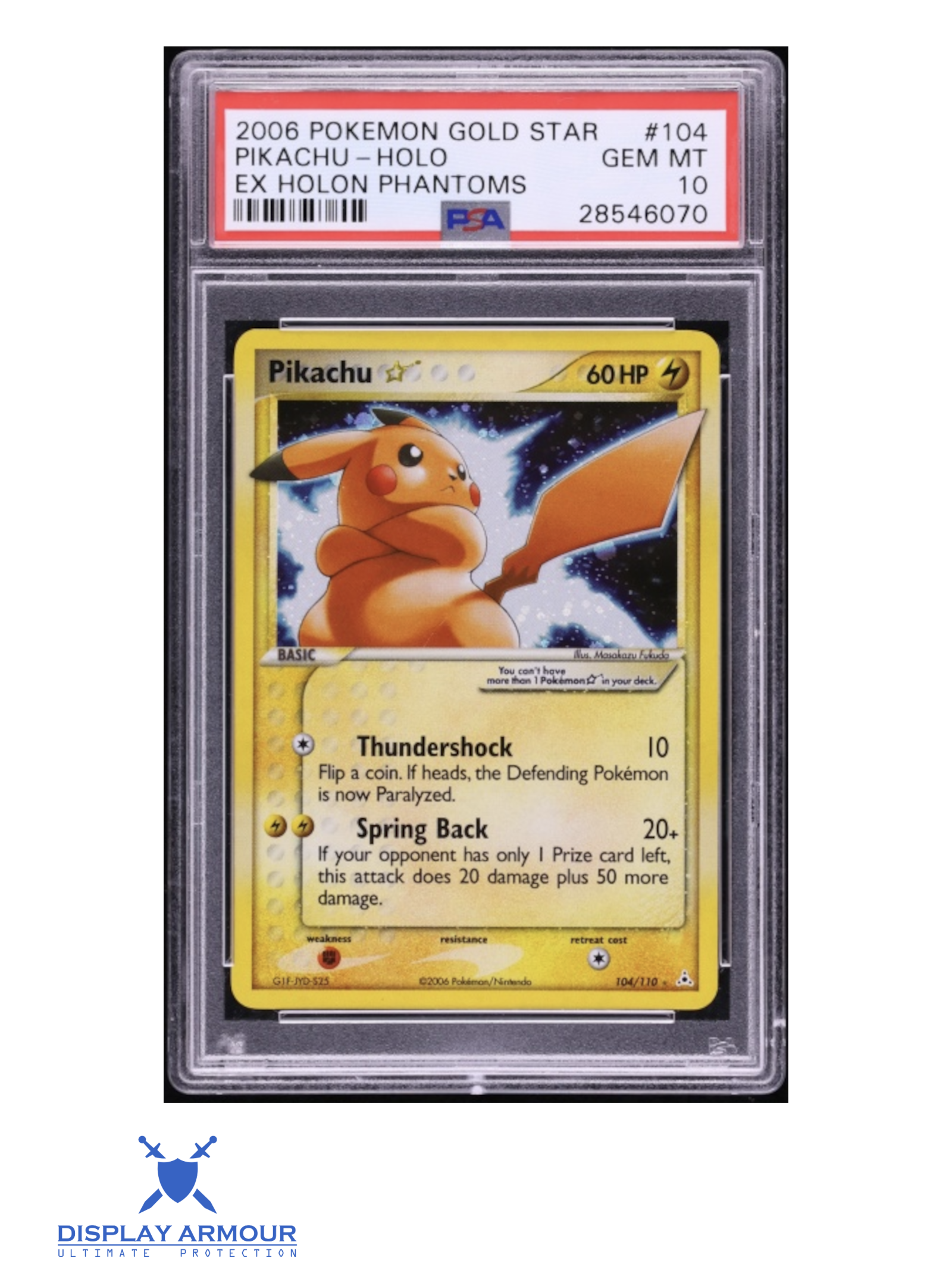
Pikachu Gold Star 104/110 shows a shiny-toned Pikachu bursting beyond the artwork frame. It pairs mascot demand with one of the EX era’s most collected mechanics. The $480,000 (approx. £363,600) PSA 10 benchmark is for a Gem Mint example of the correct EX Holon Phantoms card; edge whitening and holo wear make lower grades substantially more common than flawless presentation.
$480,000 (approx. £363,600) is the documented PSA 10 benchmark reported by Fanatics Collect on 28 September 2026. Primary sale evidence — Fanatics Collect.
25. Charizard Gold Star — 2006 EX Dragon Frontiers
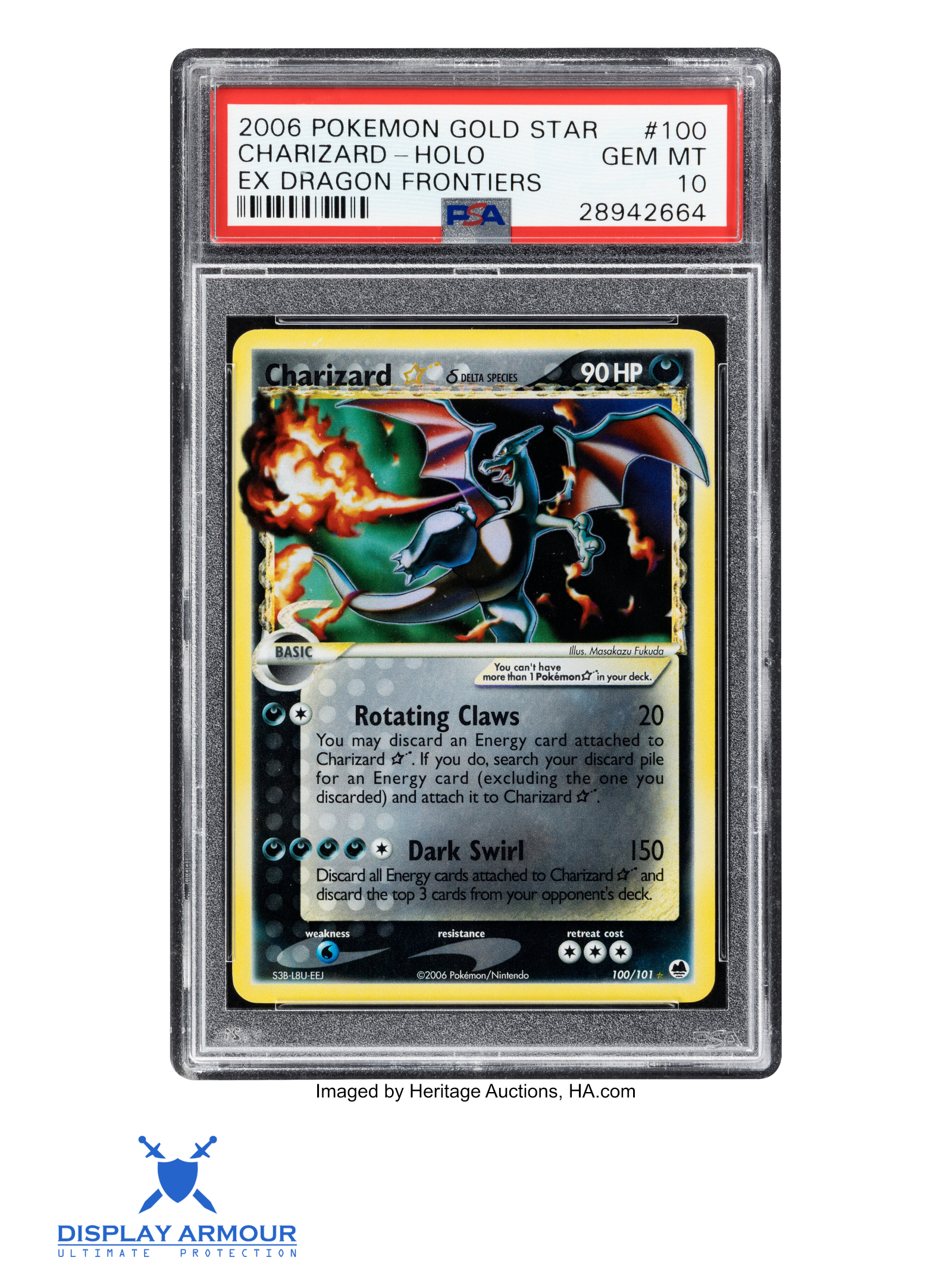
Charizard Gold Star depicts a shiny-colour Charizard with artwork breaking beyond the illustration frame, a signature of the EX-era Gold Star family. EX Dragon Frontiers is remembered for Delta Species cards, but Charizard remains its dominant high-end chase. The $475,000 (approx. £359,800) PSA 10 benchmark reflects a rare combination of character demand and demanding condition; edge wear, holo scratching and centering quickly reduce the grade.
$475,000 (approx. £359,800) is the documented PSA 10 benchmark reported by Heritage on 18 September 2026. Primary sale evidence — Heritage.
26. Super Secret Battle No. 2 Trainer — 1999 Japanese trophy promo
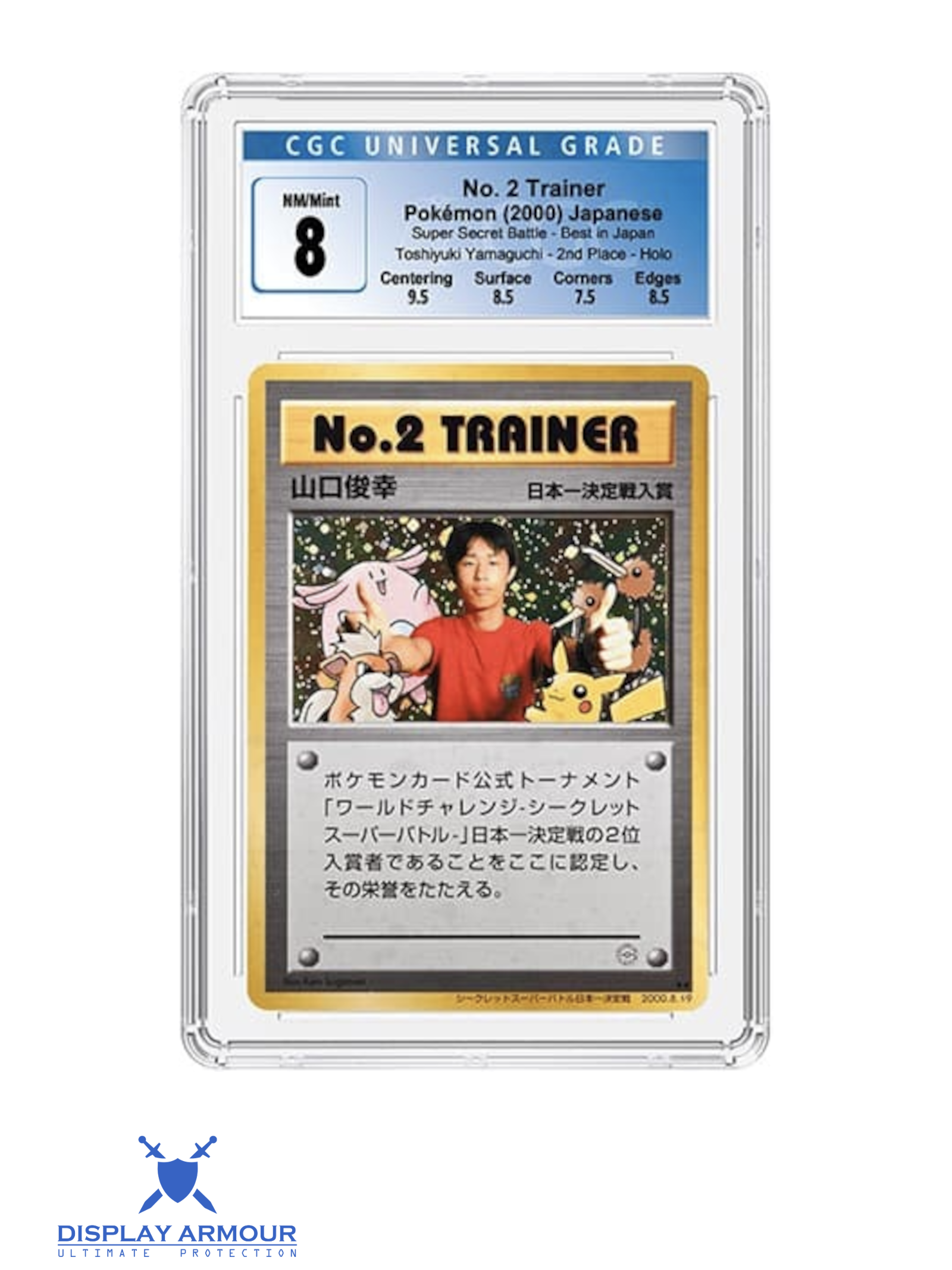
The No. 2 Trainer complements the first-place Super Secret Battle card but represents its own placing. Its Mewtwo imagery belongs to the 1999 competitive programme, rather than the later World Championships designs. Collectors need the event and placing together to distinguish it from other similarly titled Trainer prizes.
$466,698 (approx. £353,500) is the documented PSA 10 benchmark reported by Alt on 4 June 2026. A scarce second-place trophy in PSA 8 should be compared with its own issue, not with a Gem Mint card from another tournament. Primary sale evidence — Alt.
27. Gold Trophy Pikachu No. 1 Trainer — Second Tournament — 1998 Second Tournament trophy
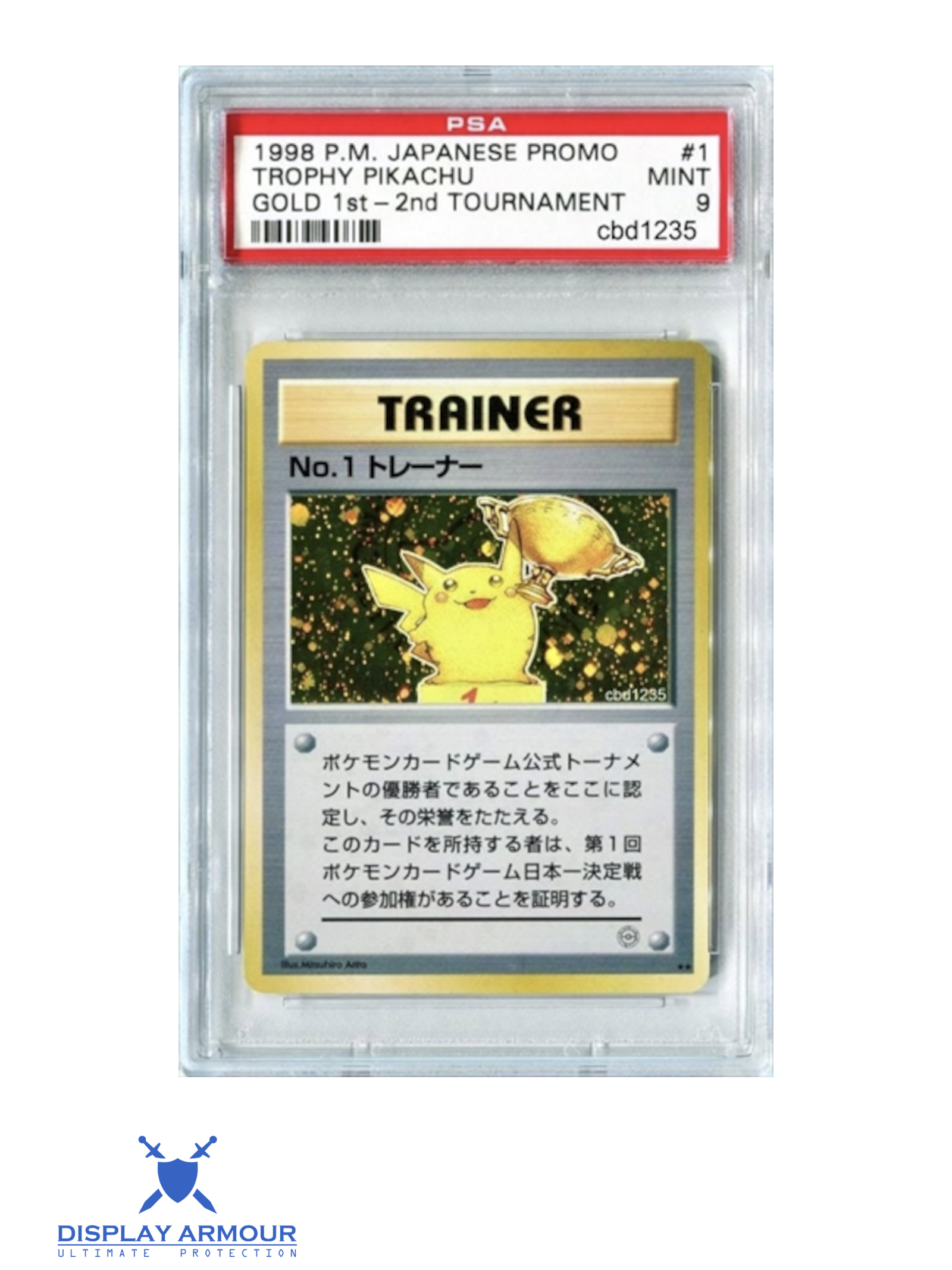
The second-tournament gold trophy records a different competitive event from the 1997 first-tournament No. 1 Trainer. Its appeal comes from winning an early Pokémon competition, with the trophy-bearing Pikachu making that achievement part of the artwork. The event designation is more useful than the shorthand “Gold Pikachu”.
$450,000 (approx. £340,900) is the documented PSA 9; original award plaque included benchmark reported by Heritage on 12 December 2025. The cited Heritage lot included the original award plaque, so the realised total includes that associated presentation material. Primary sale evidence — Heritage.
28. Silver Trophy Pikachu No. 2 Trainer — Second Tournament — 1998 Second Tournament trophy
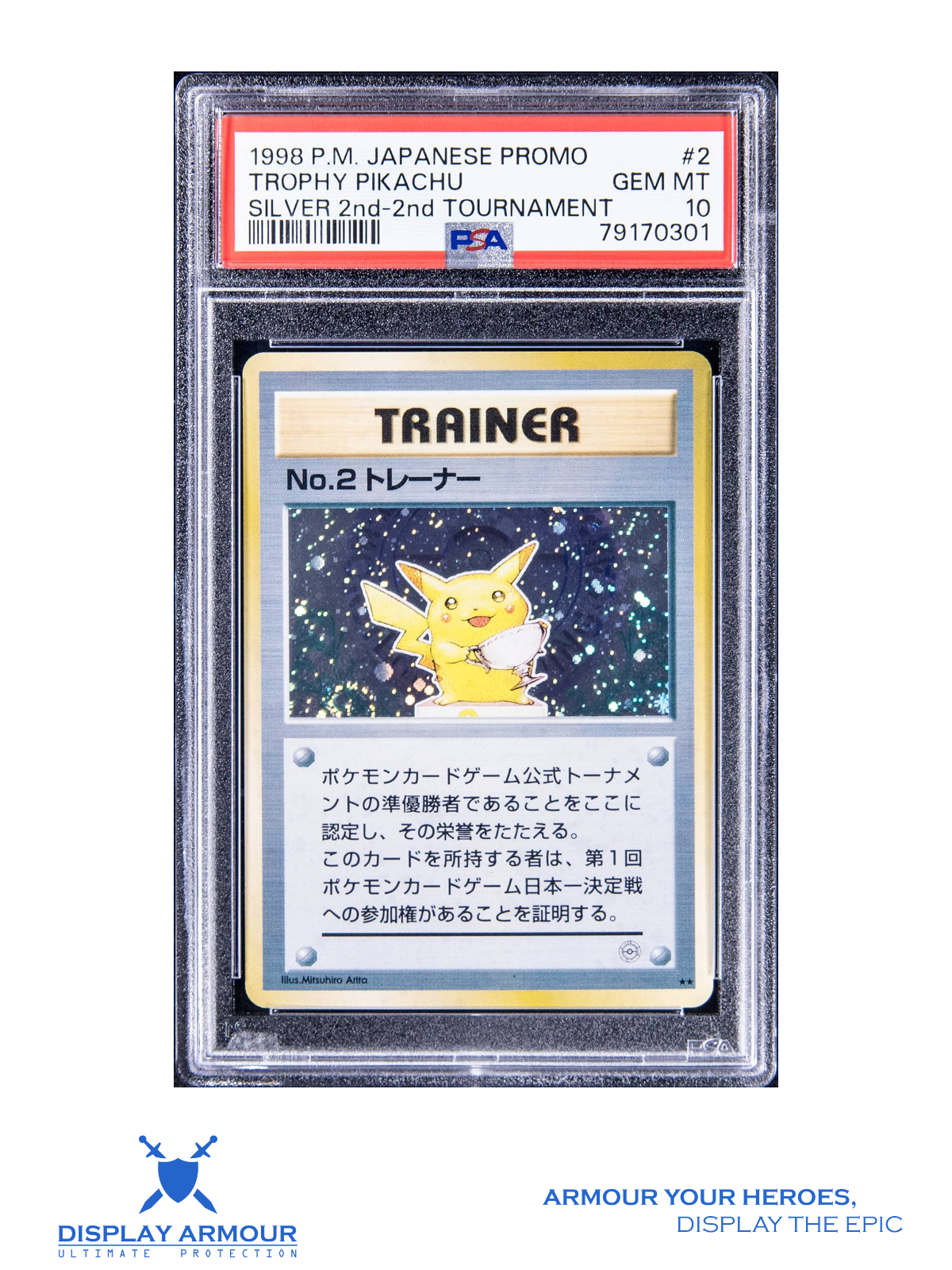
The silver No. 2 Trainer represents second place in Pokémon’s earliest competitive prize-card system. Its trophy-holding Pikachu artwork visually pairs it with the gold and bronze issues, but the exact year and event remain critical. A PSA 10 benchmark of $444,000 (approx. £336,300) reflects the difficulty of finding an early prize card with Gem Mint surfaces and edges. It should be assessed as its own issue, not as an interchangeable member of a generic trophy set.
$444,000 (approx. £336,300) is the documented PSA 10 benchmark reported by Goldin on 7 September 2023. Primary sale evidence — Goldin.
29. Typhlosion Holo — Neo Genesis First Edition (T17) — 2000 Neo Genesis — 17/111
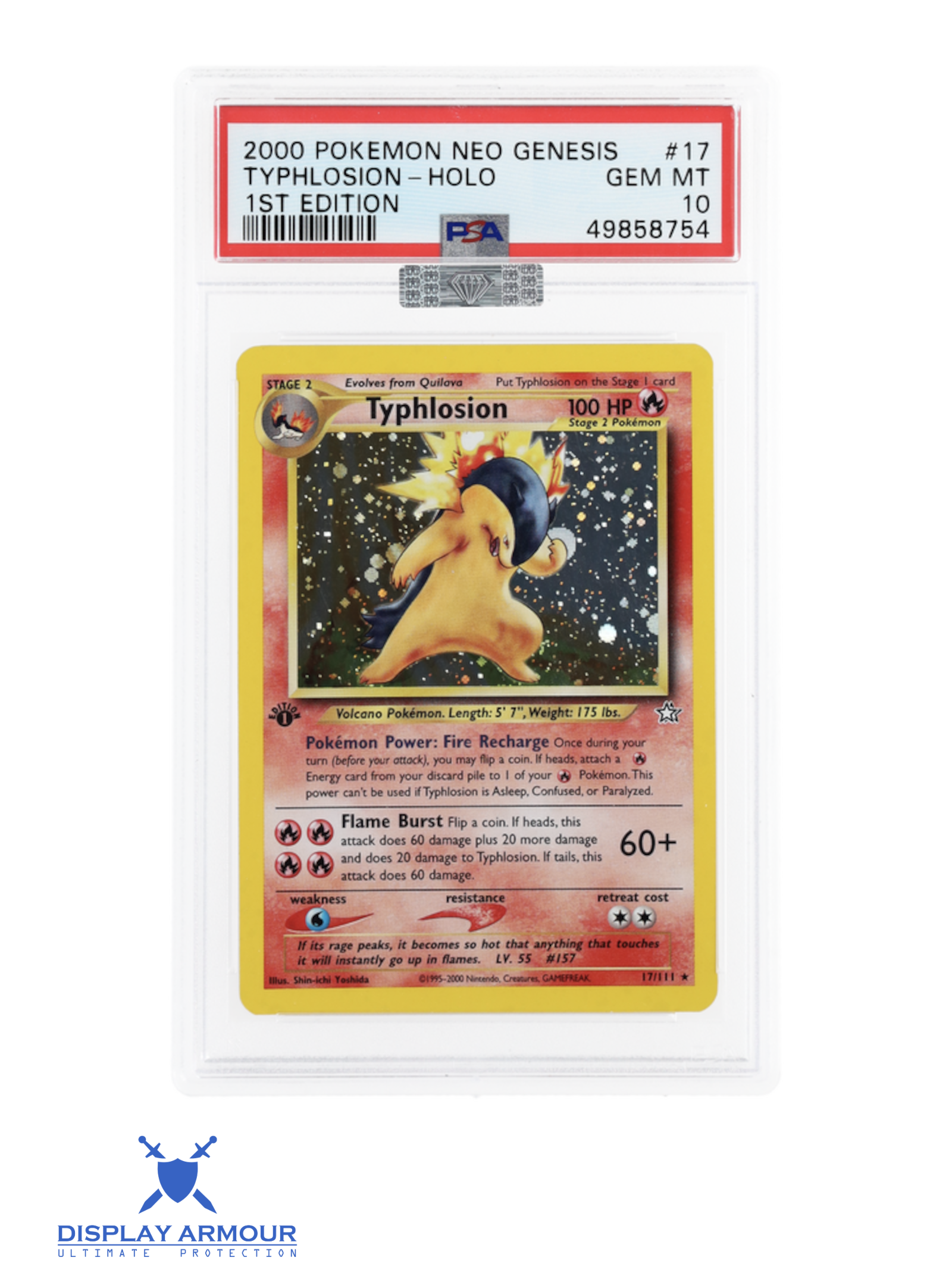
Typhlosion number 17/111, often called T17, is one of Neo Genesis’ two Typhlosion holos. The particular artwork and First Edition stamp establish its identity. Print lines, foil scratches and edge defects are important on this early English holo, so an attractive raw card is not automatically a top-grade comparable.
$415,500 (approx. £314,800) is the documented PSA 10 benchmark reported by Alt on 4 June 2026. The verified public PSA 10 auction is used here. A separately reported $750,000 private transaction is not substituted for the public benchmark. Primary sale evidence — Alt.
30. Misdreavus Holo — Neo Revelation First Edition — 2001 Neo Revelation — 11/64
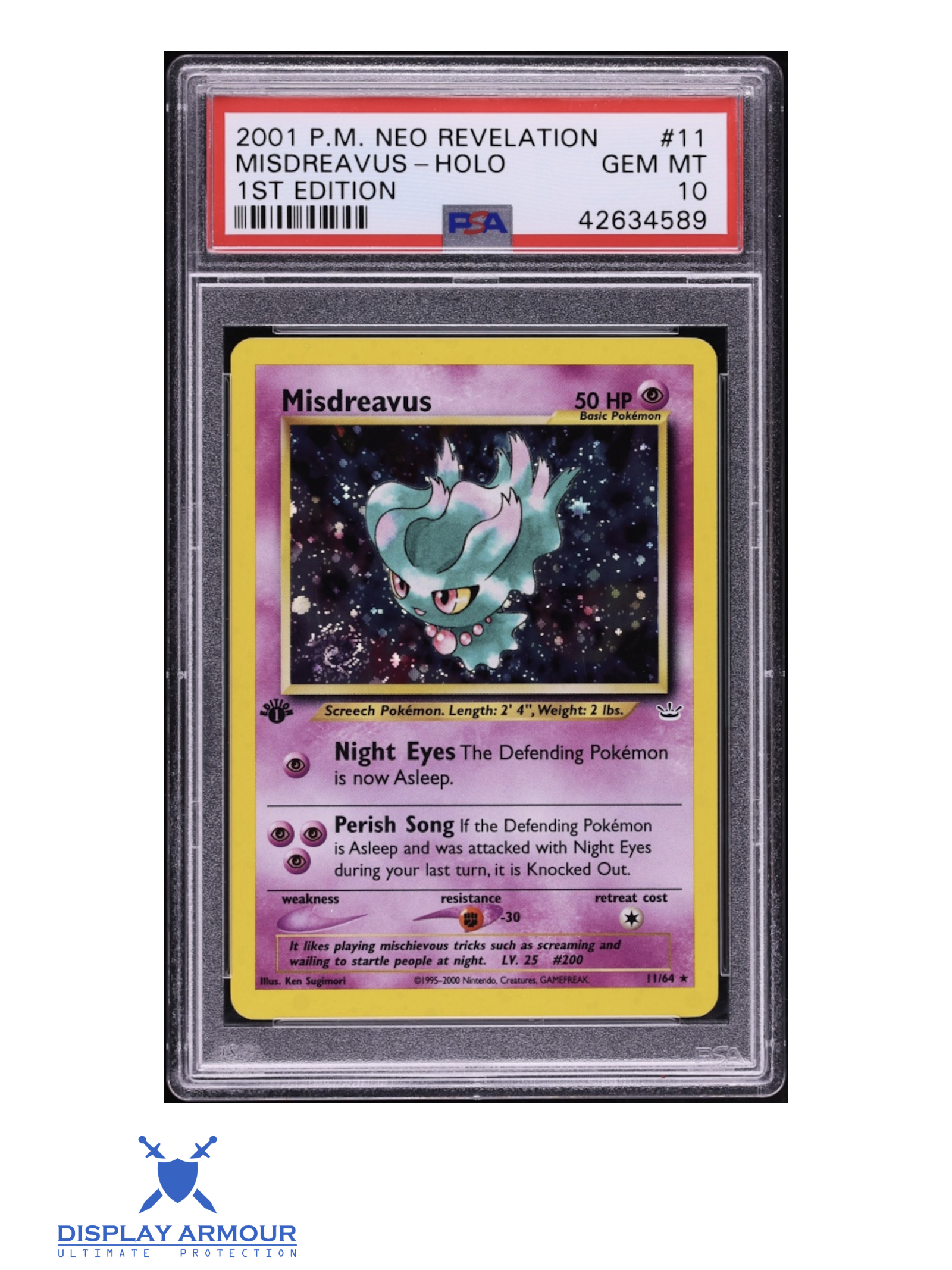
Misdreavus shows how an early Neo holo can attract an exceptional result without being a starter Pokémon or a trophy. The First Edition printing and Gem Mint condition are the meaningful identifiers. The dark artwork, foil and reverse need detailed examination rather than an assumption that any Neo Revelation copy is comparable.
$408,000 (approx. £309,100) is the documented PSA 10 benchmark reported by Fanatics Collect on 28 September 2026. The result is an isolated PSA 10 First Edition sale, not a market average for Misdreavus. Primary sale evidence — Fanatics Collect.
31. Bronze Trophy Pikachu No. 3 Trainer — First Tournament — 1997 First Tournament trophy
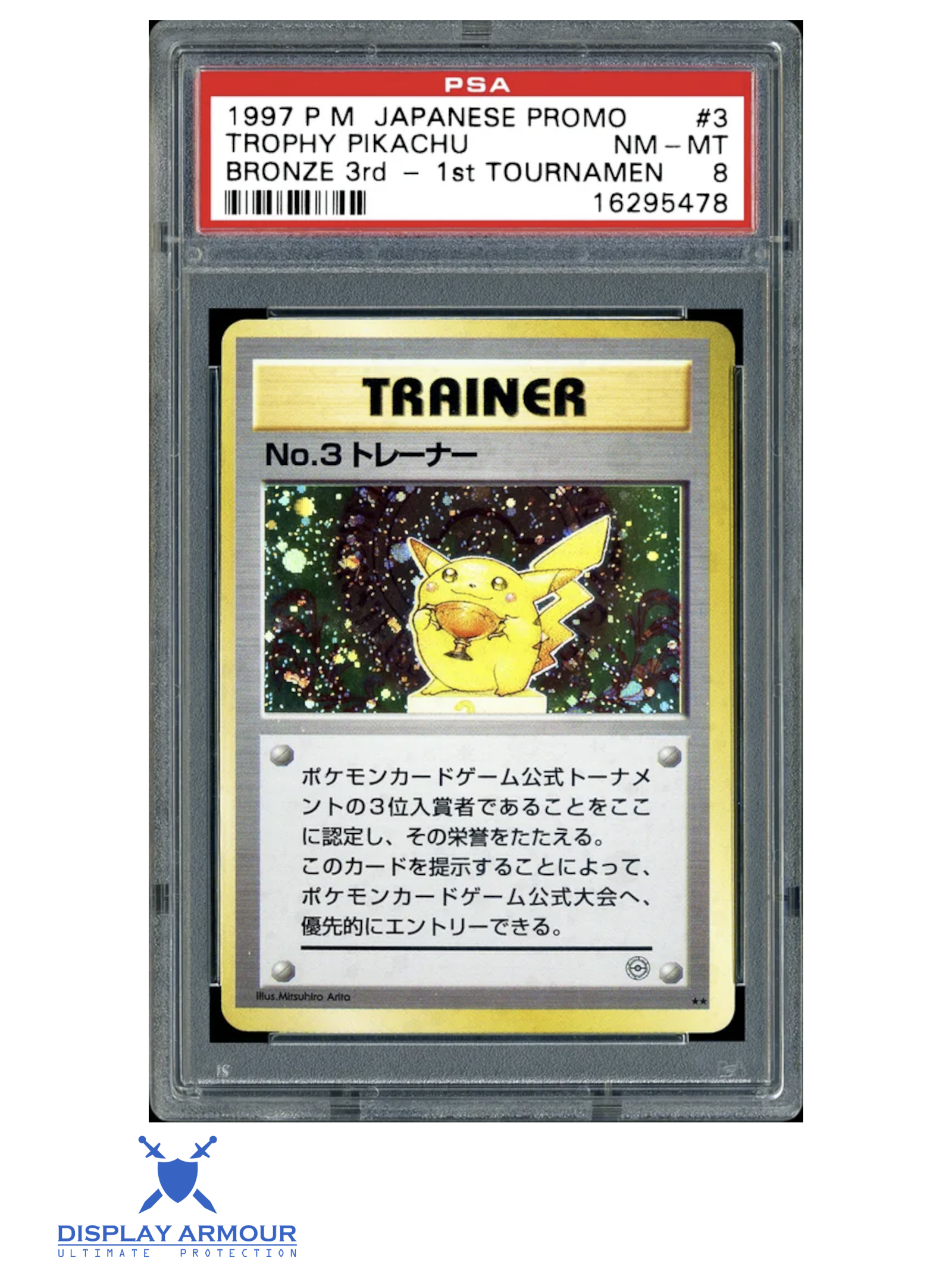
The first-tournament bronze trophy takes the familiar No. 3 Trainer artwork back to the earliest competitive prize series. It is separate from the 1998 second- and third-tournament bronze cards. This is an event-history collectible: the placing and tournament identification are essential parts of the card’s name.
$402,601 (approx. £305,000) is the documented PSA NM-MT 8 benchmark reported by Goldin on 29 June 2026. The PSA 8 sale values this first-tournament issue; the higher-priced 1998 PSA 10 bronze trophy is a different release. Primary sale evidence — Goldin.
32. Team Aqua’s Kyogre EX Full Art — Double Crisis — 2015 Double Crisis — 6/34
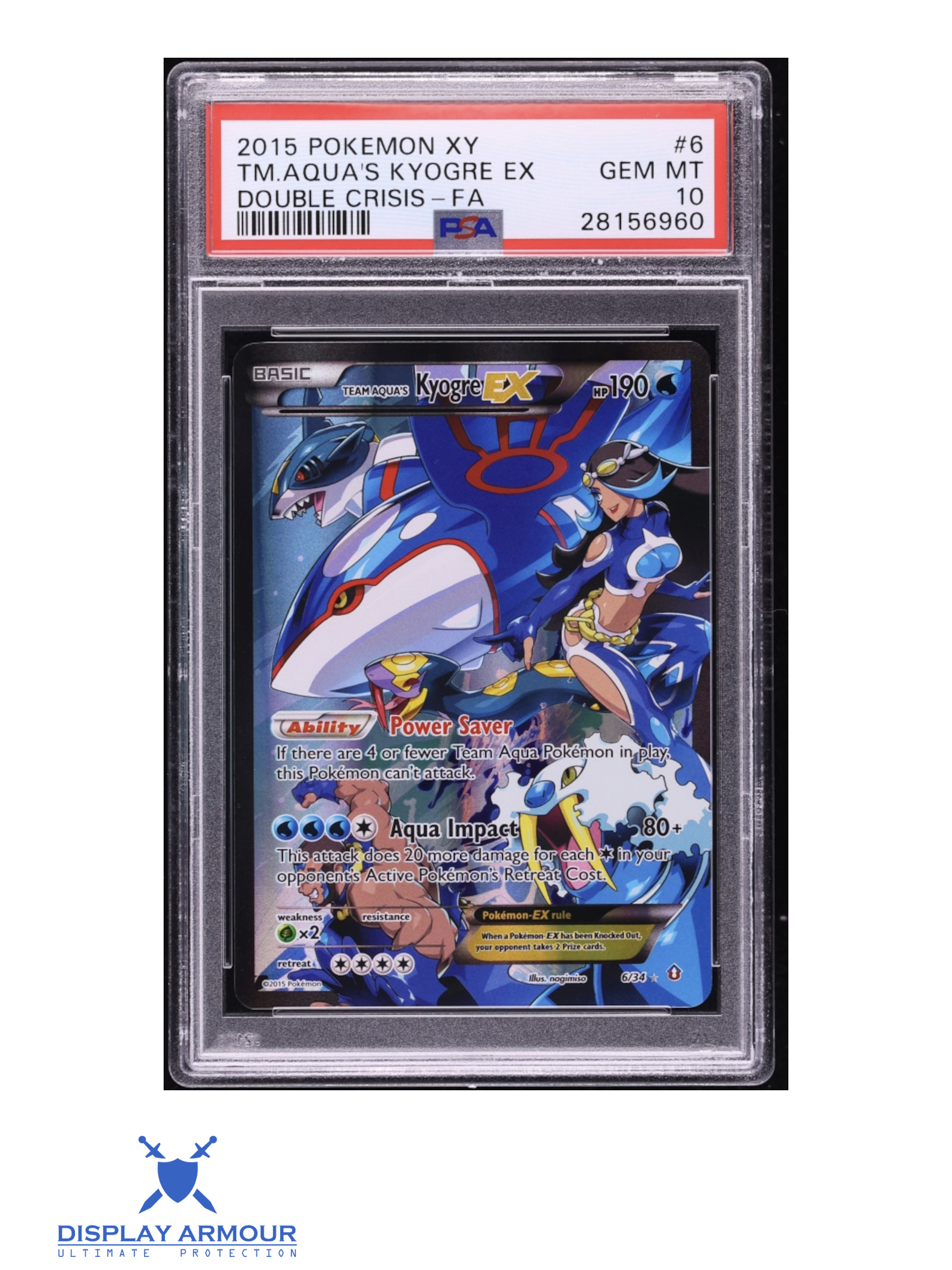
Double Crisis uses a full-art scene to connect Kyogre with Team Aqua, making the card more than an isolated legendary portrait. The compact expansion and team theme give it a distinct collector identity. The textured face, corners and reverse still need examination before comparing a raw copy with a top-grade result.
$384,000 (approx. £290,900) is the documented PSA 10 benchmark reported by Fanatics Collect on 28 September 2026. The PSA 10 English full art is the subject of the sale; Japanese versions and other Kyogre EX designs have their own benchmarks. Primary sale evidence — Fanatics Collect.
33. Latias Gold Star — 2005 EX Deoxys
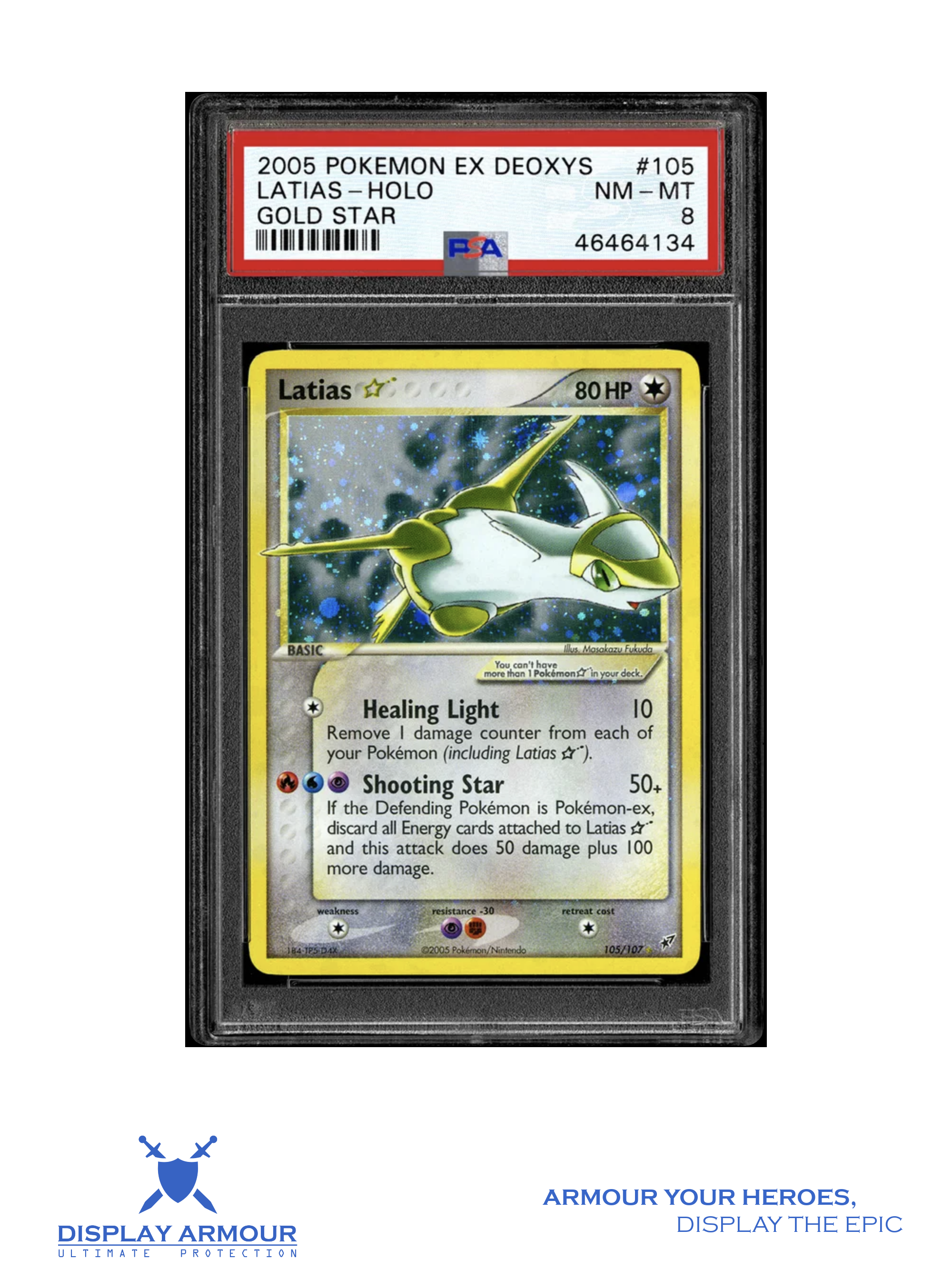
Latias Gold Star 105/107 is one half of EX Deoxys’s Eon duo. The shiny artwork, secret-rare numbering and difficulty of locating clean EX-era copies support the $375,000 (approx. £284,100) documented high-grade benchmark. Do not use the Latios artwork or price interchangeably: the two cards have separate populations, demand and transaction histories.
$375,000 (approx. £284,100) is the documented PSA 10 benchmark reported by Alt (July 2026). The auction-platform company announced this completed sale; the announcement does not state the exact closing day. Primary sale evidence — Alt.
34. Lugia Regular Holo — Call of Legends — 2011 Call of Legends — 15/95
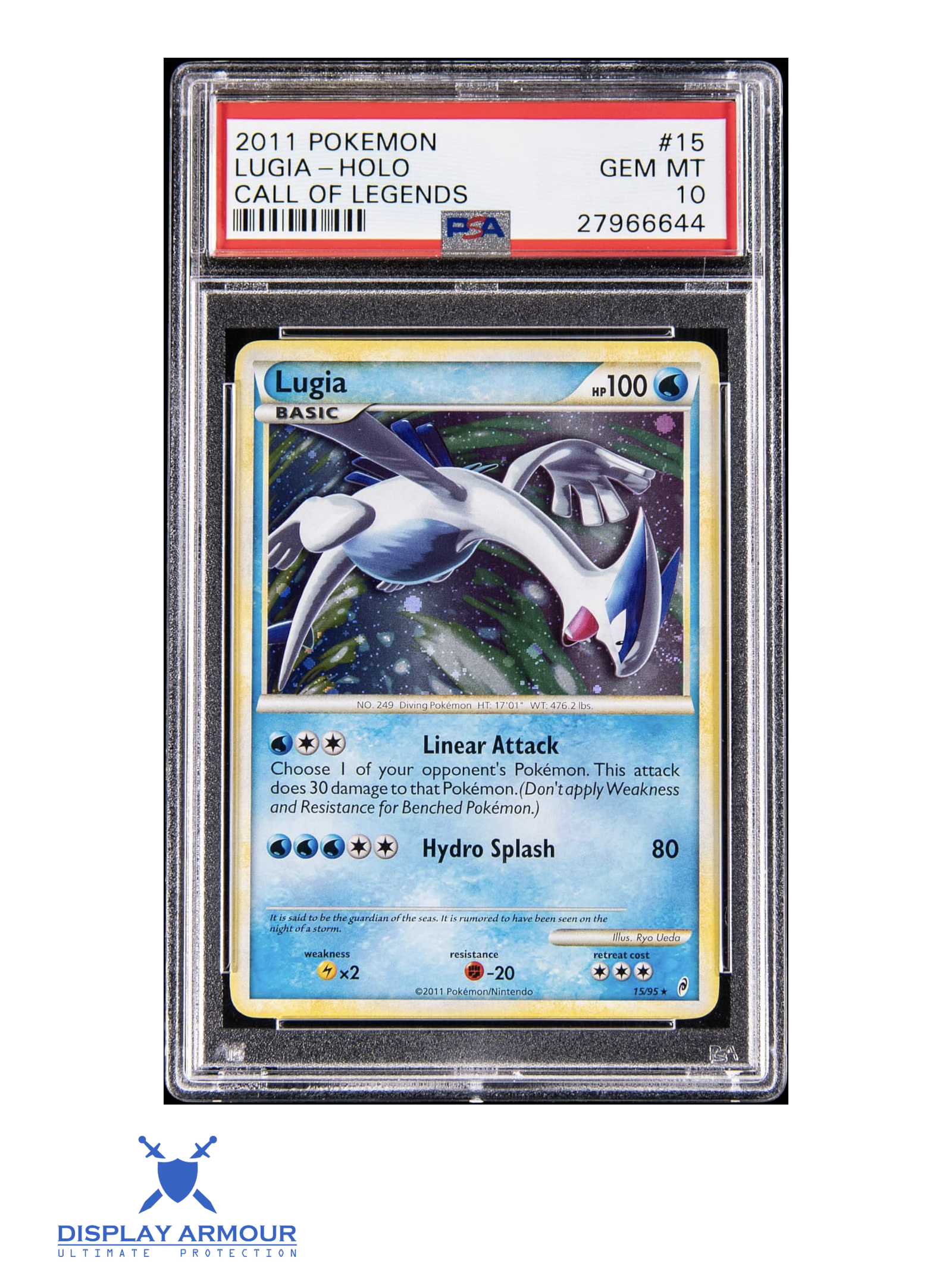
Call of Legends contains more than one collectible associated with Lugia. The card here is the regular holo numbered 15/95, rather than the separately numbered shiny SL7. Its pale artwork and foil still demand careful surface inspection, but the checklist identity must come before any condition comparison.
$367,220 (approx. £278,200) is the documented PSA GEM MT 10 benchmark reported by Goldin on 10 September 2026. The PSA 10 result belongs to the regular holo; transferring it to SL7 or a reverse-holo copy would mix distinct variants. Primary sale evidence — Goldin.
35. Blastoise Commissioned Presentation Star — 1998 WOTC Prototype

This Blastoise is a presentation prototype associated with Wizards of the Coast’s work on an English-language Pokémon card concept. It was not a retail release and carries design differences that mark it as development material. A CGC 8.5 example sold for $360,000 (approx. £272,700). Prototypes demand particularly careful authentication because production purpose, printing characteristics and provenance determine whether an object is historically significant or merely resembles one.
$360,000 (approx. £272,700) is the documented CGC 8.5 benchmark reported by Heritage on 14 January 2021. Primary sale evidence — Heritage.
36. Silver Trophy Pikachu No. 2 Trainer — First Tournament — 1997 First Tournament trophy
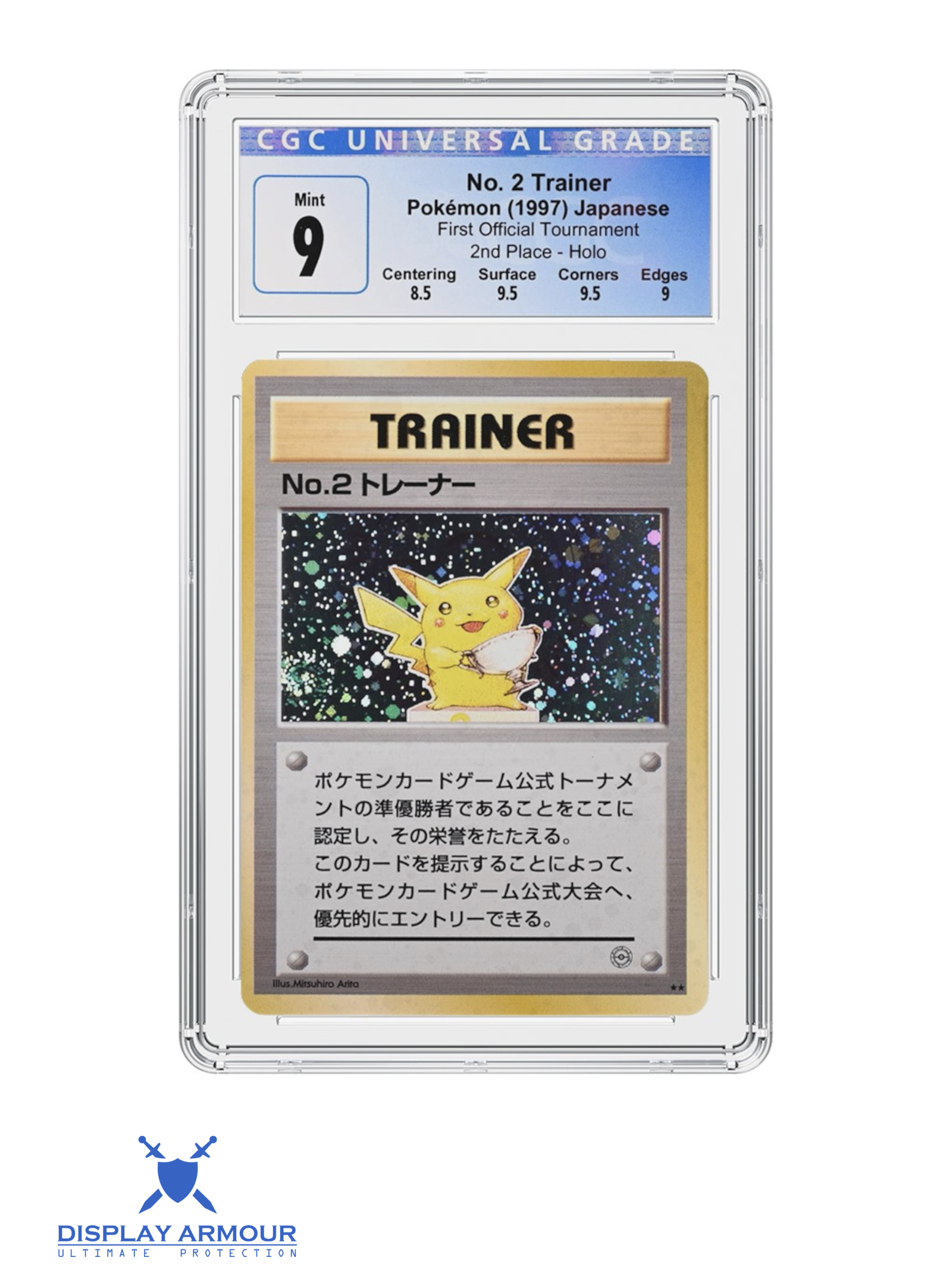
This silver No. 2 Trainer represents the first tournament, giving it a different event origin from the 1998 second-tournament silver card. Pikachu’s trophy links the artwork to competitive achievement. A collector completing the earliest prize series is buying that history, not simply another card featuring the mascot.
$359,900 (approx. £272,600) is the documented PSA NM-MT 8 benchmark reported by Goldin on 8 March 2026. This is the PSA 8 first-tournament benchmark, not the PSA 10 second-tournament silver result. Primary sale evidence — Goldin.
37. Mewtwo LV.X — Legends Awakened — 2008 Legends Awakened — 144/146
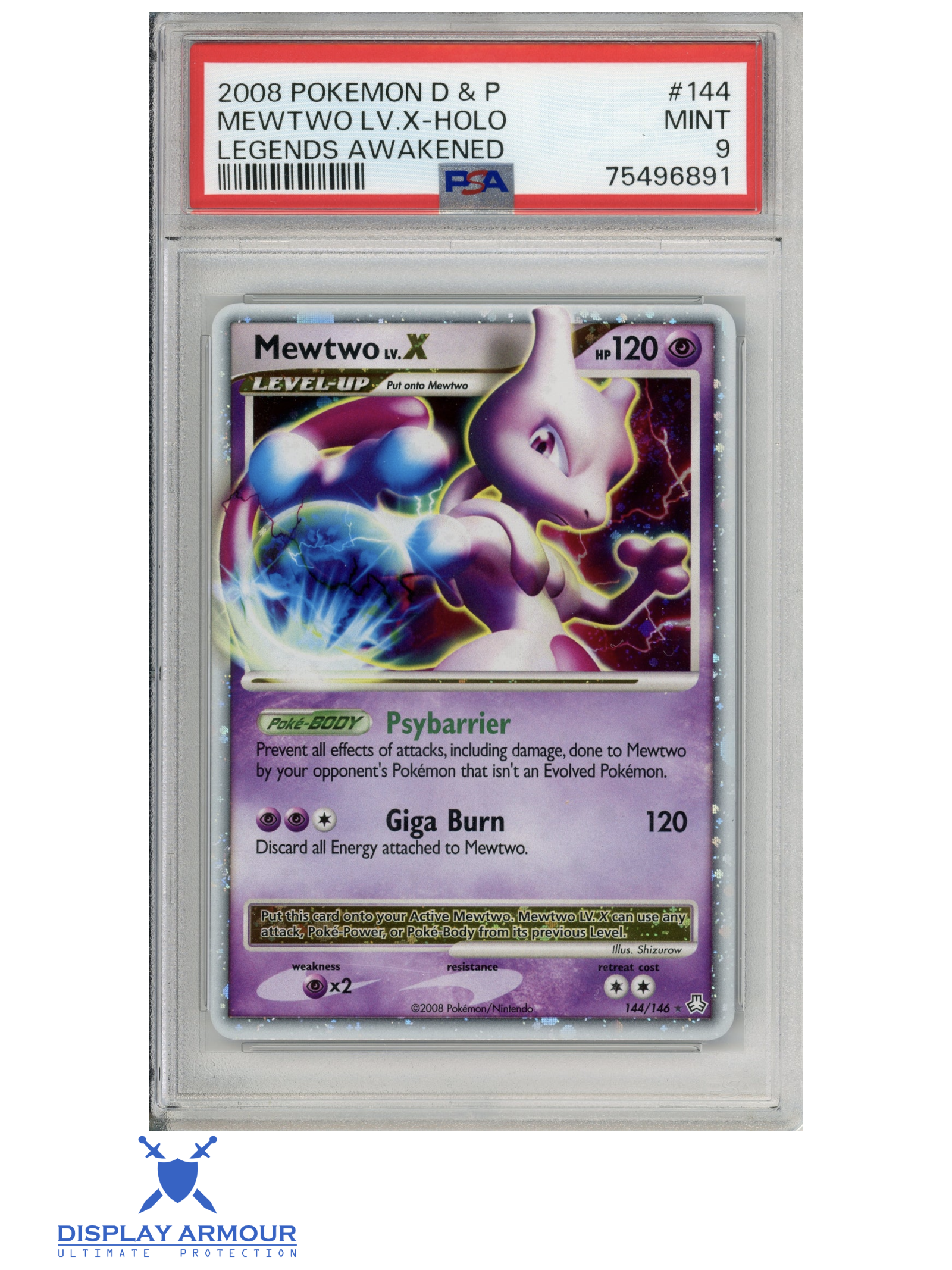
Mewtwo LV.X brings the character into Legends Awakened’s level-up collecting group. Its foil framing and Diamond & Pearl mechanics make it a separate issue from Shining and Gold Star Mewtwo. The expansion number matters because promotional Mewtwo cards can carry the same LV.X label with another distribution story.
$264,000 (approx. £200,000) is the documented PSA 10 benchmark reported by Fanatics Collect on 21 September 2026. The cited platform sales-history row, rather than the listing’s current guide value, records this completed PSA 10 sale. Primary sale evidence — Fanatics Collect.
38. Espeon Gold Star — Japanese PLAY Promo — 2005 Japanese PLAY Promo — 025/PLAY
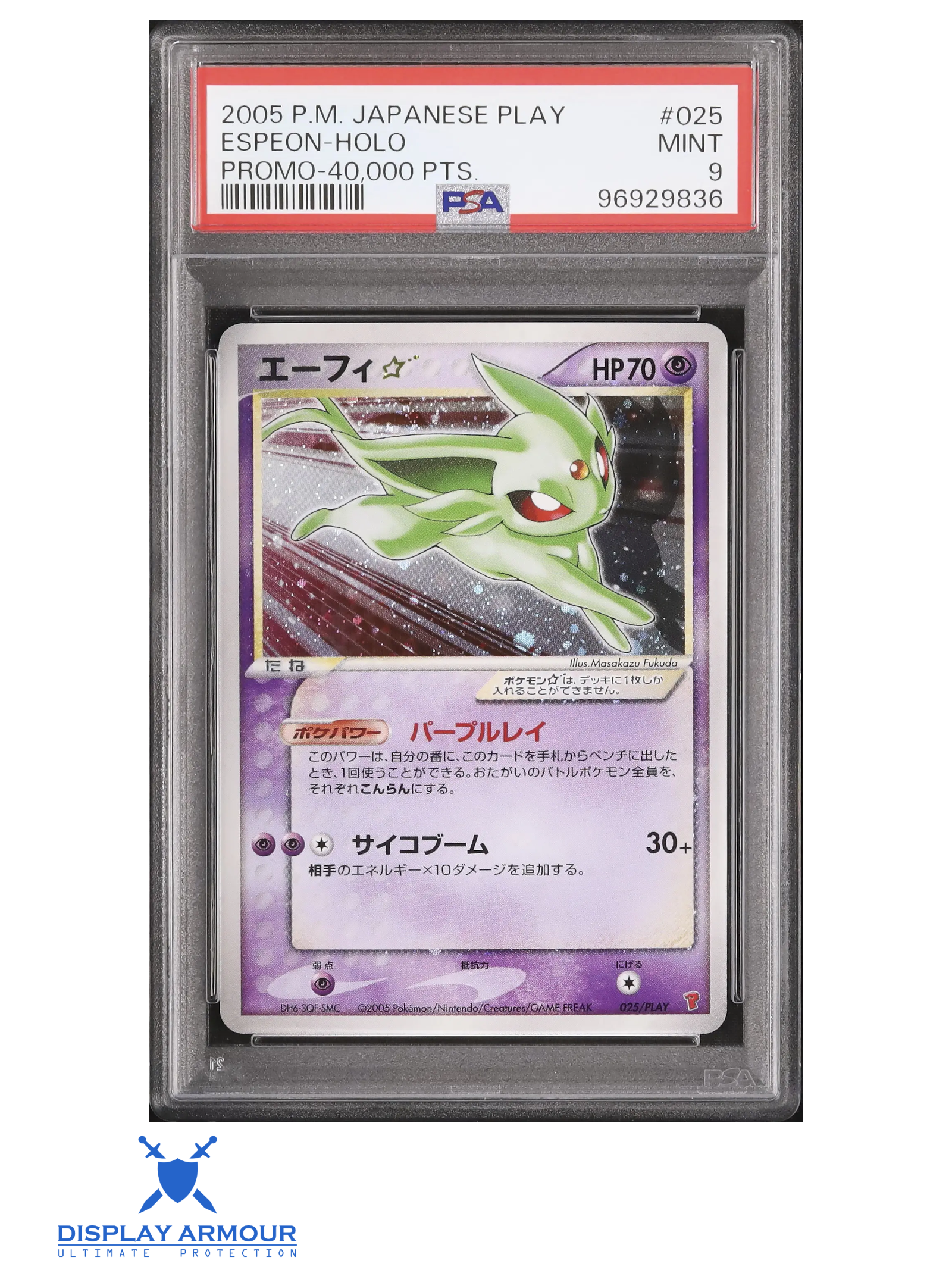
The Japanese Espeon Gold Star was a 50,000-point Pokémon Players Club reward. Its acquisition route separates it from the English POP Series 5 card, despite their shared shiny artwork. The promo number and Japanese printing anchor a comparison before condition and the broader Eeveelution collecting theme enter the discussion.
$262,500 (approx. £198,900) is the documented PSA 9 benchmark reported by Heritage on 18 September 2026. The PSA 9 reward-copy sale is separate from the English POP PSA 10 benchmark. A lower numerical grade can command more when distribution differs. Primary sale evidence — Heritage.
39. Mewtwo Gold Star — 2006 EX Holon Phantoms
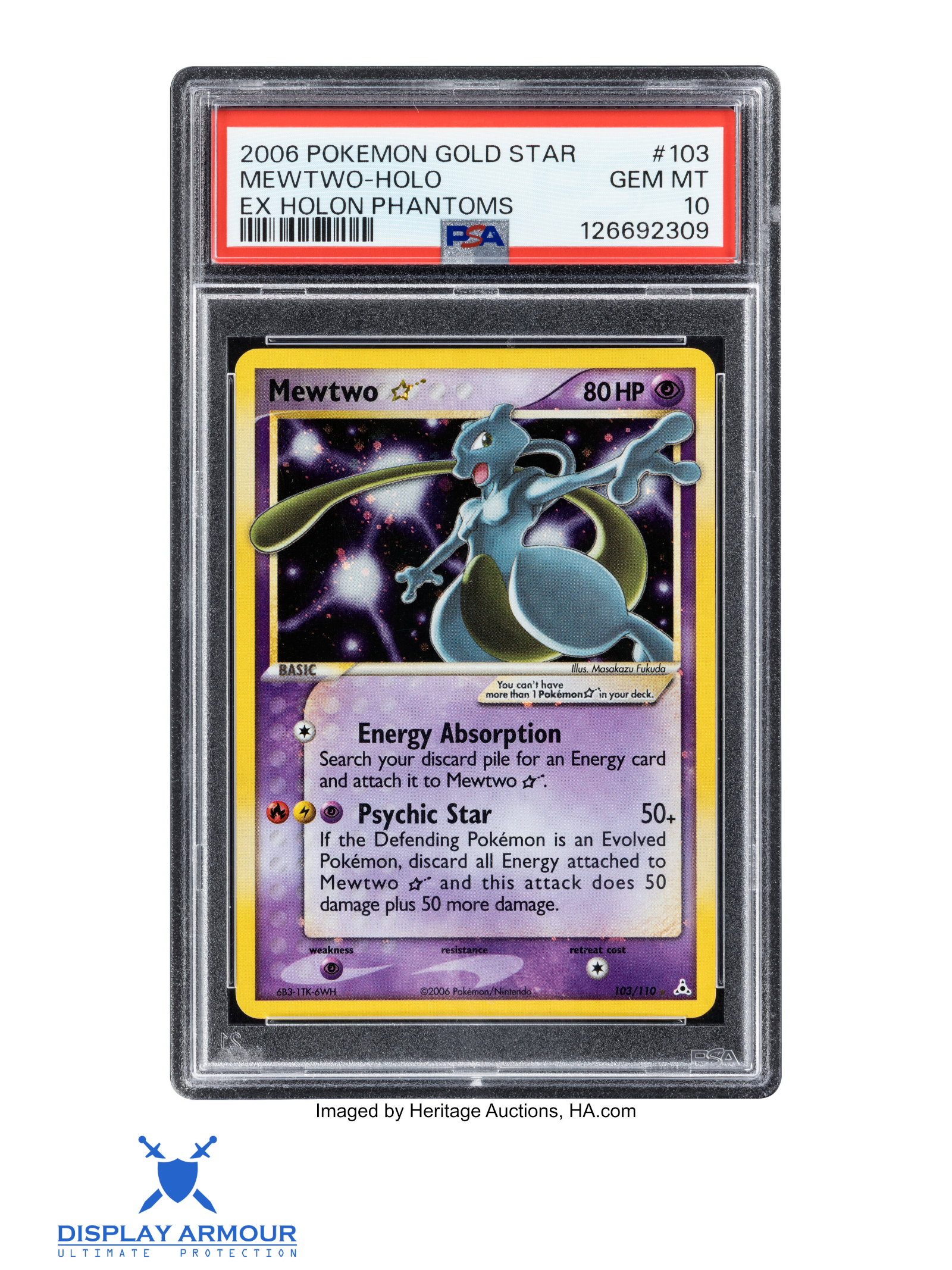
Mewtwo Gold Star 103/110 brings a major first-generation character into the EX-era shiny subset. Secret-rare numbering, a dramatic frame-breaking pose and Gem Mint scarcity support the $262,500 (approx. £198,900) documented high-grade benchmark. Check holo scratches and the reverse edges carefully, as heavily handled EX-era cards can look cleaner in photographs than in hand.
$262,500 (approx. £198,900) is the documented PSA 10 benchmark reported by Heritage on 18 September 2026. Primary sale evidence — Heritage.
40. Snorlax LV.X — Rising Rivals — 2009 Rising Rivals — 111/111
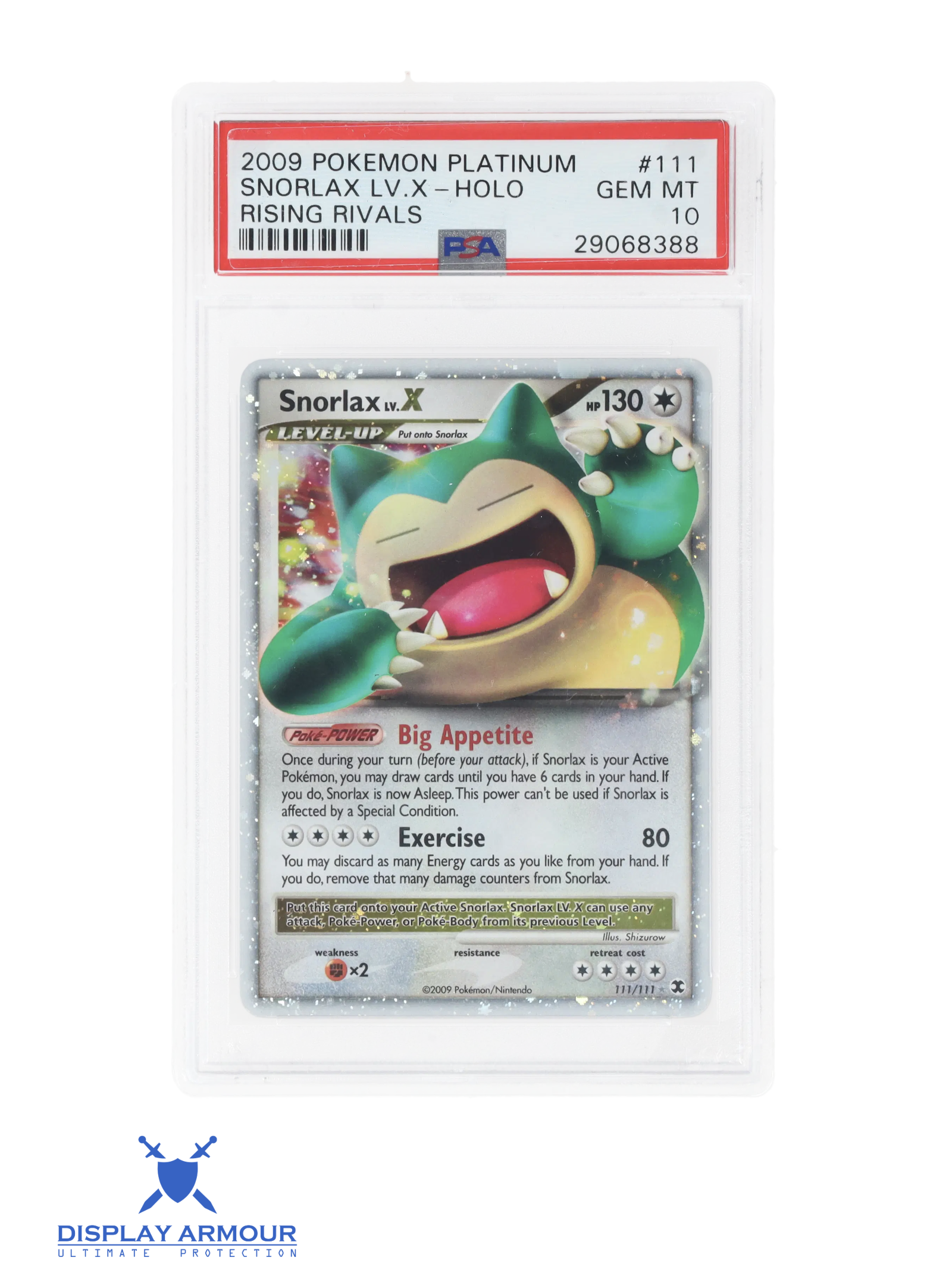
Snorlax LV.X is the level-up card at the end of Rising Rivals’ regular checklist. Its broad foil treatment and pale framing create condition surfaces that deserve more attention than a small front photograph permits. The LV.X designation separates it from earlier Snorlax holos and Rocket’s Snorlax ex.
$253,680 (approx. £192,200) is the documented PSA 10 benchmark reported by Alt on 10 September 2026. The PSA 10 expansion card supplies this benchmark, not a different Snorlax mechanic or promotional printing. Primary sale evidence — Alt.
41. Ishihara GX — Signed Promo — 2017 Promo
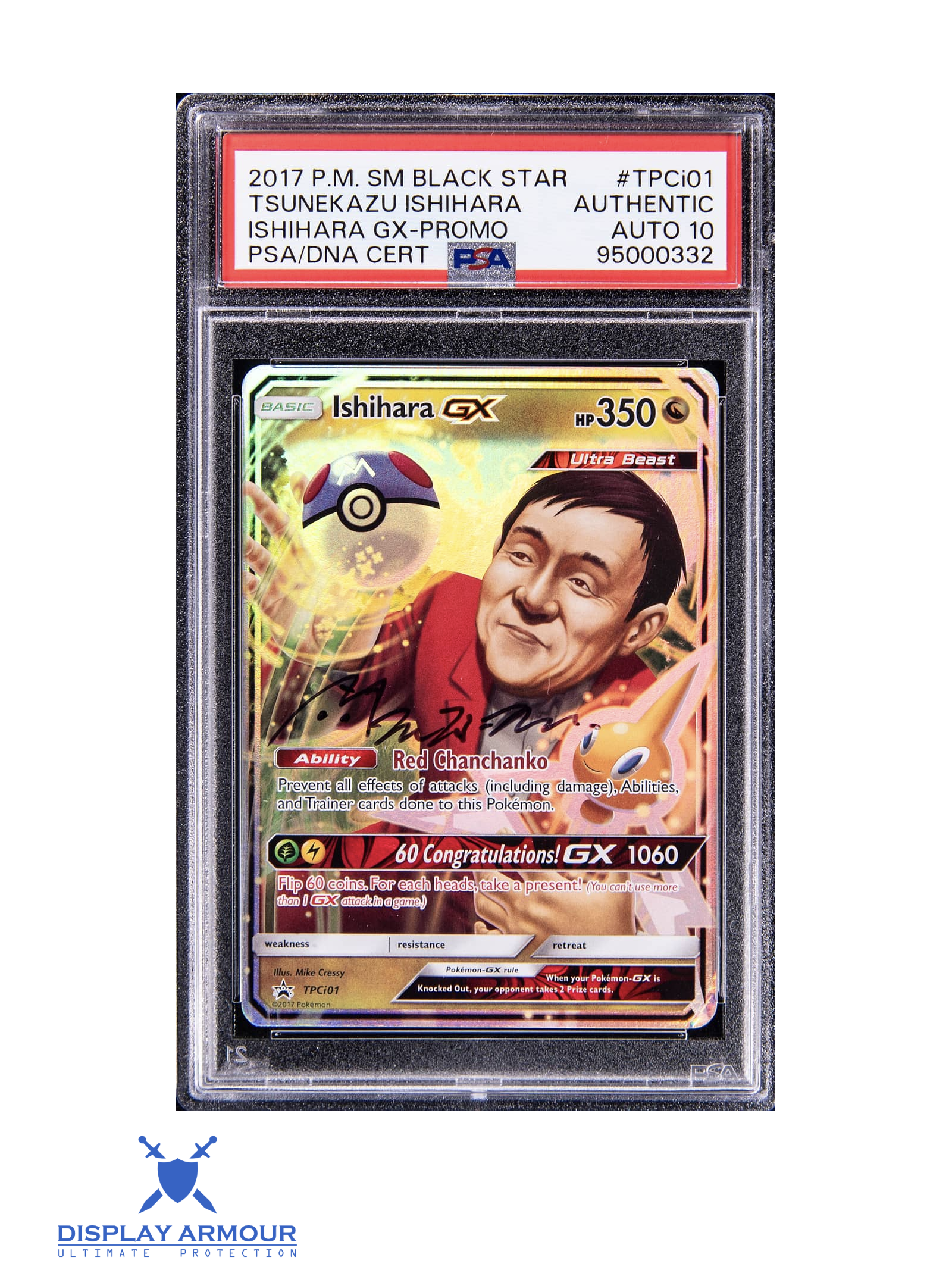
Ishihara GX features The Pokémon Company president Tsunekazu Ishihara and was created for his 60th-birthday celebration rather than public retail distribution. Signed examples occupy a different market from unsigned copies because signature authenticity and provenance become part of the object. The $247,230 (approx. £187,300) result relates to a signed graded example; collectors should never transfer that benchmark directly to an unsigned card.
$247,230 (approx. £187,300) is the documented PSA 7; authenticated Ishihara autograph benchmark reported by Goldin / PSA auction report (April 2021). Primary sale evidence — Goldin / PSA auction report.
42. Chansey Holo — Base Set First Edition — 1999 Base Set — 3/102
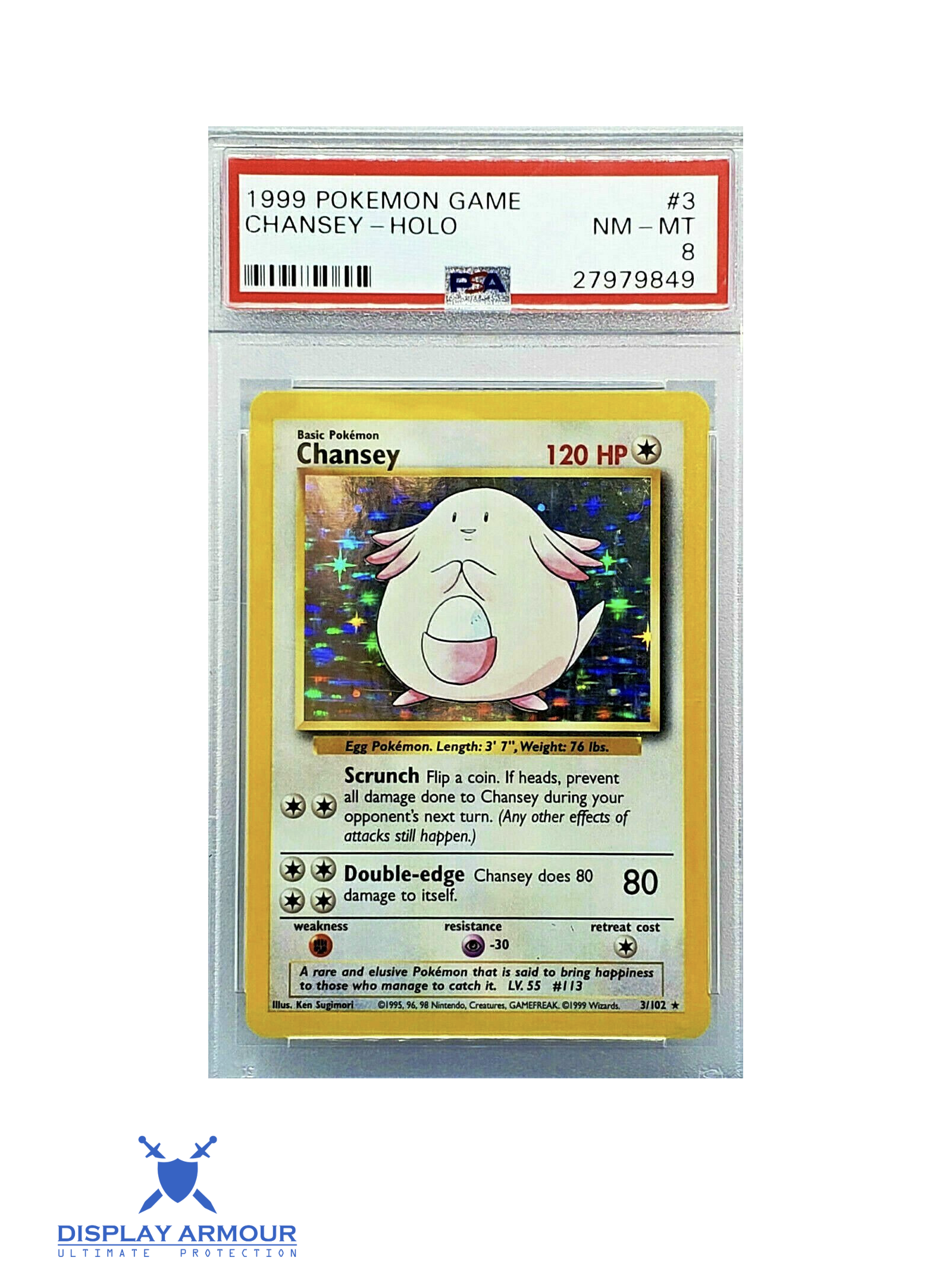
First Edition Chansey belongs to the original English Base Set holo group. Its pale foil field makes surface inspection particularly useful, while the stamp and shadowless frame establish the printing. It is entirely separate from the photographed Snap Chansey contest prize, despite sharing the Pokémon’s name.
$238,597 (approx. £180,700) is the documented PSA 10 benchmark reported by Alt on 10 September 2026. The cited Alt recent-transactions row records this PSA 10 auction. It is not the page’s modelled value or its live fixed-price listing. Primary sale evidence — Alt.
43. Mew ex Special Illustration Rare — Paldean Fates — 2024 Paldean Fates — 232/091
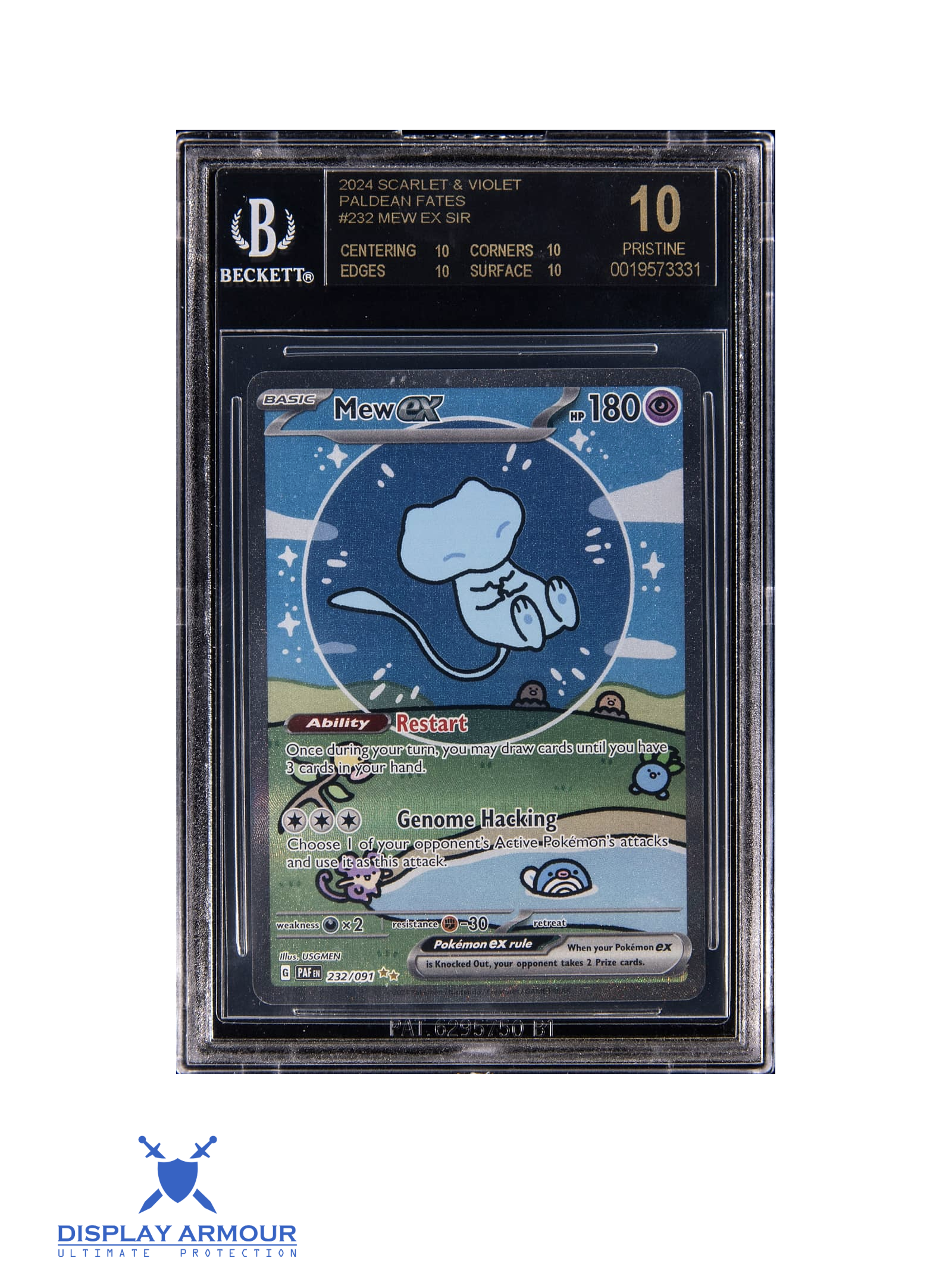
Paldean Fates gives Mew a playful full-card scene, rather than treating the mythical Pokémon as a small figure inside a conventional artwork window. It is a modern retail chase, with a very different distribution story from the trophy cards around it. Its exact English printing and textured surface are central to identification.
$236,543 (approx. £179,200) is the documented BGS PRISTINE/Black Label 10 benchmark reported by Goldin on 18 May 2026. The extreme price attaches to BGS Black Label condition, rather than to an ordinary copy pulled from a pack. Primary sale evidence — Goldin.
44. Japanese Base Set Blastoise — No Rarity — 1996 Base Set
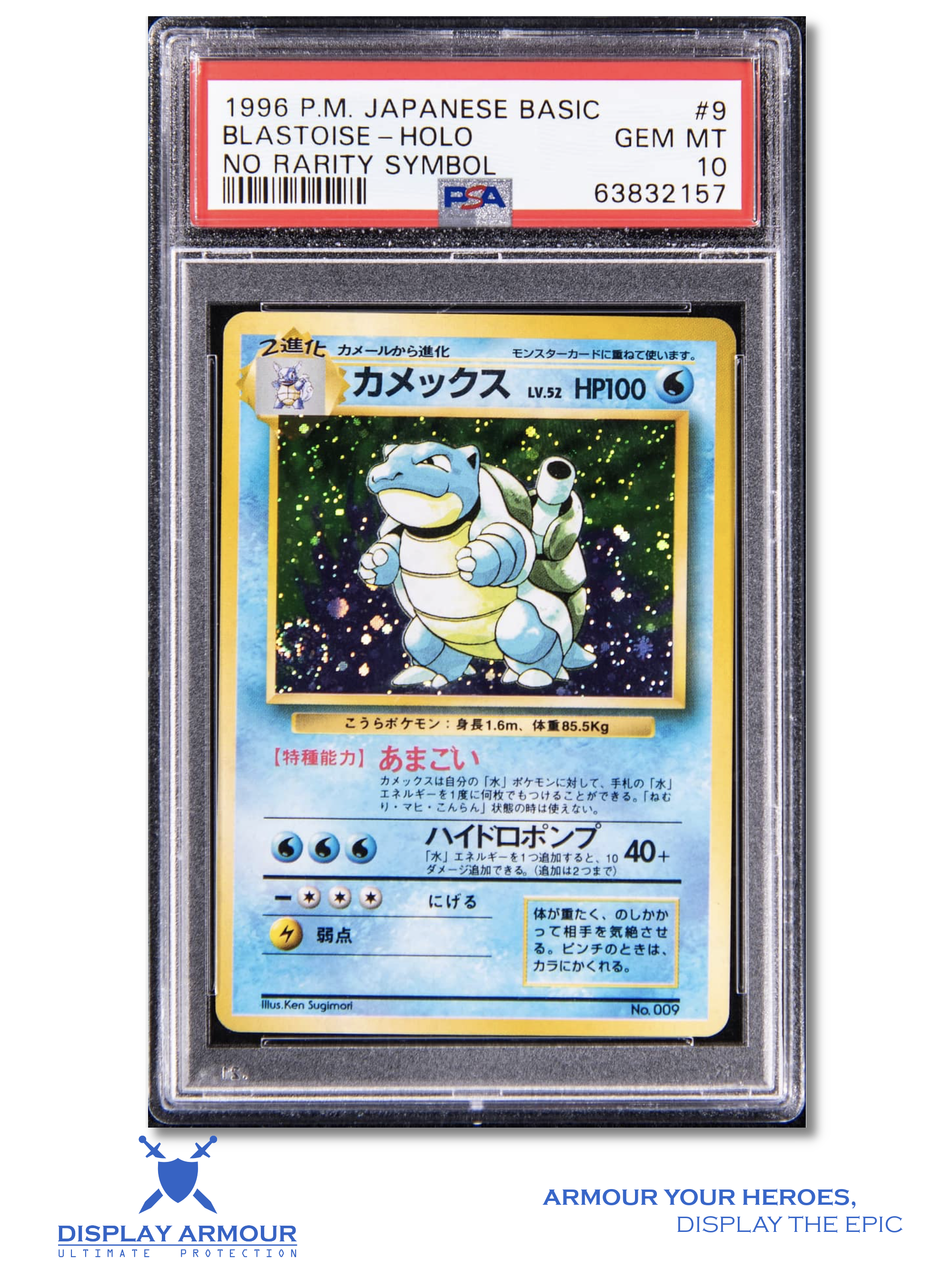
The no-rarity Blastoise represents the earliest Japanese Base Set printing, without the rarity star later seen in the lower-right corner. It combines a first-print identifier with a Kanto starter evolution and classic Ken Sugimori artwork. At $231,800 (approx. £175,600) in PSA 10, the benchmark is specifically for the scarce no-rarity variant in Gem Mint condition—not a standard Japanese Base Set Blastoise.
$231,800 (approx. £175,600) is the documented PSA 10 benchmark reported by Goldin on 7 December 2025. Primary sale evidence — Goldin.
45. Pokémon Snap Articuno — 1999 64 Mario Stadium Promo
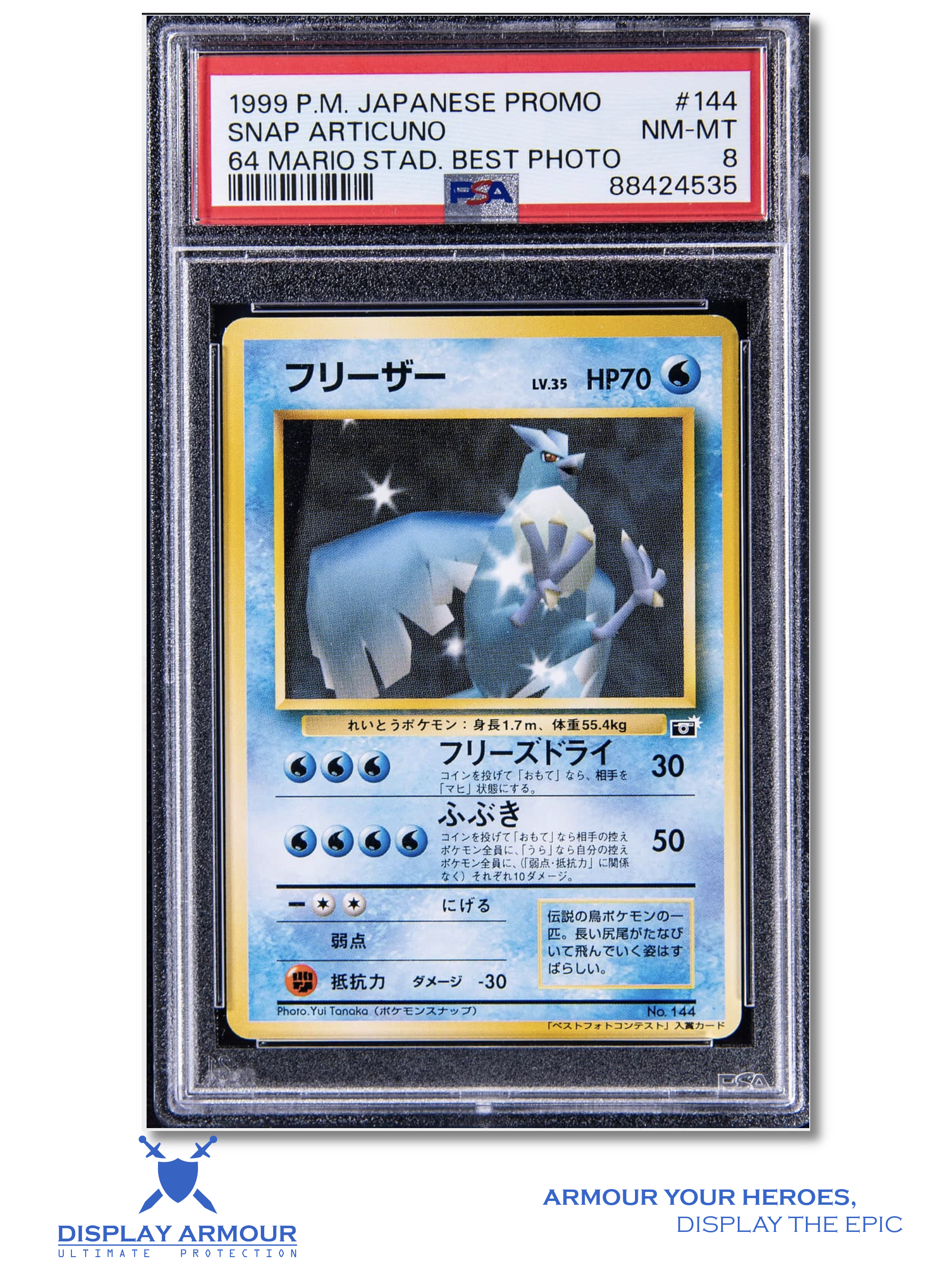
Snap Articuno turns a winning Nintendo 64 photograph into an official card, linking the legendary bird to one of Pokémon’s most creative early promotions. It was awarded rather than pulled, so the $231,800 (approx. £175,600) result reflects an authenticated contest copy with its own provenance. As with every Snap issue, exact subject and contest route matter; a general “Snap promo” comparison is not precise enough.
$231,800 (approx. £175,600) is the documented PSA 7 benchmark reported by Goldin on 10 August 2026. Primary sale evidence — Goldin.
46. Super Secret Battle No. 1 Trainer — 1999 Trophy Promo
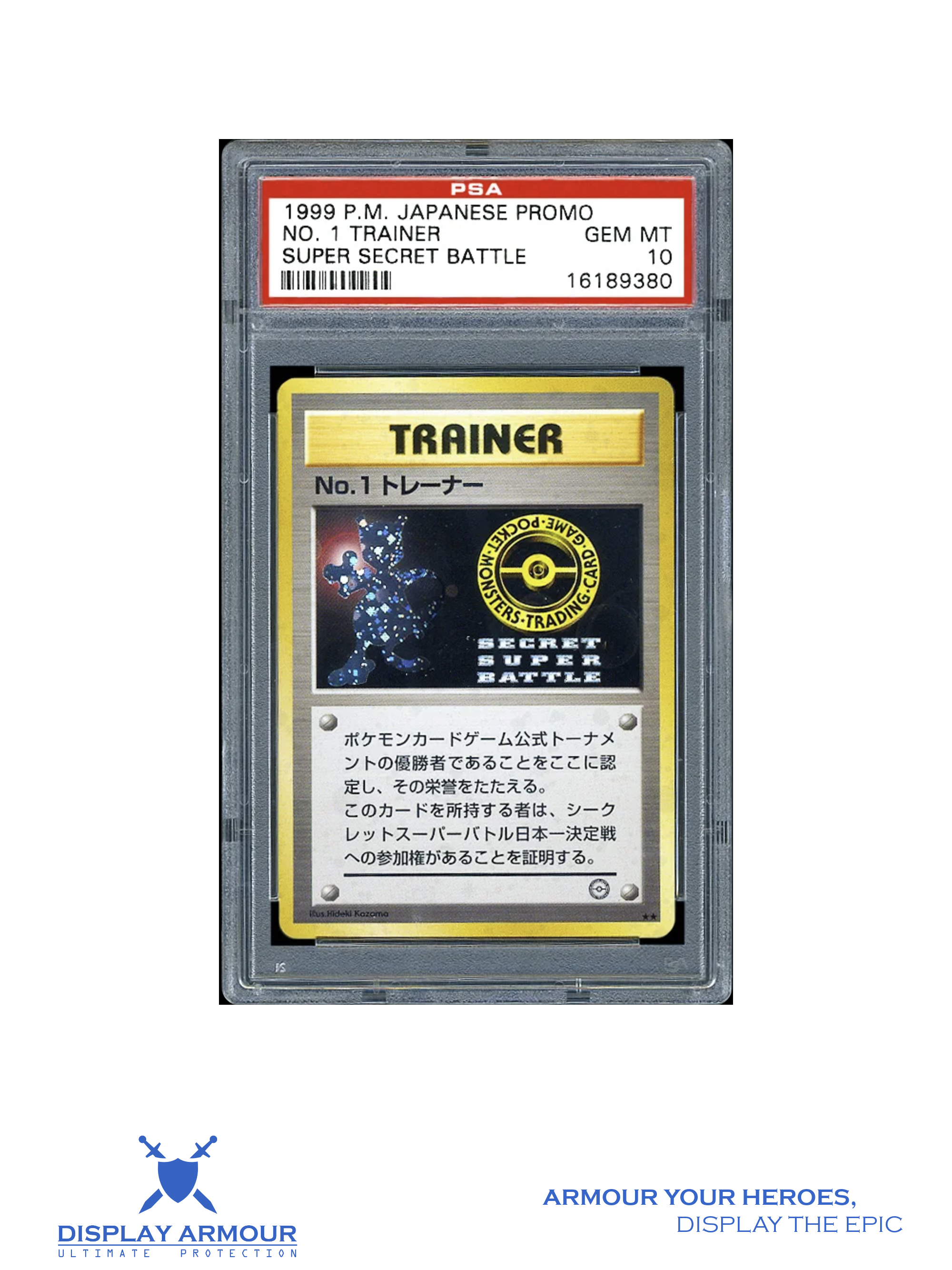
The Super Secret Battle No. 1 Trainer functioned as an invitation and trophy connected to Japan’s 1999 finals. Its Mewtwo imagery and mysterious event language give it one of the strongest narratives among early Trainer prizes. The $231,800 (approx. £175,600) PSA 8 benchmark reflects the exact event issue; other No. 1 Trainer cards are separate releases and require separate histories.
$231,800 (approx. £175,600) is the documented PSA 8 benchmark reported by Goldin on 9 March 2026. Primary sale evidence — Goldin.
47. Blastoise Gold Border Test Print — 1998 Test Print
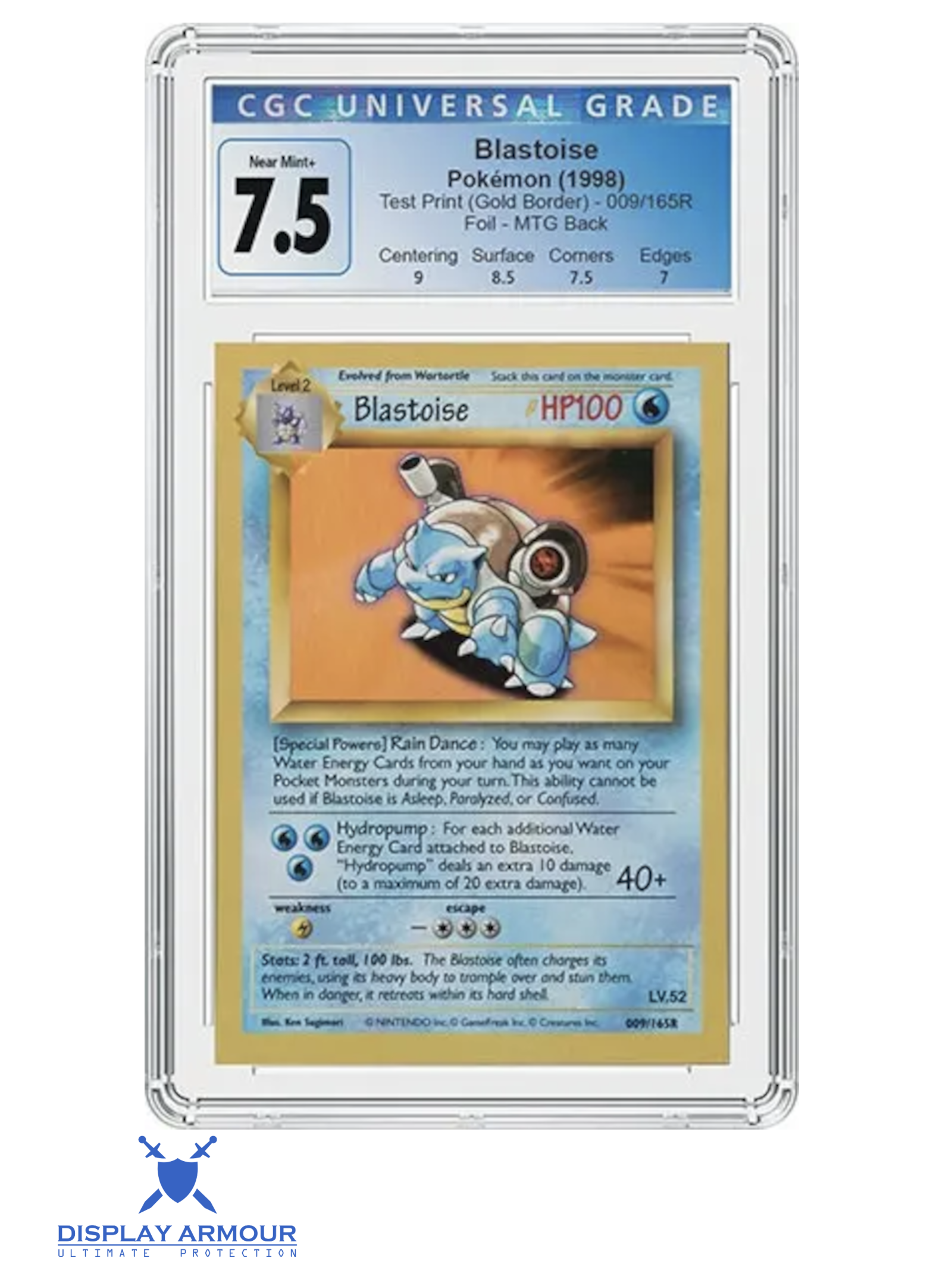
The gold-border Blastoise is development material rather than a normal Pokémon release. Its layout and border treatment document experimentation around the English TCG’s presentation. The $216,000 (approx. £163,600) benchmark applies to a CGC-authenticated example. It must not be merged with the commissioned Blastoise presentation card described separately in this guide: they are separately identified prototypes with different physical features and sale histories.
$216,000 (approx. £163,600) is the documented CGC 6.5 benchmark reported by Heritage (July 2021). Primary sale evidence — Heritage.
48. Luigi Pikachu Full Art — 2016 296/XY-P Promo
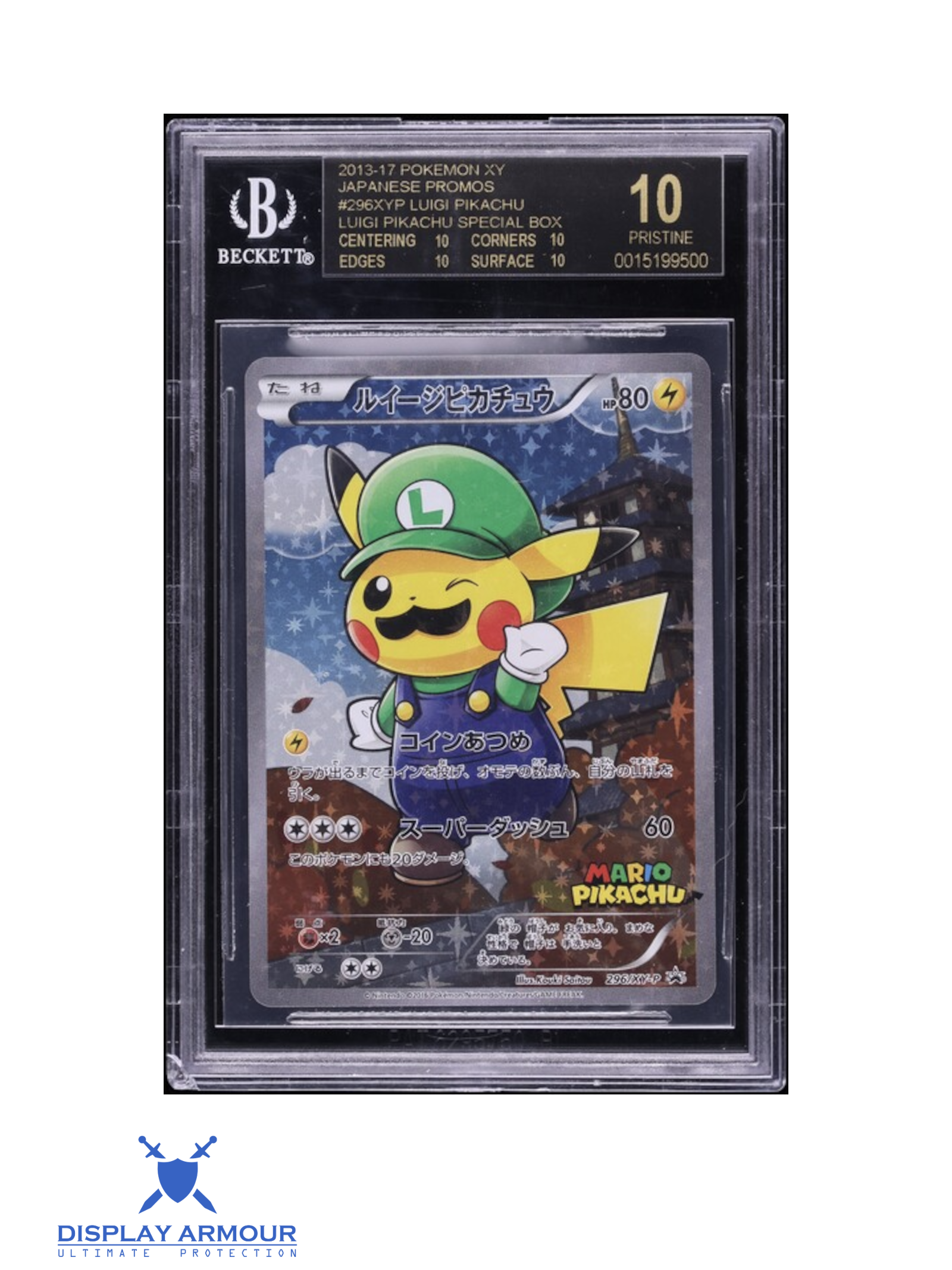
Luigi Pikachu 296/XY-P is part of the celebrated Pokémon and Mario crossover released in Japan. Pikachu wears Luigi’s costume in a full-art treatment that appeals across two major Nintendo collecting communities. Sealed promotional origins, vivid surfaces and strong character recognition support the $216,000 (approx. £163,600) BGS 10 Black Label benchmark. Confirm the card number because the campaign included multiple artworks and formats.
$216,000 (approx. £163,600) is the documented BGS 10 Black Label benchmark reported by Fanatics Collect on 24 November 2025. Primary sale evidence — Fanatics Collect.
49. Gengar — Masaki Evolution Campaign — 1999 Japanese Masaki promo — 094
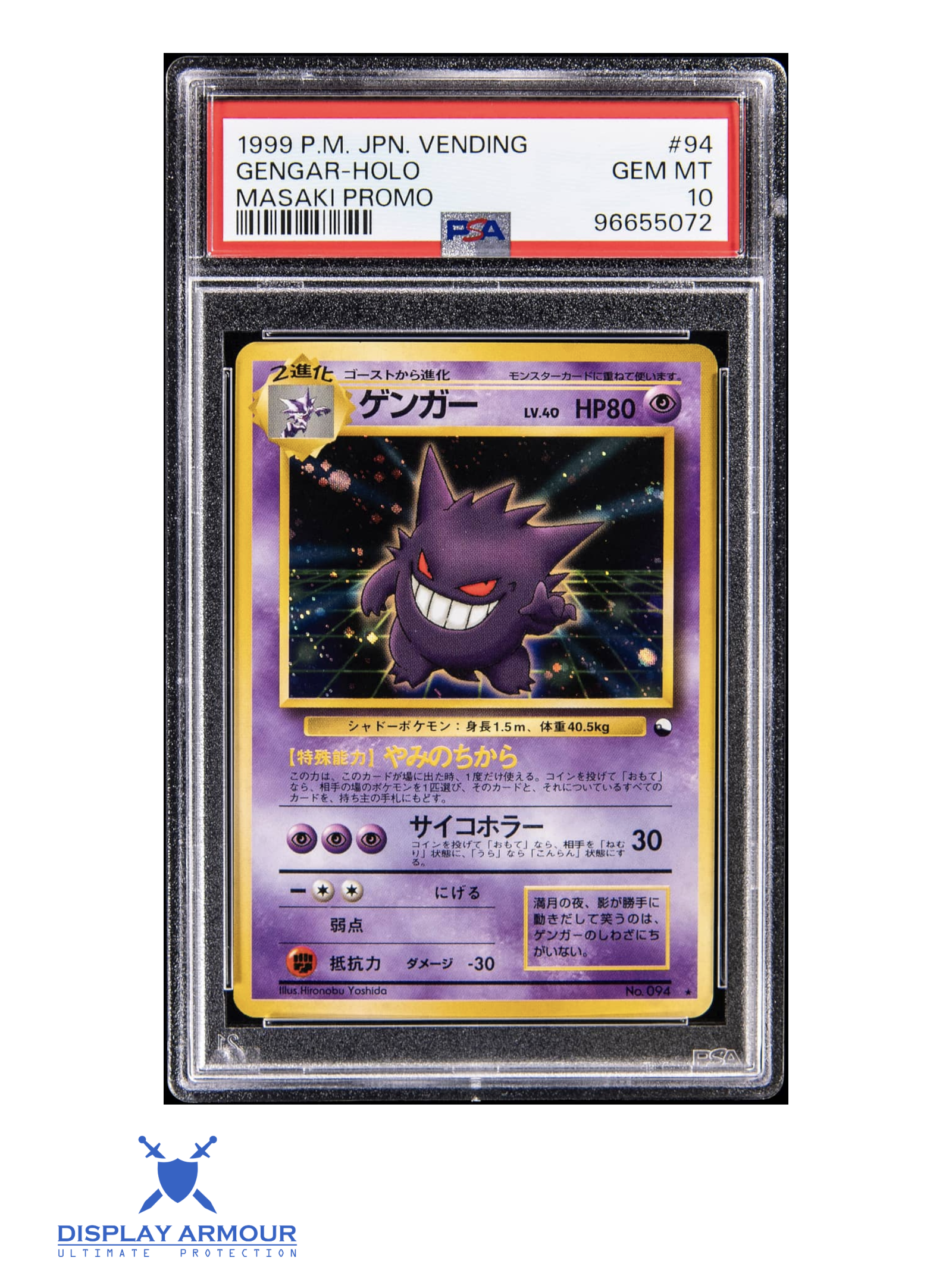
Masaki Gengar came through Japan’s evolution-promotion programme rather than a normal expansion. Its distinctive artwork has made it a focal point of Japanese Gengar collecting. The campaign identity and numbered subject must be checked before comparing it with the many other vintage Gengar holos.
$207,400 (approx. £157,100) is the documented PSA 10 benchmark reported by Goldin on 10 August 2026. The PSA 10 promotional copy is the sold subject; packaging and surface condition should be examined separately on ungraded examples. Primary sale evidence — Goldin.
50. Psyduck Reverse Holo — Legendary Collection — 2002 Legendary Collection — 88/110
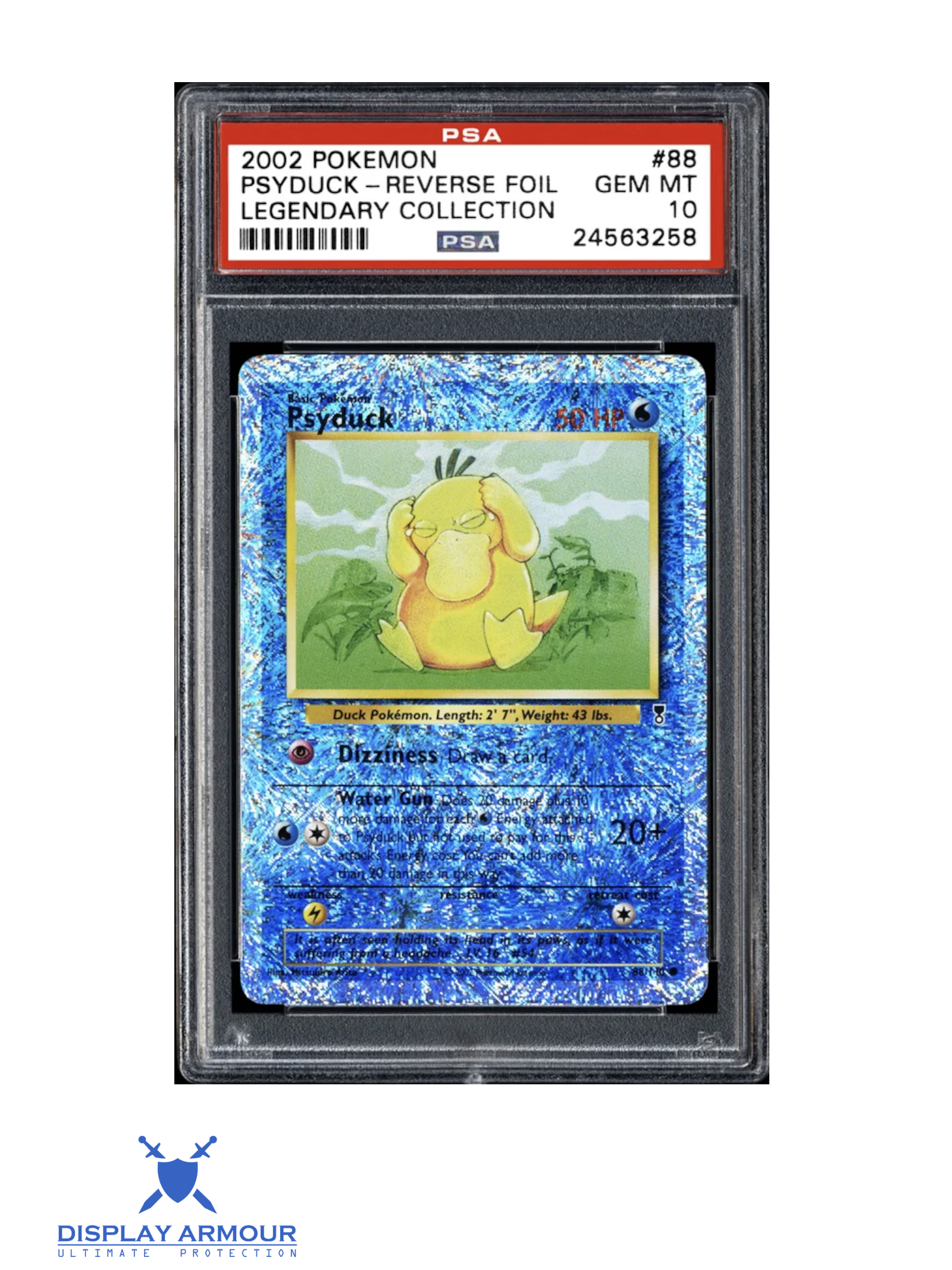
Legendary Collection Psyduck takes a familiar small Pokémon and surrounds it with the expansion’s firework reverse-holo finish. The extensive foil makes preservation part of the collecting challenge, even on a card without Charizard-level character demand. The correct reverse treatment must be visible across the face.
$200,000 (approx. £151,500) is the documented PSA 10 benchmark reported by Heritage on 18 September 2026. The PSA 10 reverse holo is the priced variant; a regular non-holo Psyduck is not comparable. Primary sale evidence — Heritage.
51. Blastoise Holo — Japanese Base Set (Rarity Symbol) — 1996 Japanese Base Set
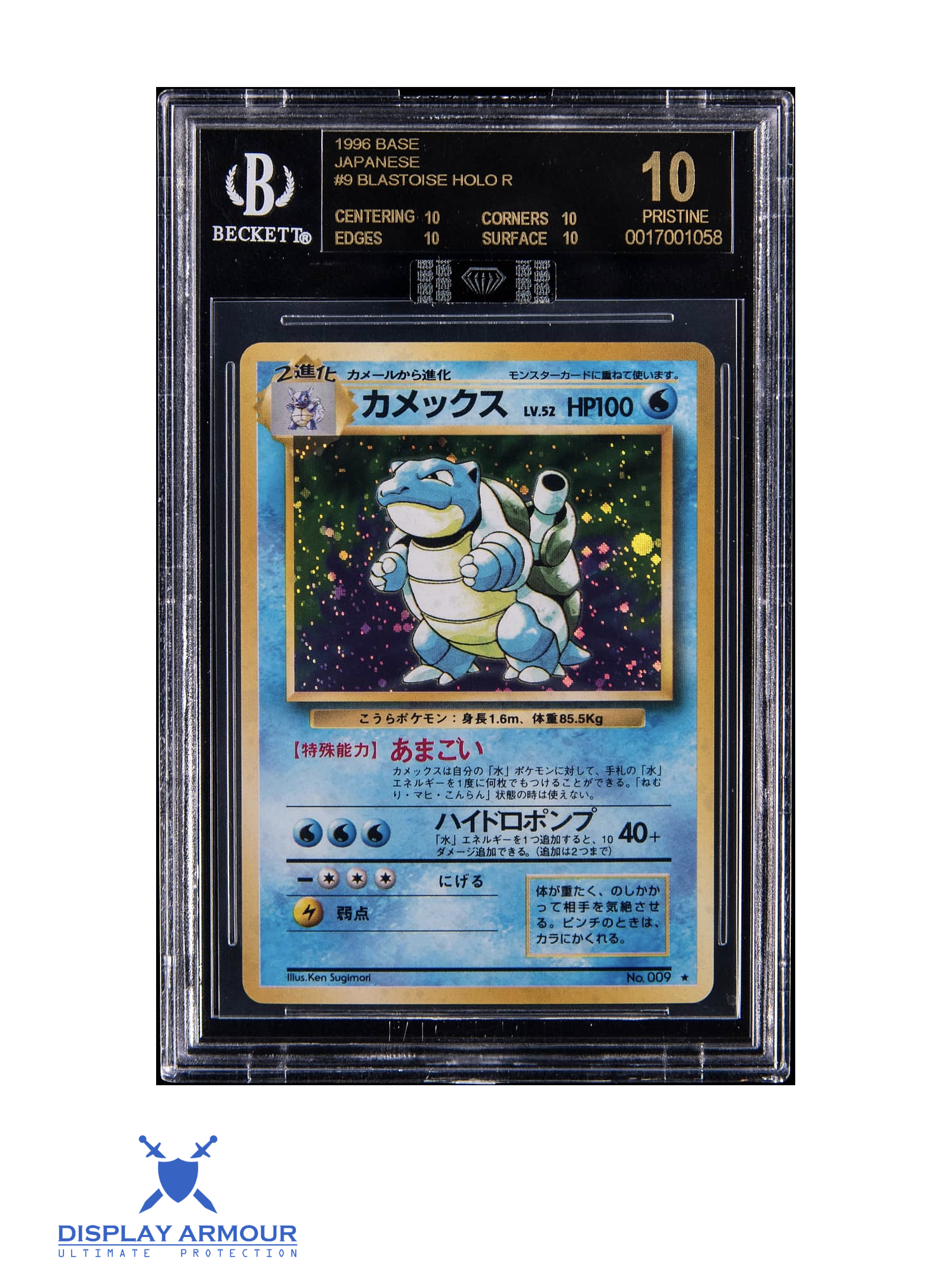
The standard Japanese Base Set Blastoise shares Ken Sugimori’s artwork with its no-rarity predecessor, but it carries the normal rarity symbol. Both are early releases; neither should inherit the other’s sale history. The extensive foil and dark reverse make surface and edge examination worthwhile even on an attractive front.
$197,640 (approx. £149,700) is the documented BGS PRISTINE/Black Label 10 - MBA Black Diamond Certified benchmark reported by Goldin on 10 August 2026. The BGS Black Label result is specific to an unusually strong graded copy of the rarity-symbol printing. Primary sale evidence — Goldin.
52. Mew Gold Star — 2006 EX Dragon Frontiers
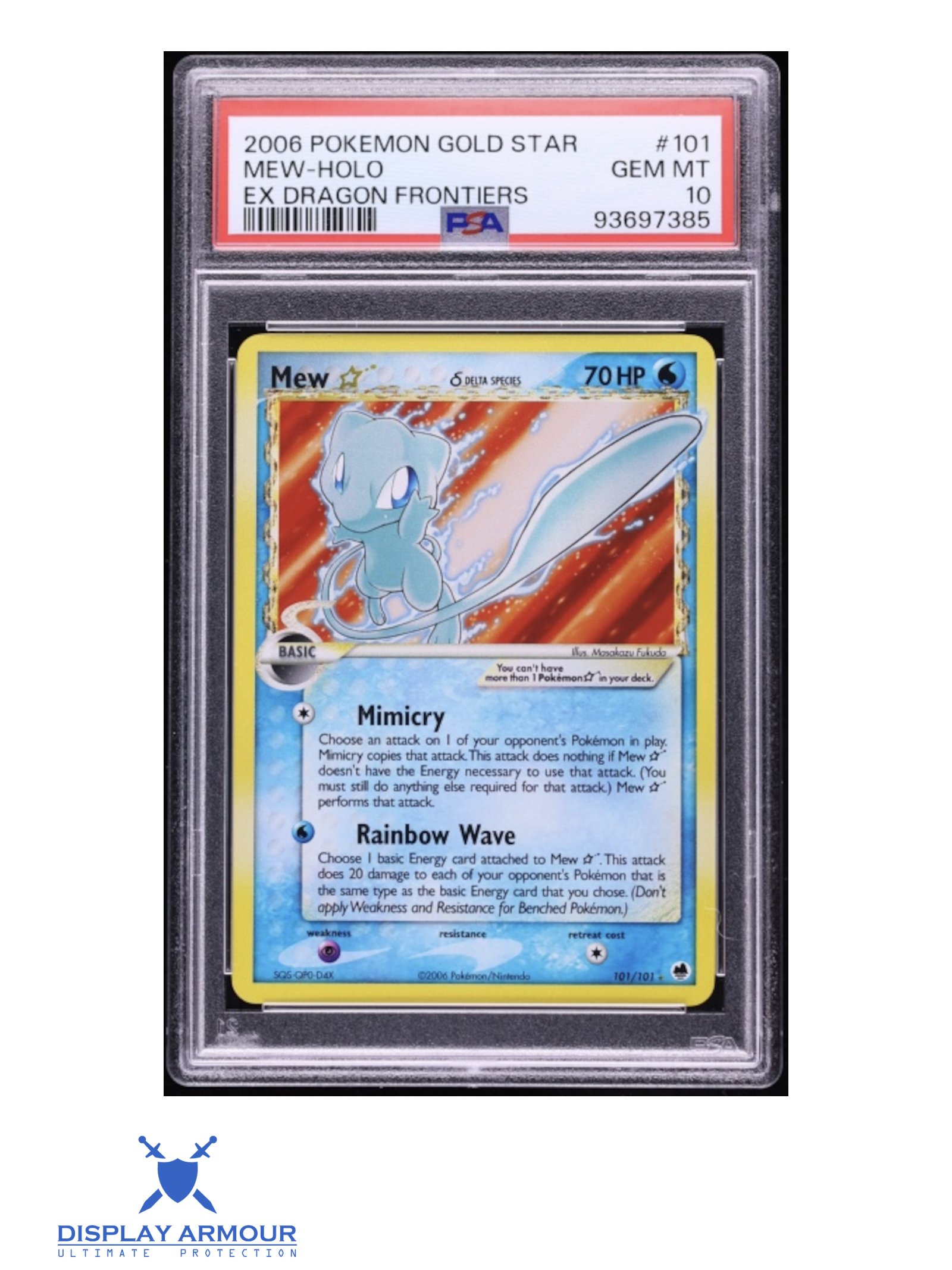
Mew Gold Star is the secret rare numbered 101/101 from EX Dragon Frontiers. Its shiny coloration, compact mythical subject and Masakazu Fukuda artwork extending beyond the frame make it one of the era’s most recognisable cards. The $192,000 (approx. £145,400) PSA 10 benchmark is driven by both Gold Star family demand and the challenge of preserving the holo and dark edges at Gem Mint level.
$192,000 (approx. £145,400) is the documented PSA 10 benchmark reported by Fanatics Collect on 6 July 2026. Primary sale evidence — Fanatics Collect.
53. Bronze Trophy Pikachu No. 3 Trainer — Second Tournament — 1998 Second Tournament trophy
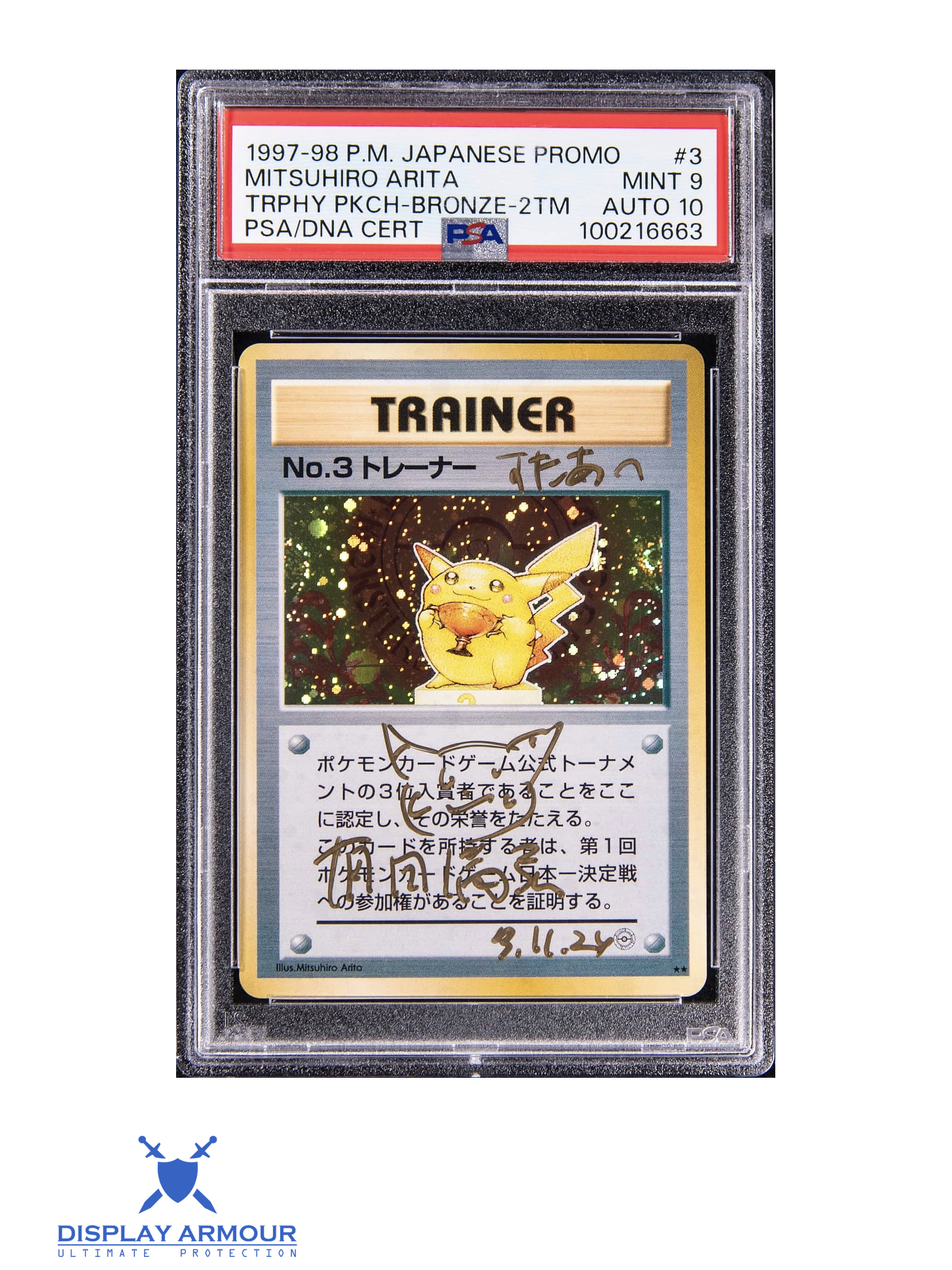
The second-tournament bronze Pikachu sits between the first- and third-tournament issues in competitive history. Its placing alone cannot identify it. The cited copy also carries Mitsuhiro Arita’s signature and sketch, making the realised price a combination of the underlying trophy and authenticated artist embellishment.
$189,100 (approx. £143,200) is the documented PSA MINT 9, PSA/DNA GEM MT 10 benchmark reported by Goldin on 9 March 2026. The card graded PSA 9 and the autograph PSA/DNA 10; the signature is a feature of this sold copy, not an extra ranked card. Primary sale evidence — Goldin.
54. Tamamushi University Magikarp — 1998 Promo
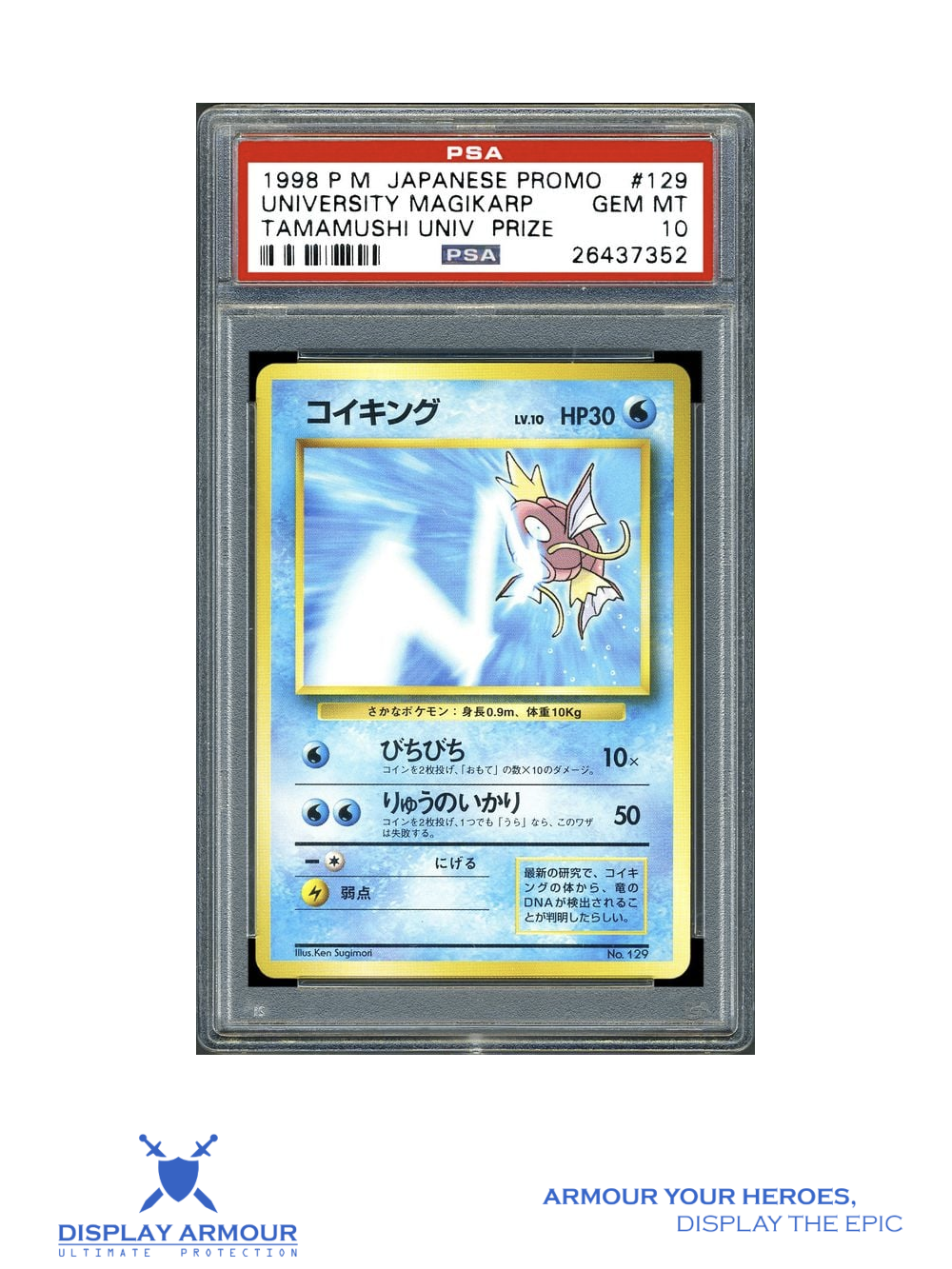
Illustration of this card; not verification of the cited sold copy or its grade.
Often called University Magikarp, this Japanese promo was connected to the Tamamushi University campaign and a test-based distribution route. That unusual academic theme, limited eligibility and Magikarp’s cult popularity give it a story unlike any booster card. The $186,000 (approx. £140,900) PSA 10 result applies to a top-grade prize copy; surface and edge condition remain decisive on surviving examples.
$186,000 (approx. £140,900) is the documented PSA 10 benchmark reported by Goldin on 16 February 2026. Primary sale evidence — Goldin.
55. Umbreon Gold Star — Japanese PLAY Promo — 2005 Japanese PLAY Promo
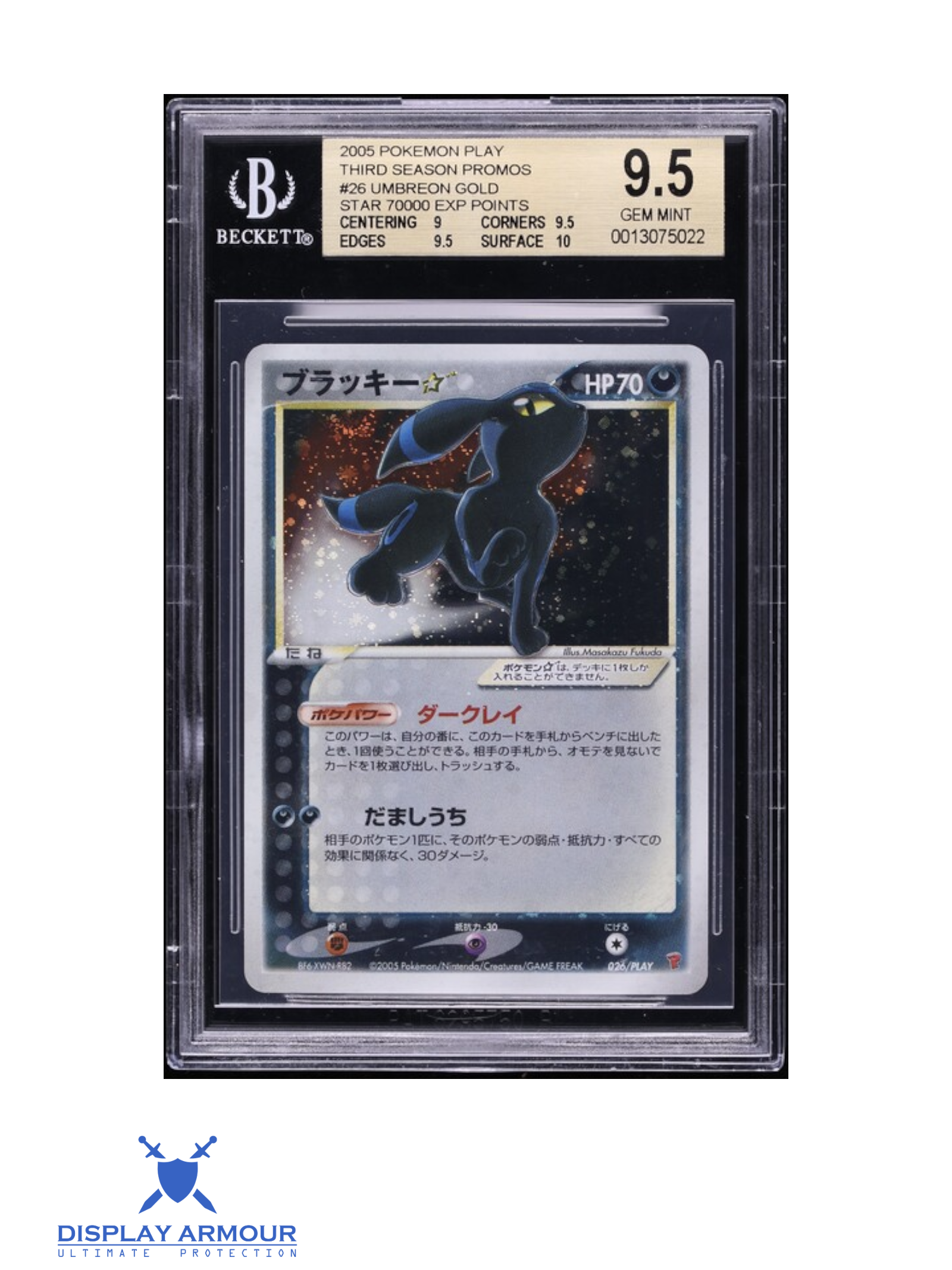
Illustration of this card; not verification of the cited sold copy or its grade.
The Japanese Umbreon Gold Star was earned through the Pokémon Players Club points programme, separating it from the English POP Series 5 version. Its demanding reward threshold, Eeveelution popularity and shiny artwork support the $180,000 (approx. £136,400) BGS 9.5 benchmark. Language and distribution are crucial: collectors must not treat PLAY Promo and POP Series 5 copies as the same card.
$180,000 (approx. £136,400) is the documented BGS 9.5 benchmark reported by Fanatics Collect on 17 November 2025. Primary sale evidence — Fanatics Collect.
56. Poncho-Wearing Pikachu — Mega Charizard X — 2016 Japanese promo — 207/XY-P
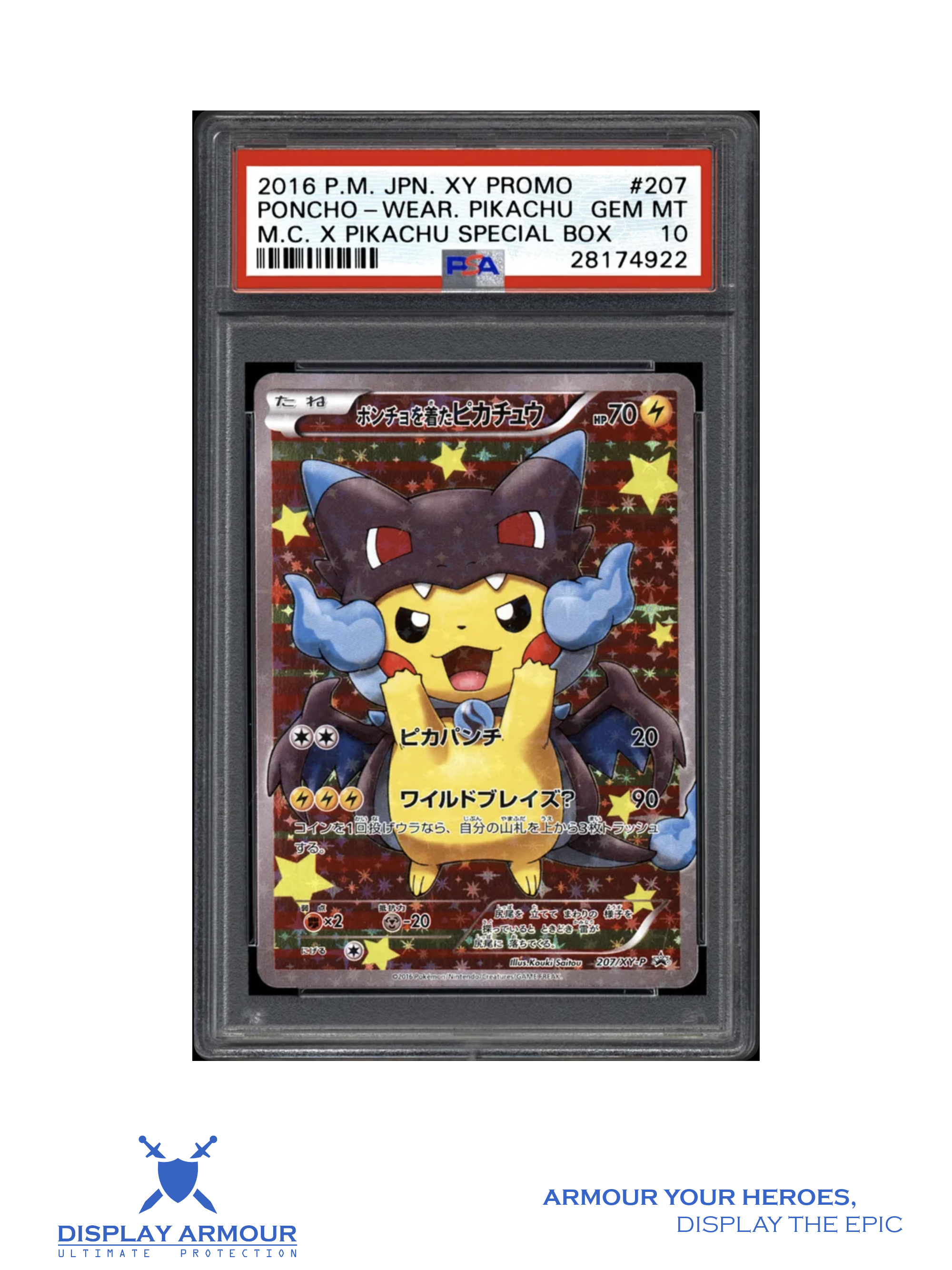
Illustration of this card; not verification of the cited sold copy or its grade.
Mega Charizard X Poncho-Wearing Pikachu pairs two of the franchise’s strongest characters in a Japanese promotional release. Sealed-box origins, vivid full-art surfaces and Pikachu crossover demand drive the $175,680 (approx. £133,100) documented high-grade benchmark used here. Confirm the exact X artwork and promo number, because the matching Mega Charizard Y card is a separate collectible.
$175,680 (approx. £133,100) is the documented BGS 10 Black Label benchmark reported by Goldin on 10 August 2026. Primary sale evidence — Goldin.
57. Umbreon Gold Star — POP Series 5 — 2007 POP Series 5
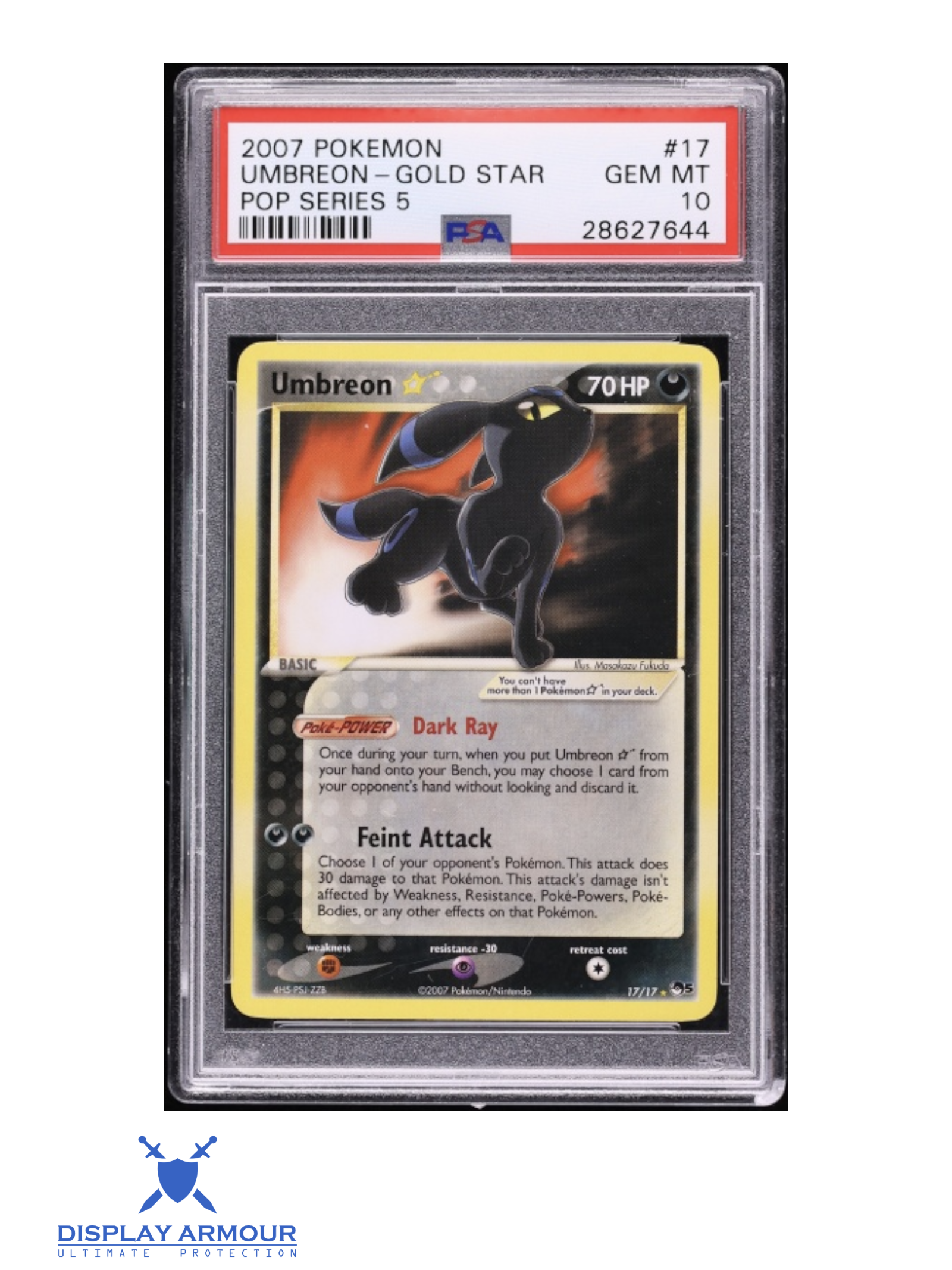
Illustration of this card; not verification of the cited sold copy or its grade.
POP Series 5 Umbreon Gold Star is the English 17/17 version distributed through organised-play promotional packs. Small packs, handling and a dark card design create condition challenges, while Umbreon attracts dedicated Eeveelution collectors. The $168,000 (approx. £127,300) PSA 10 benchmark is for the English POP card and remains distinct from the Japanese PLAY Promo described separately here.
$168,000 (approx. £127,300) is the documented PSA 10 benchmark reported by Fanatics Collect on 29 June 2026. Primary sale evidence — Fanatics Collect.
58. Lugia ex — EX Unseen Forces — 2005 EX Unseen Forces — 105/115
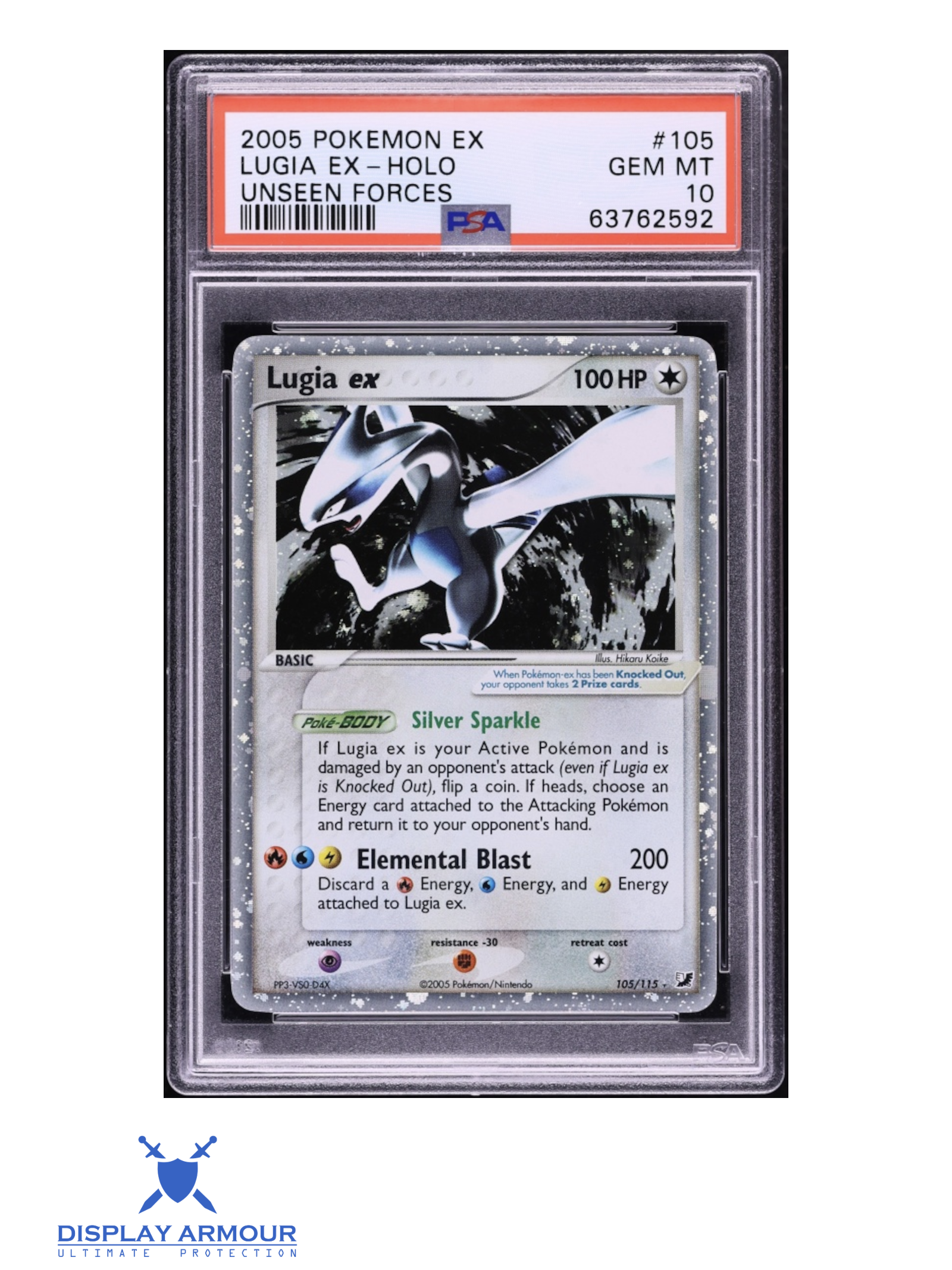
Lugia ex carries the legendary Pokémon into the EX Unseen Forces era, with a design distinct from Neo Genesis and Crystal Lugia. The Pokémon-ex mechanics and foil framing identify a different collecting chapter. The card’s number and English printing should accompany any surface and edge comparison.
$156,000 (approx. £118,200) is the documented PSA 10 benchmark reported by Fanatics Collect on 28 September 2026. This PSA 10 Pokémon-ex sale does not value Neo Genesis, Aquapolis or later lowercase ex Lugia cards. Primary sale evidence — Fanatics Collect.
59. Umbreon Holo — Daisuki Club 7,200 Points — 2010 Japanese promo — 054/L-P
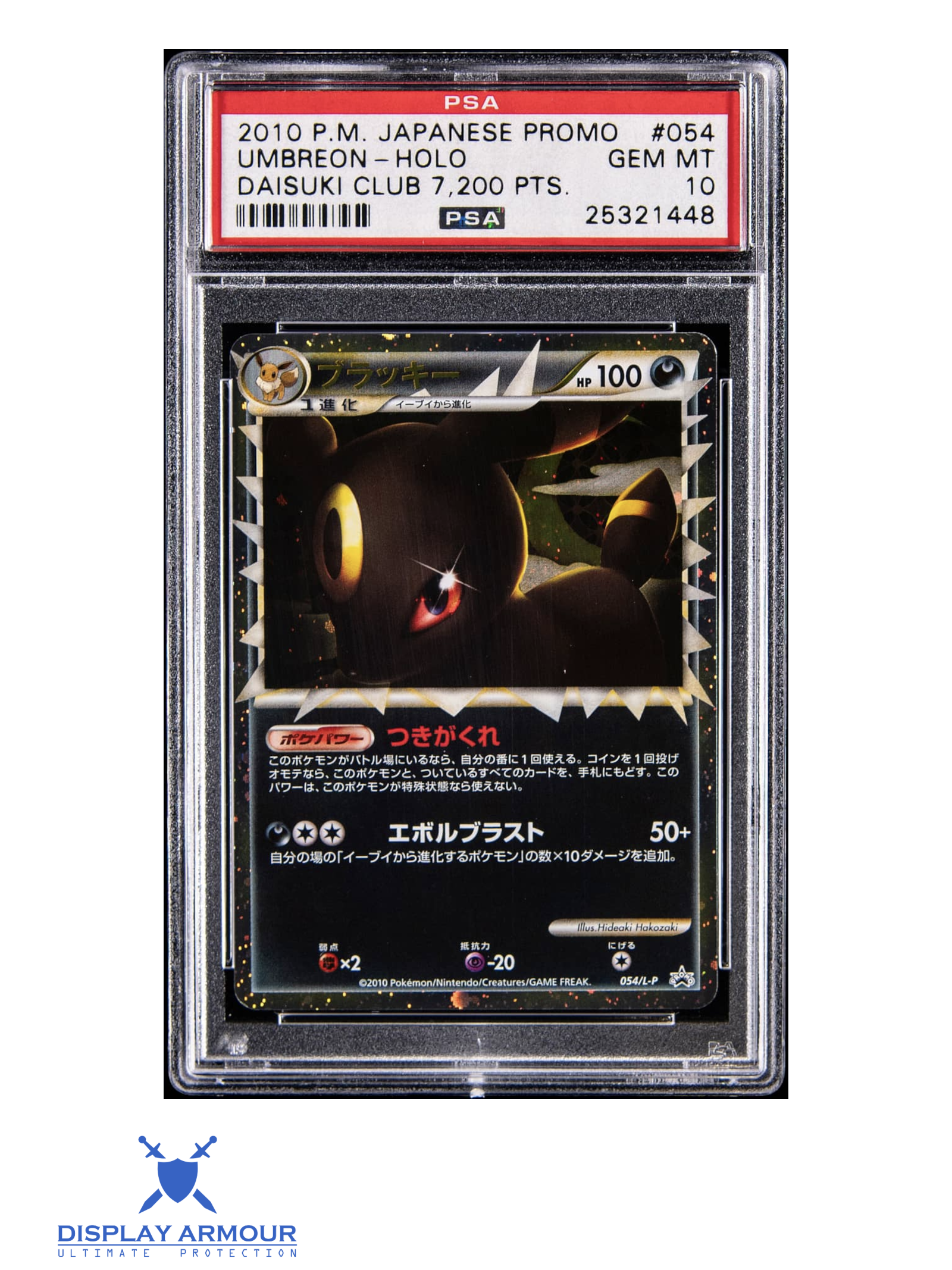
This Umbreon belongs to the Daisuki Club reward programme, rather than either Gold Star release. The 7,200-point designation is part of its distribution identity. That distinction matters because an Umbreon collection can contain several superficially similar promos whose acquisition routes and supply are quite different.
$146,400 (approx. £110,900) is the documented PSA GEM MT 10 benchmark reported by Goldin on 18 May 2026. The PSA 10 reward copy does not establish the value of a lower-grade example or another Daisuki Club points tier. Primary sale evidence — Goldin.
60. Blastoise 1st Edition Base Set — 1999 Base Set
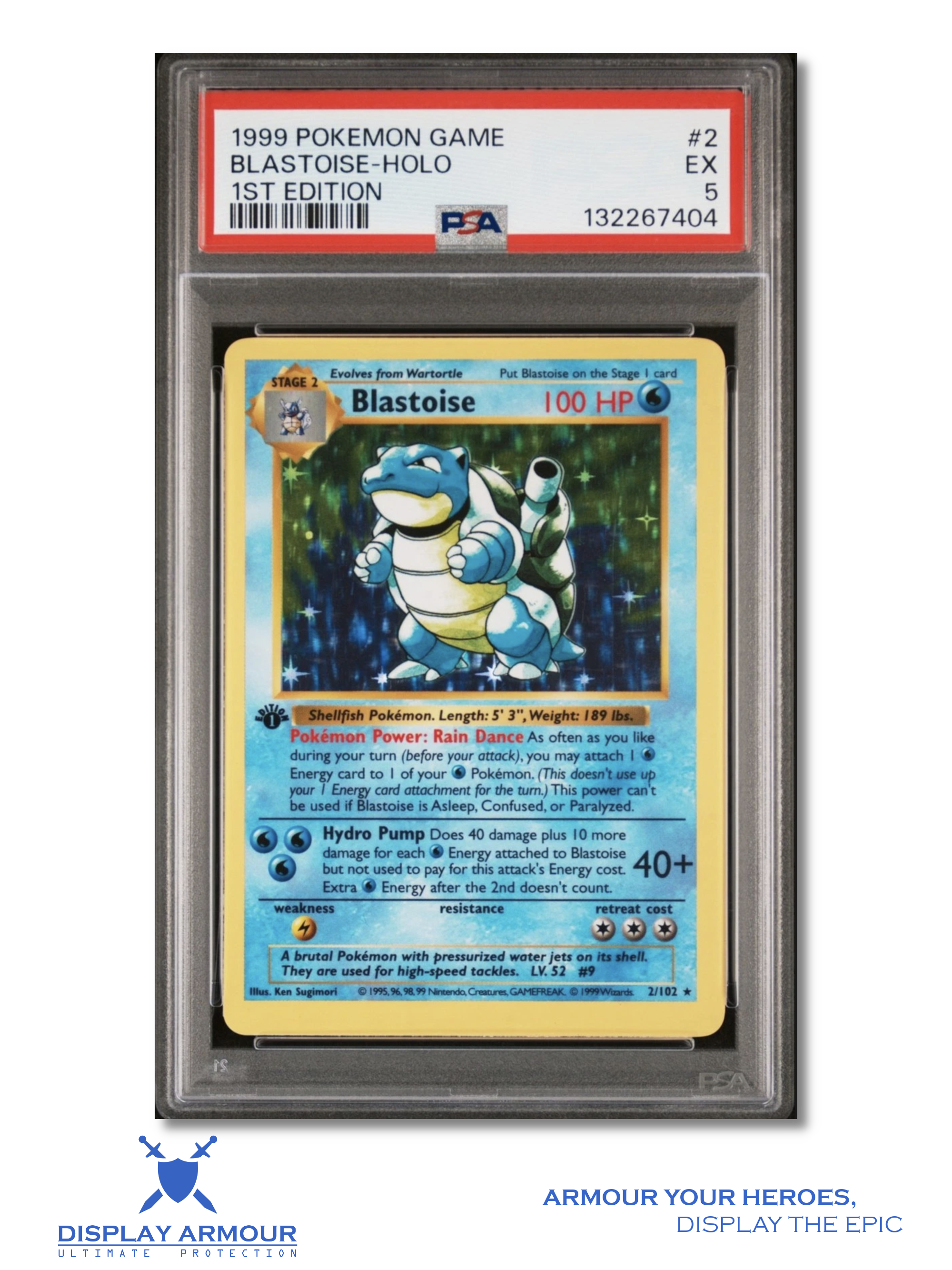
Illustration of this card; not verification of the cited sold copy or its grade.
Blastoise 2/102 is one of English Base Set’s three final-stage starter holos. First Edition copies are also shadowless and carry the familiar stamp beside the artwork. Dark borders, holo scratching and childhood handling make PSA 10 examples scarce, supporting the $138,880 (approx. £105,200) high-grade benchmark. Unlimited and later Base Set printings are far more accessible and should not be compared directly.
$138,880 (approx. £105,200) is the documented PSA 10; Logan Paul break provenance benchmark reported by Goldin on 16 February 2026. The sold PSA 10 has Logan Paul box-break provenance. Primary sale evidence — Goldin.
61. Dark Vaporeon Reverse Holo — Legendary Collection — 2002 Legendary Collection — 9/110
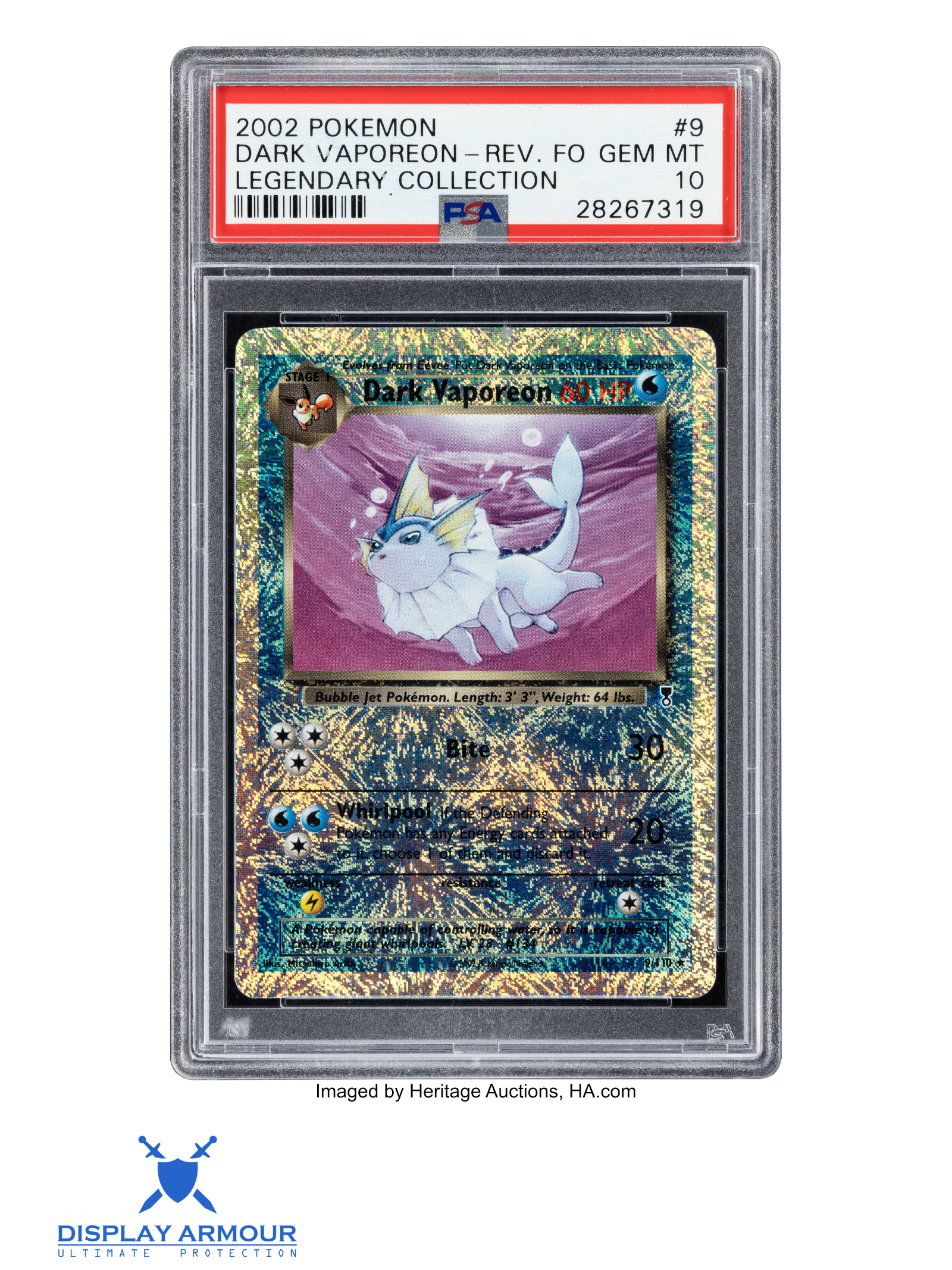
Dark Vaporeon combines the Team Rocket-era dark-Pokémon identity with Legendary Collection’s reverse-holo finish. The reprinted artwork does not make this interchangeable with the earlier Team Rocket card. Its set number and surface treatment must remain attached to the sale, alongside inspection of the foil and edges.
$137,500 (approx. £104,200) is the documented PSA 10 benchmark reported by Heritage on 18 September 2026. The PSA 10 Legendary Collection reverse holo is separate from both the regular holo and the earlier Team Rocket printing. Primary sale evidence — Heritage.
62. Toshiyuki Yamaguchi No. 2 Trainer — World Summer Challenge — 2000 Japanese World Summer Challenge
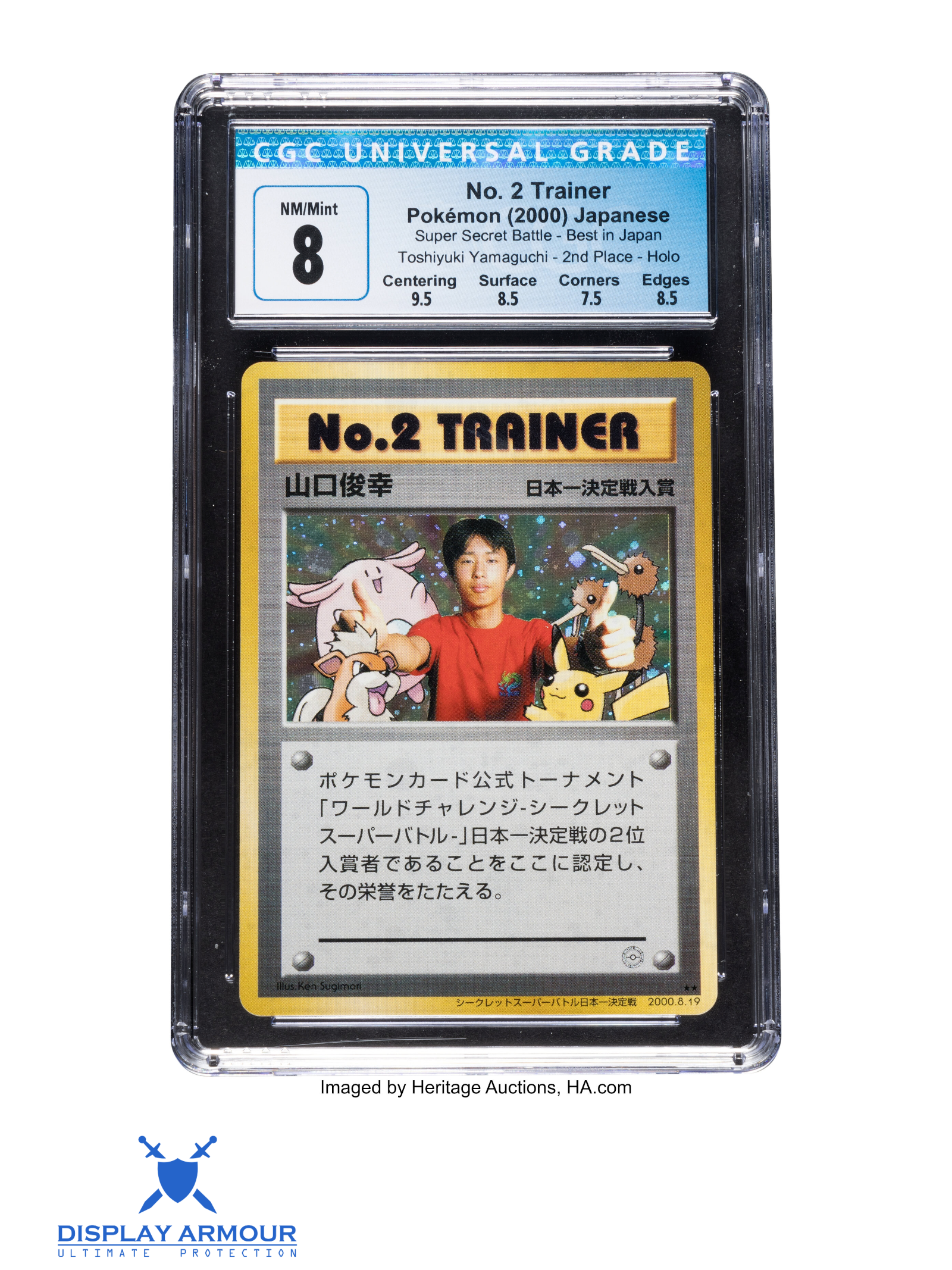
This personalised No. 2 Trainer incorporates Toshiyuki Yamaguchi’s photograph and records his result in the 2000 World Summer Challenge programme. The recipient-specific design gives it a different identity from generic placement trophies. Its significance depends on that named achievement and authenticated event history, rather than a familiar Pokémon artwork alone.
$137,500 (approx. £104,200) is the documented CGC 8 benchmark reported by Heritage on 7 July 2023. The CGC 8 personalised trophy is the subject of this sale. A different recipient’s card or another No. 2 Trainer is not the same variant. Primary sale evidence — Heritage.
63. Lucky Stadium — Tropical Mega Battle — 2000 Tropical Mega Battle promo
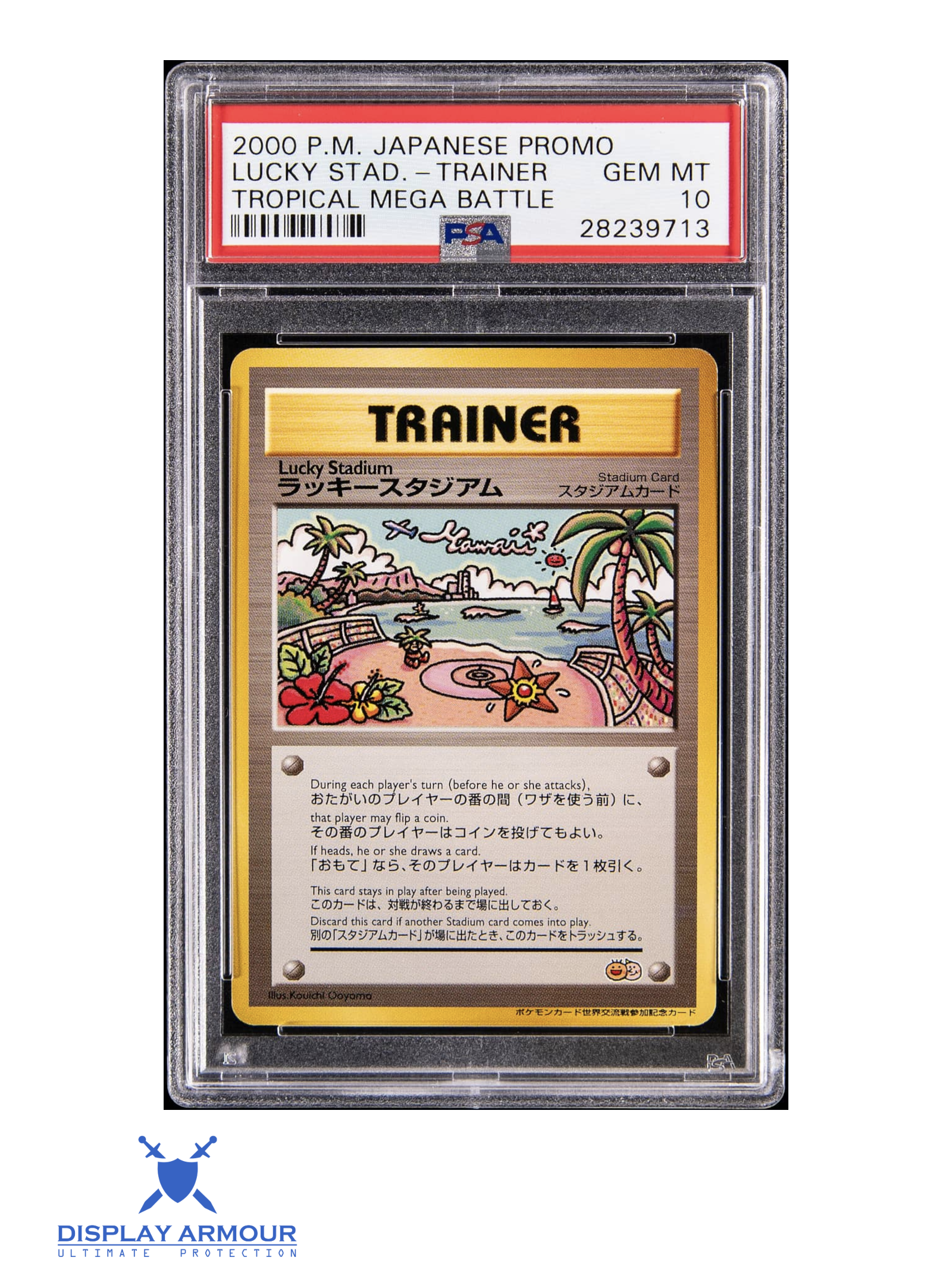
Lucky Stadium connects a playable Stadium card with the Tropical Mega Battle event programme. The bilingual issue occupies a different collecting niche from ordinary Stadium cards distributed in retail sets. Language, event origin and the physical printing need to align before a broad “Lucky Stadium” sale comparison is useful.
$134,200 (approx. £101,700) is the documented PSA GEM MT 10 benchmark reported by Goldin on 14 September 2026. The PSA 10 bilingual promo is the subject of the sale; later Lucky Stadium releases are not substitutes. Primary sale evidence — Goldin.
64. Treecko Gold Star — EX Team Rocket Returns — 2004 EX Team Rocket Returns — 109/109
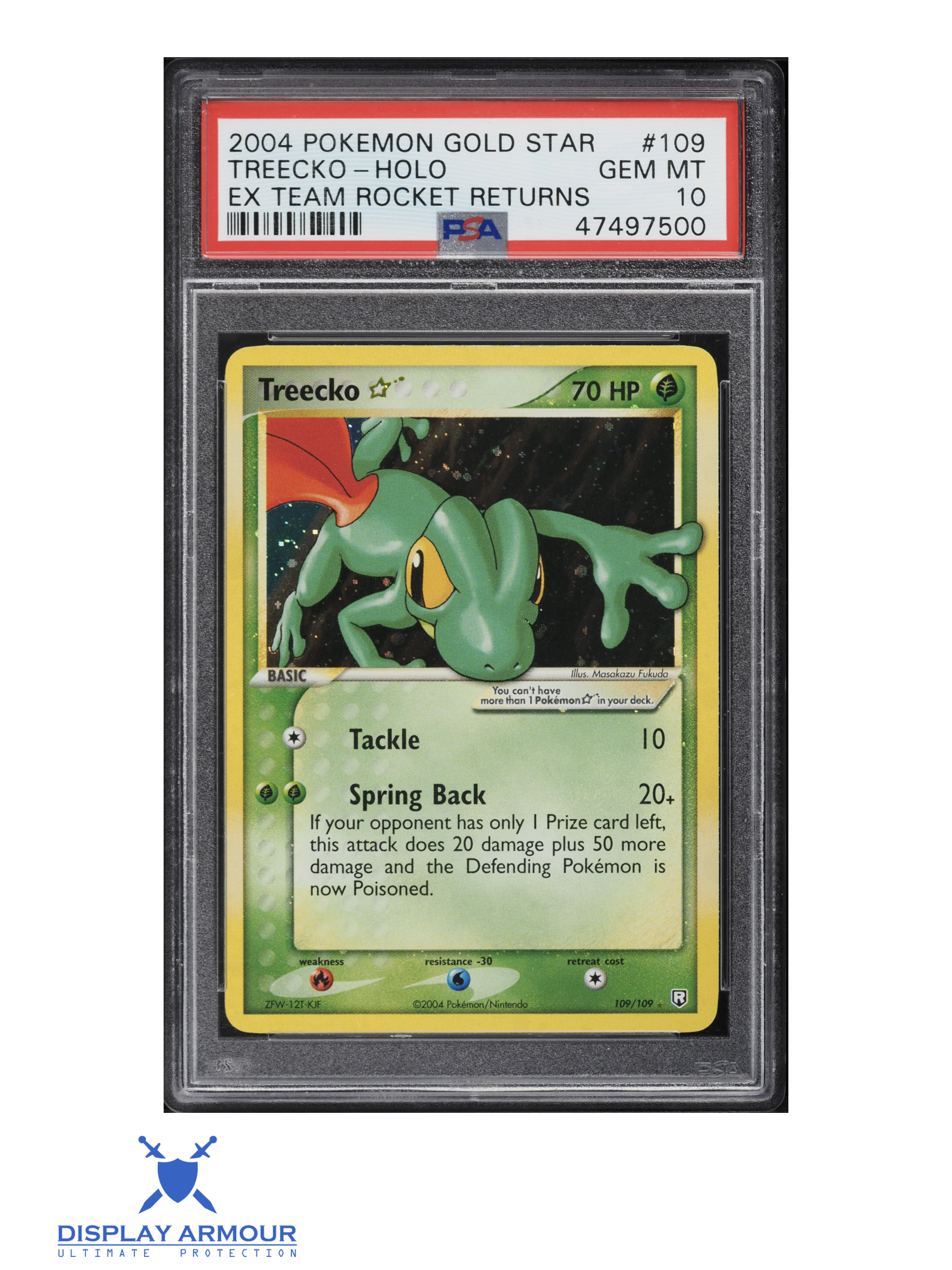
Treecko completes Team Rocket Returns’ three Gold Stars, alongside Mudkip and Torchic. The shiny Pokémon reaches beyond the illustration frame, giving the family a consistent visual identity. Pair and trio collecting can strengthen demand, while foil and edge defects still separate a clean-looking card from a top numerical grade.
$132,000 (approx. £100,000) is the documented PSA 10 benchmark reported by Fanatics Collect on 17 August 2026. The English PSA 10 Treecko result should be compared independently from its two set companions and the Japanese release. Primary sale evidence — Fanatics Collect.
65. Latias & Latios GX Alternate Art — 2019 Sun & Moon: Team Up
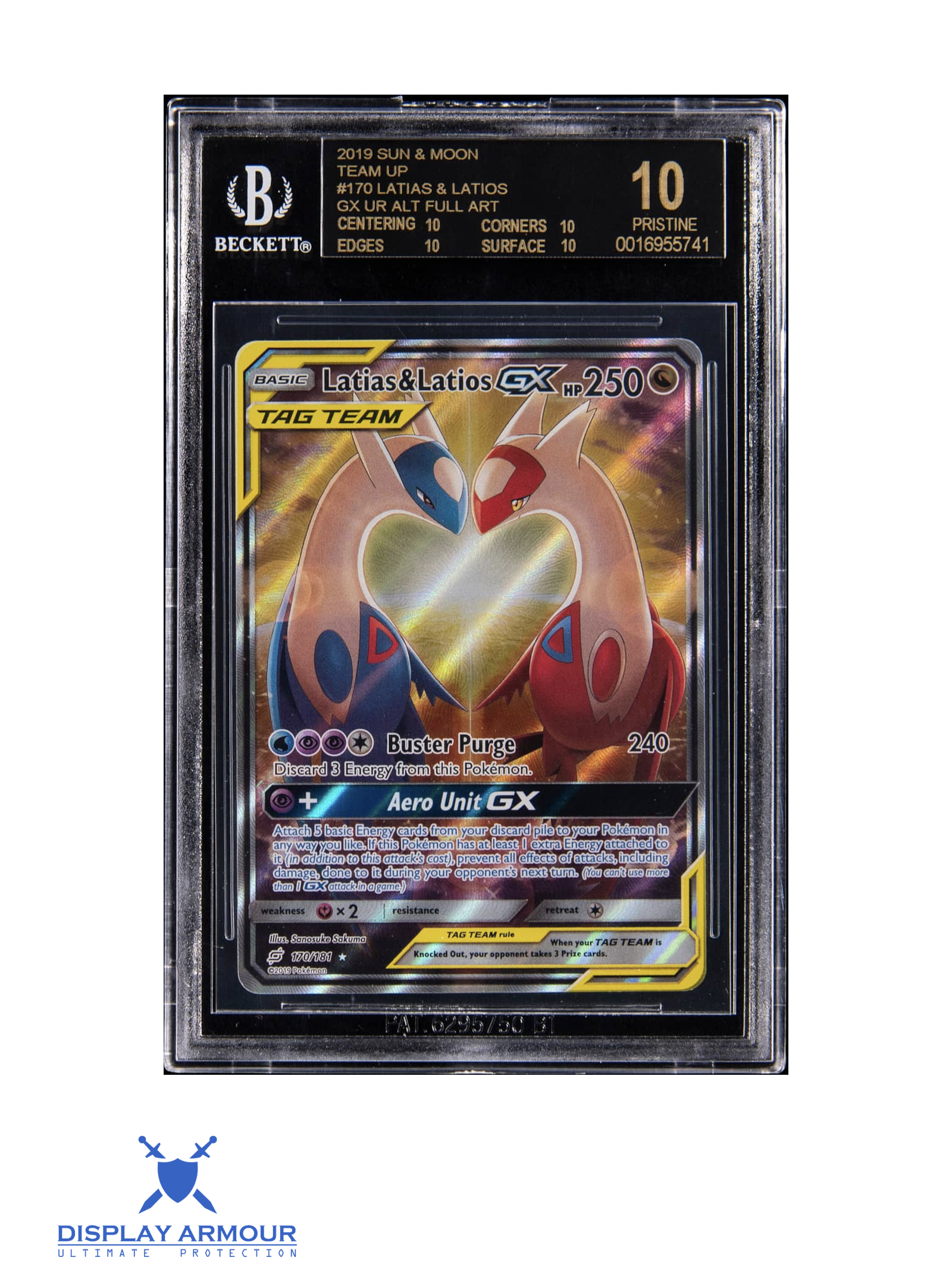
Illustration of this card; not verification of the cited sold copy or its grade.
Latias & Latios GX 170/181 is best known for its intertwined “heart” composition. Team Up’s popularity, TAG TEAM nostalgia and modern alternate-art demand support the $123,220 (approx. £93,300) documented high-grade benchmark. It is substantially more available than early trophy cards, so current supply and recent comparable sales should carry greater weight when evaluating it.
$123,220 (approx. £93,300) is the documented BGS 10 Black Label benchmark reported by Goldin on 10 August 2026. Primary sale evidence — Goldin.
66. Venusaur Holo — Japanese Base Set (Rarity Symbol) — 1996 Japanese Base Set
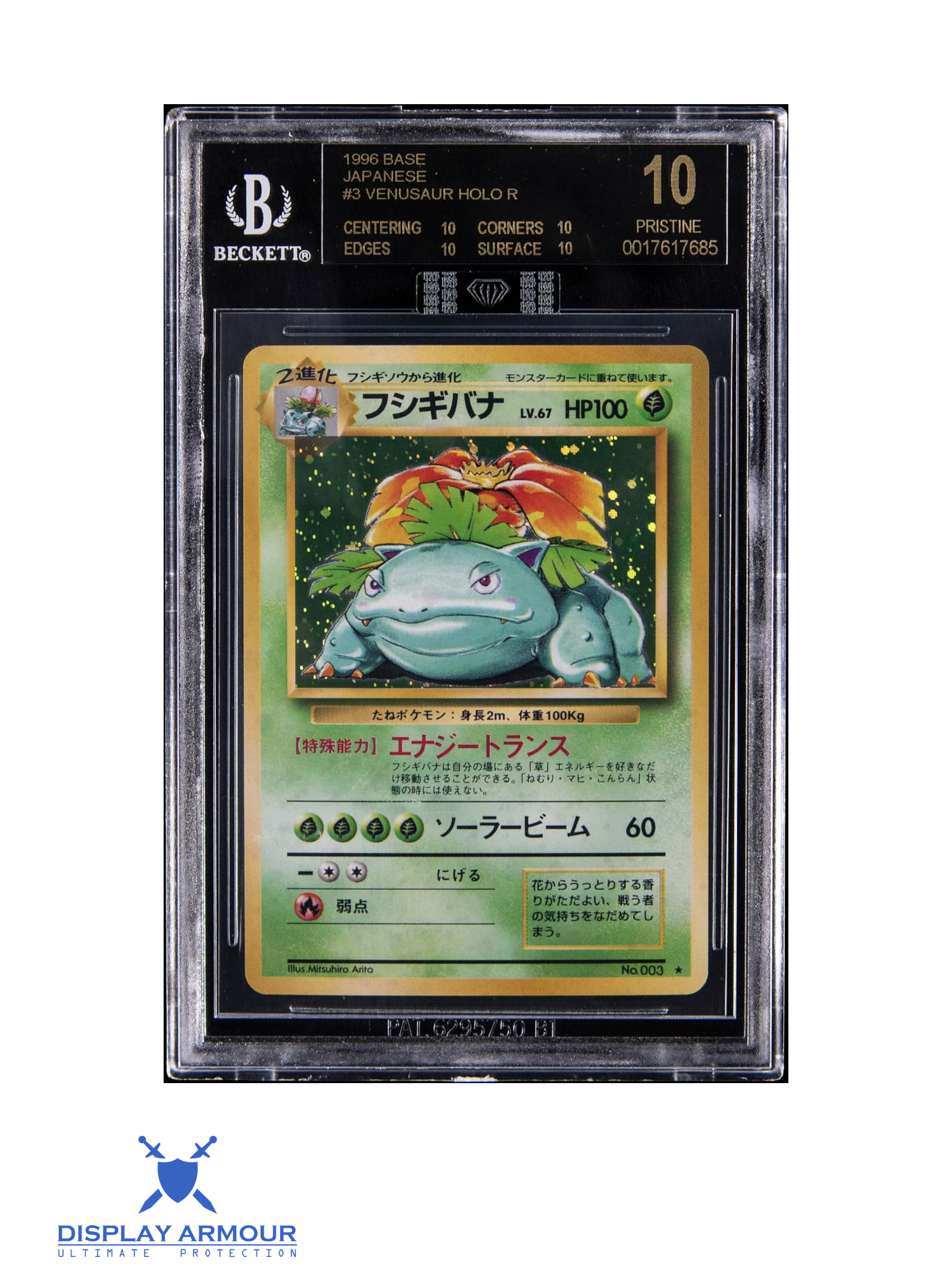
Japanese Base Set Venusaur completes the familiar starter-evolution trio in its normal rarity-symbol printing. Its artwork is recognisable immediately, but the rarity mark separates this issue from the earliest no-rarity card. Collectors should examine the foil, green border and reverse rather than relying on the character alone.
$123,220 (approx. £93,300) is the documented BGS PRISTINE/Black Label 10 - MBA Black Diamond Certified benchmark reported by Goldin on 10 August 2026. The BGS Black Label benchmark is not the normal value of every Japanese Venusaur or of the no-rarity variant. Primary sale evidence — Goldin.
67. Rayquaza Gold Star — Japanese Unlimited — 2004 Clash of the Blue Sky — 067/082
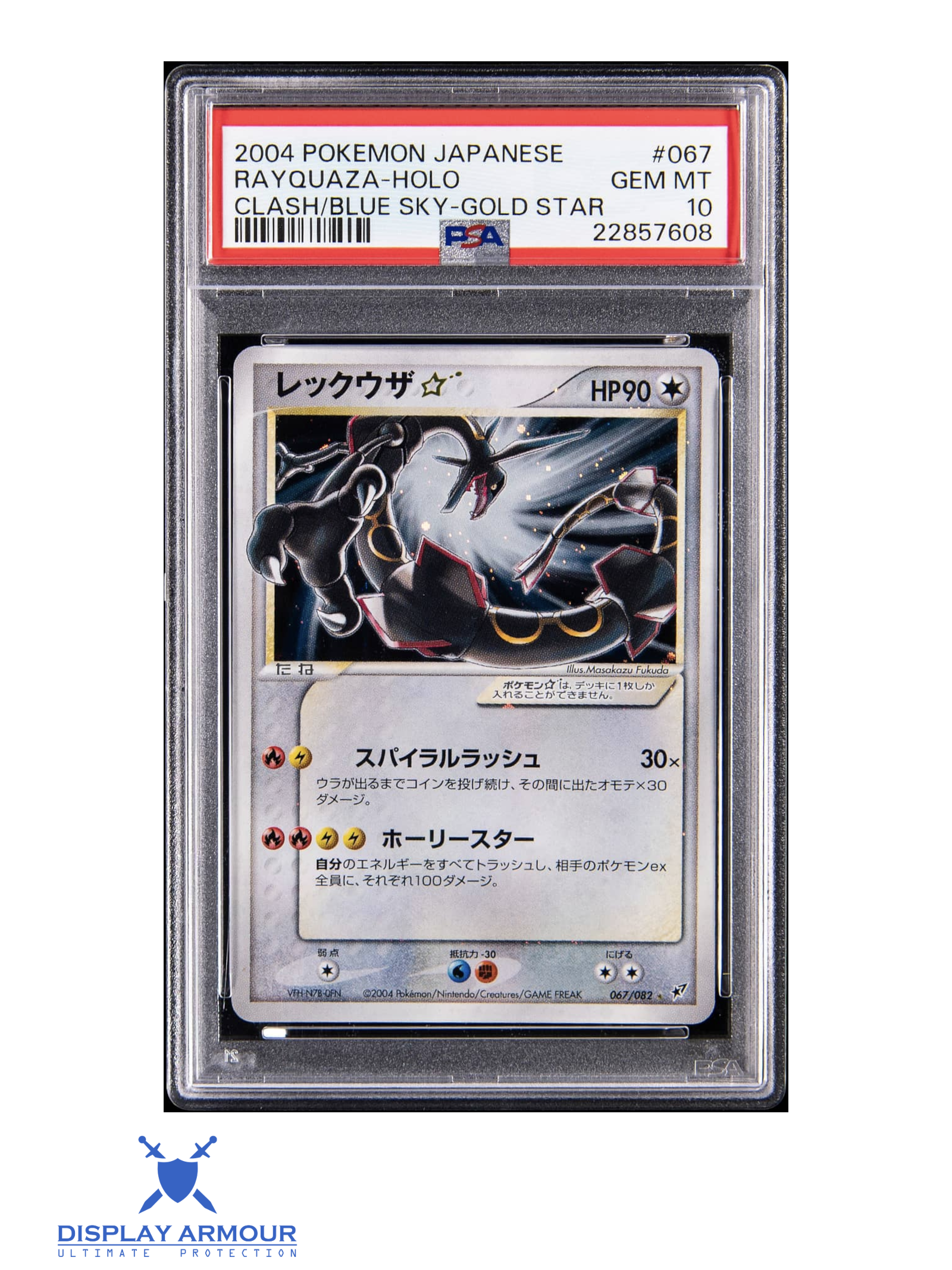
The Japanese Rayquaza Gold Star predates the English EX Deoxys release and carries Clash of the Blue Sky numbering. The shiny black Pokémon and artwork spilling beyond the frame remain familiar, but language and edition identify a separate collectible. This entry concerns the unlimited Japanese printing.
$122,000 (approx. £92,400) is the documented PSA GEM MT 10 benchmark reported by Goldin on 24 August 2026. Do not apply the English CGC Pristine result to this PSA 10 Japanese unlimited card, or substitute a Japanese First Edition copy. Primary sale evidence — Goldin.
68. Charizard Disco Holo Test Print — Shadowless Base Set — 1999 WOTC test print — 4/102
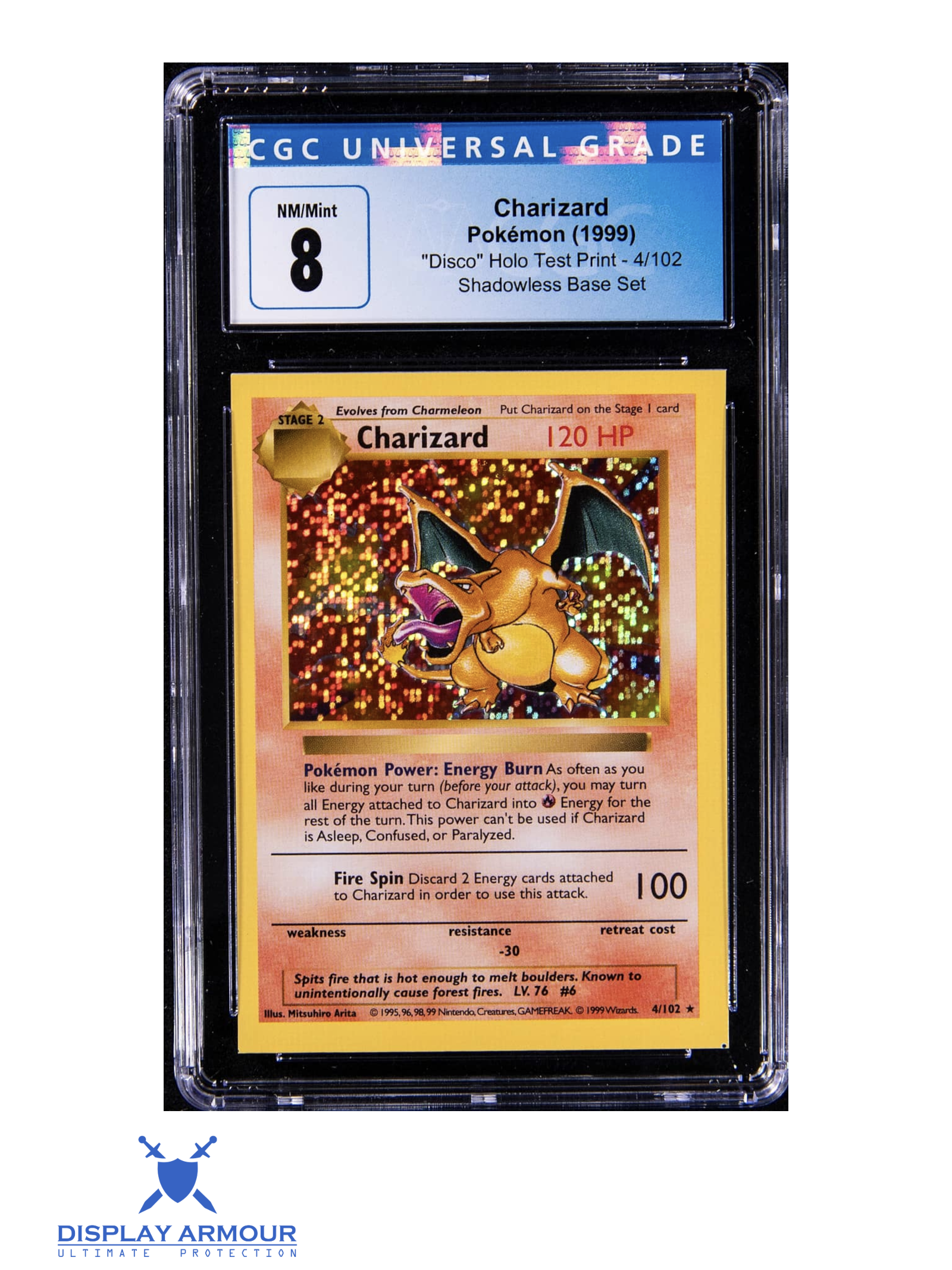
The experimental disco-holo Charizard changes the foil treatment of the familiar shadowless Base Set design. That production difference makes it distinct from normal First Edition and unlimited holos. A test print needs evidence of its origin and physical characteristics, rather than an assumption that an unusual reflection proves rarity.
$113,880 (approx. £86,300) is the documented CGC NM/MINT 8 benchmark reported by Goldin on 7 September 2023. The authenticated CGC 8 test print should be assessed as production material, not as a standard Base Set Charizard. Primary sale evidence — Goldin.
69. Extra Battle Day Lillie Full Art — 2019 Japanese Promo
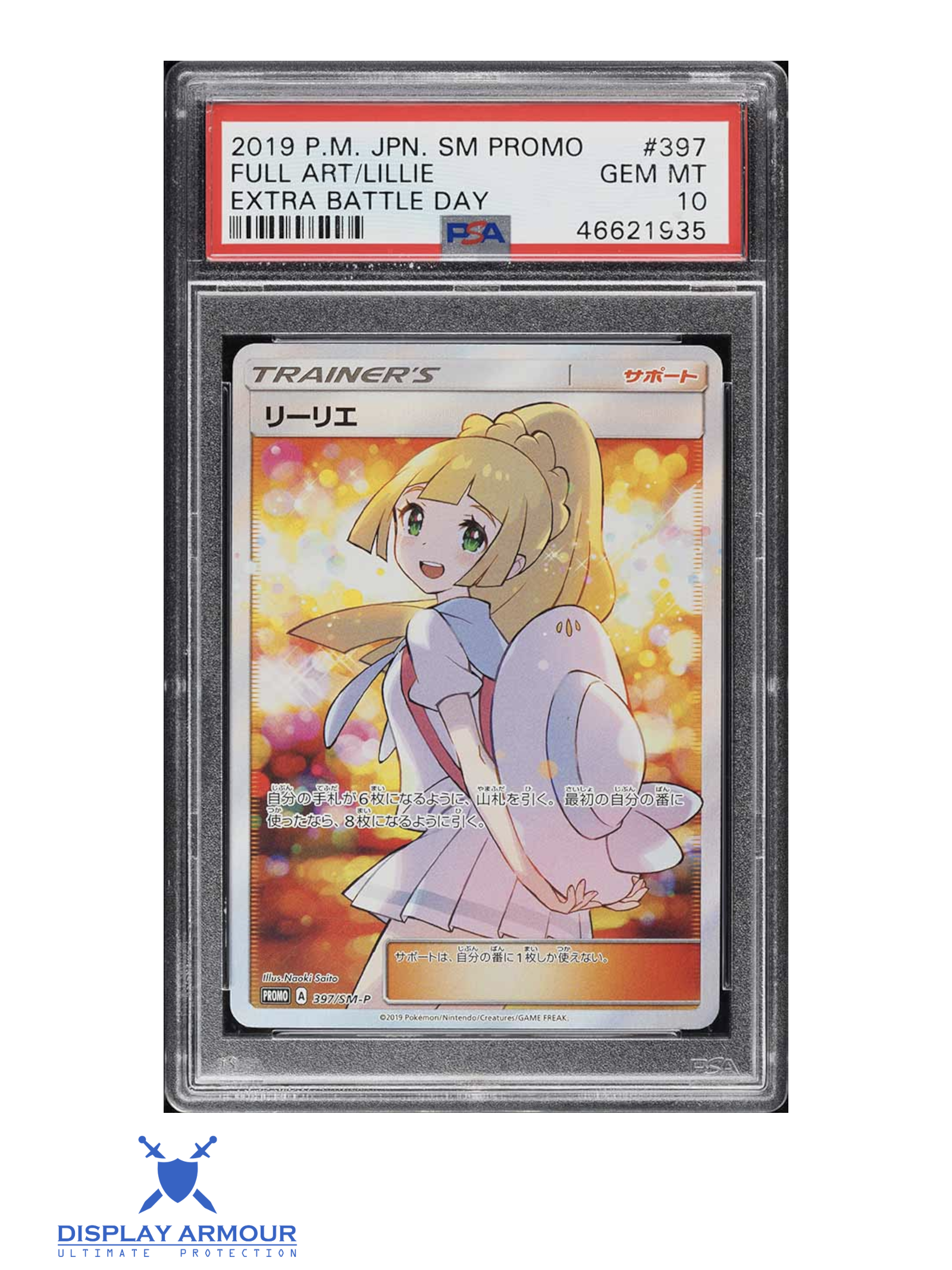
Illustration of this card; not verification of the cited sold copy or its grade.
This Lillie full art was distributed through Japan’s Extra Battle Day event programme, not ordinary packs. It combines a popular Trainer character with limited event supply and a documented PSA 10 benchmark. The $108,000 (approx. £81,800) figure should therefore be attached to that grade and copy quality; PSA, CGC, BGS Gem Mint and raw examples are not direct equivalents.
$108,000 (approx. £81,800) is the documented PSA 10 benchmark reported by Fanatics Collect on 28 July 2023. Primary sale evidence — Fanatics Collect.
70. Crystal Charizard Holo — 2003 Skyridge
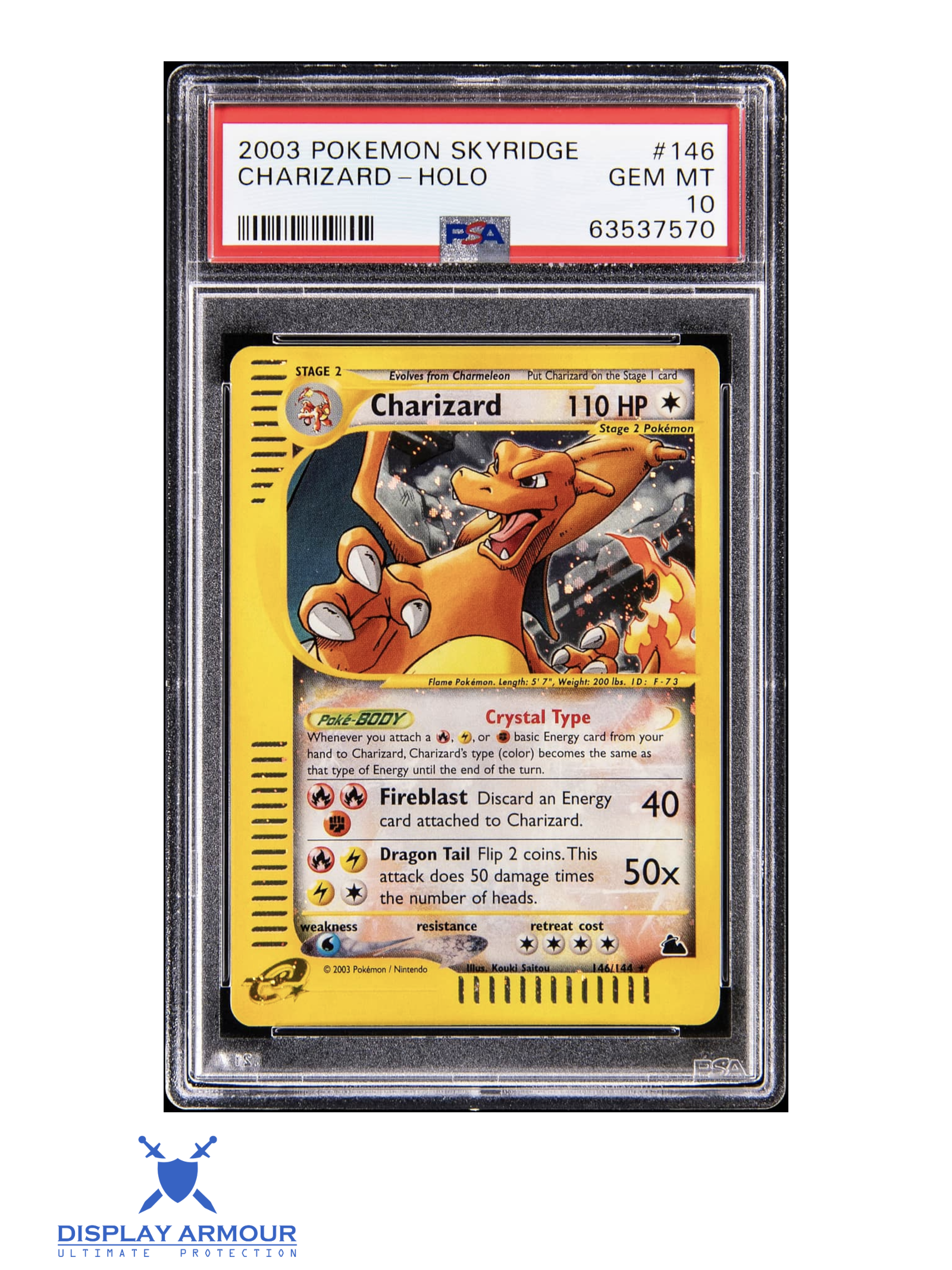
Crystal Charizard 146/144 is a secret rare from Skyridge, the final English e-Reader expansion. Its colourless Crystal typing, e-Reader border and dramatic artwork make it visually distinct from Base Set and EX-era Charizards. Skyridge’s limited availability and the card’s holo sensitivity underpin the $97,600 (approx. £73,900) PSA 10 benchmark.
$97,600 (approx. £73,900) is the documented PSA 10 benchmark reported by Goldin on 27 July 2026. Primary sale evidence — Goldin.
71. Rayquaza Regular Holo — Call of Legends — 2011 Call of Legends — 20/95
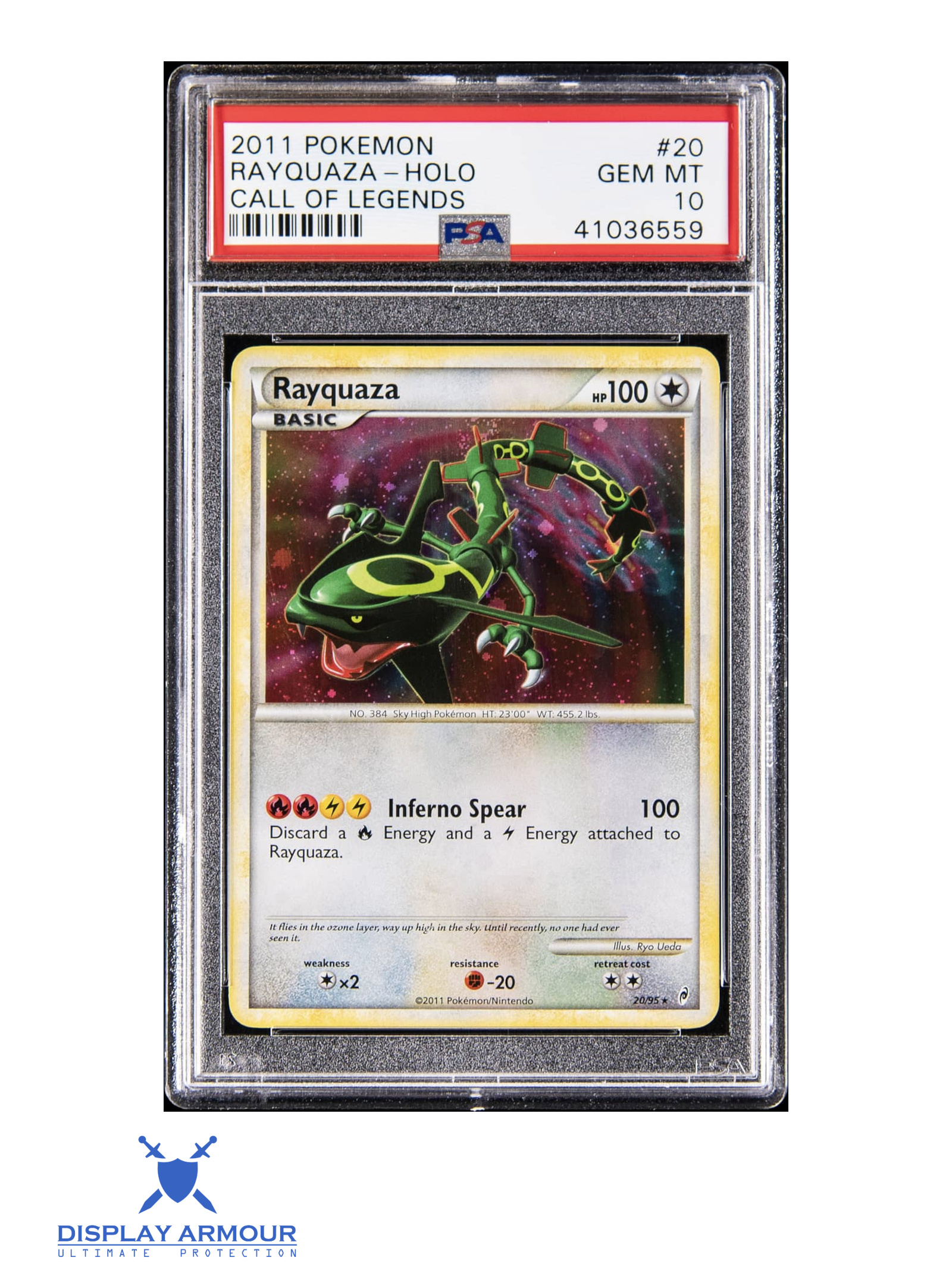
The regular Rayquaza holo is numbered 20/95 in Call of Legends. It is distinct from the shiny SL10 card, an easy confusion when prices are collected under the Pokémon’s name alone. The conventional holo artwork and checklist number identify the issue before grading condition enters the discussion.
$97,600 (approx. £73,900) is the documented PSA GEM MT 10 benchmark reported by Goldin on 10 September 2026. The PSA 10 regular-holo result cannot be carried over to SL10 or the reverse-holo printing. Primary sale evidence — Goldin.
72. Crystal Lugia Holo — 2003 Aquapolis
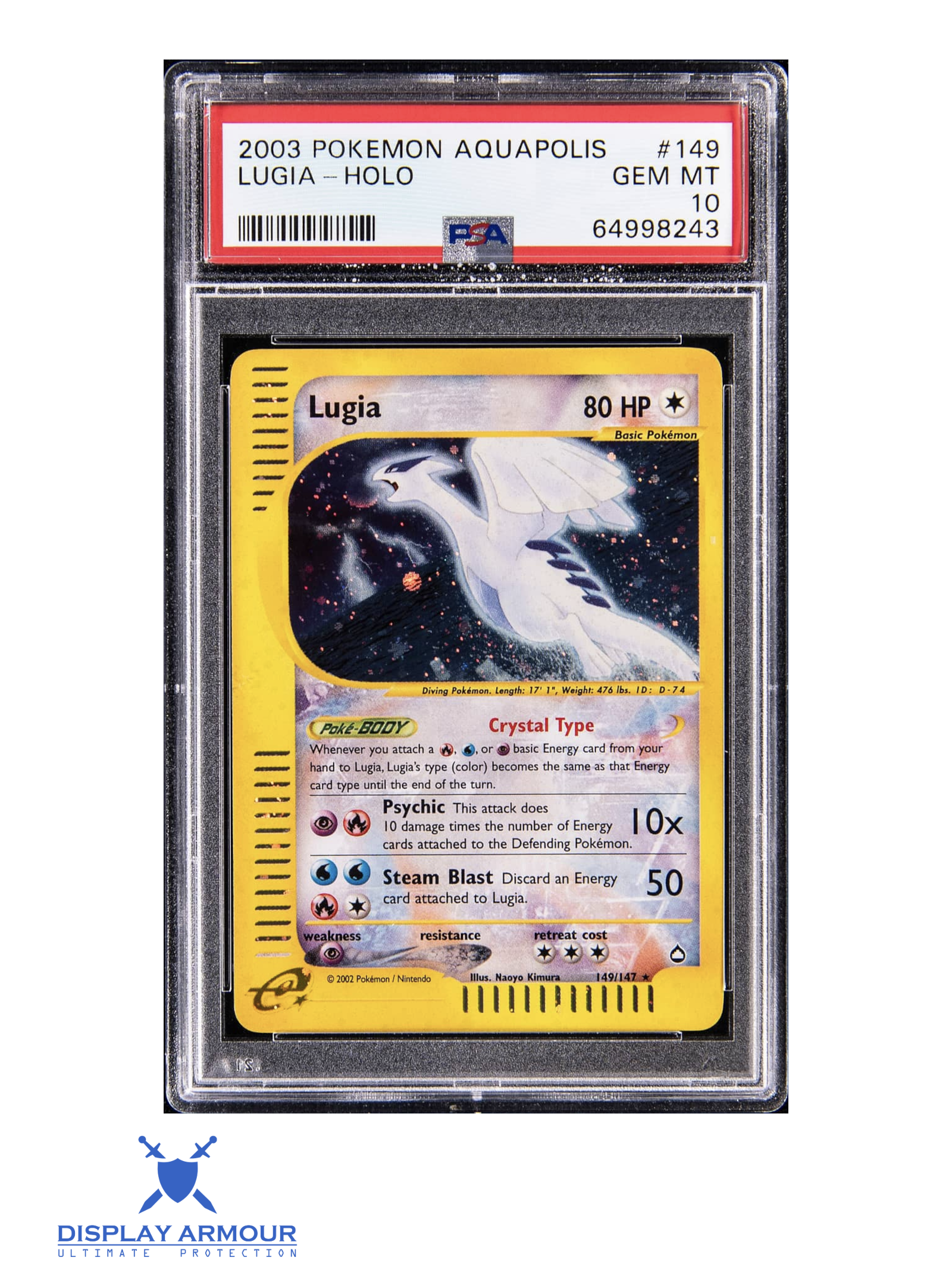
Crystal Lugia 149/147 is an Aquapolis secret rare with the e-Reader era’s Crystal Type mechanic. Lugia’s legendary status and a broad holo surface make strong copies highly collected. The $95,770 (approx. £72,500) documented high-grade benchmark reflects top-grade demand; distinguish it from Neo Genesis Lugia and from the Aquapolis reverse-holo treatment.
$95,770 (approx. £72,500) is the documented PSA 10 benchmark reported by Goldin on 13 April 2026. Primary sale evidence — Goldin.
73. No. 1 Trainer — 2018 World Championships — 2018 World Championships
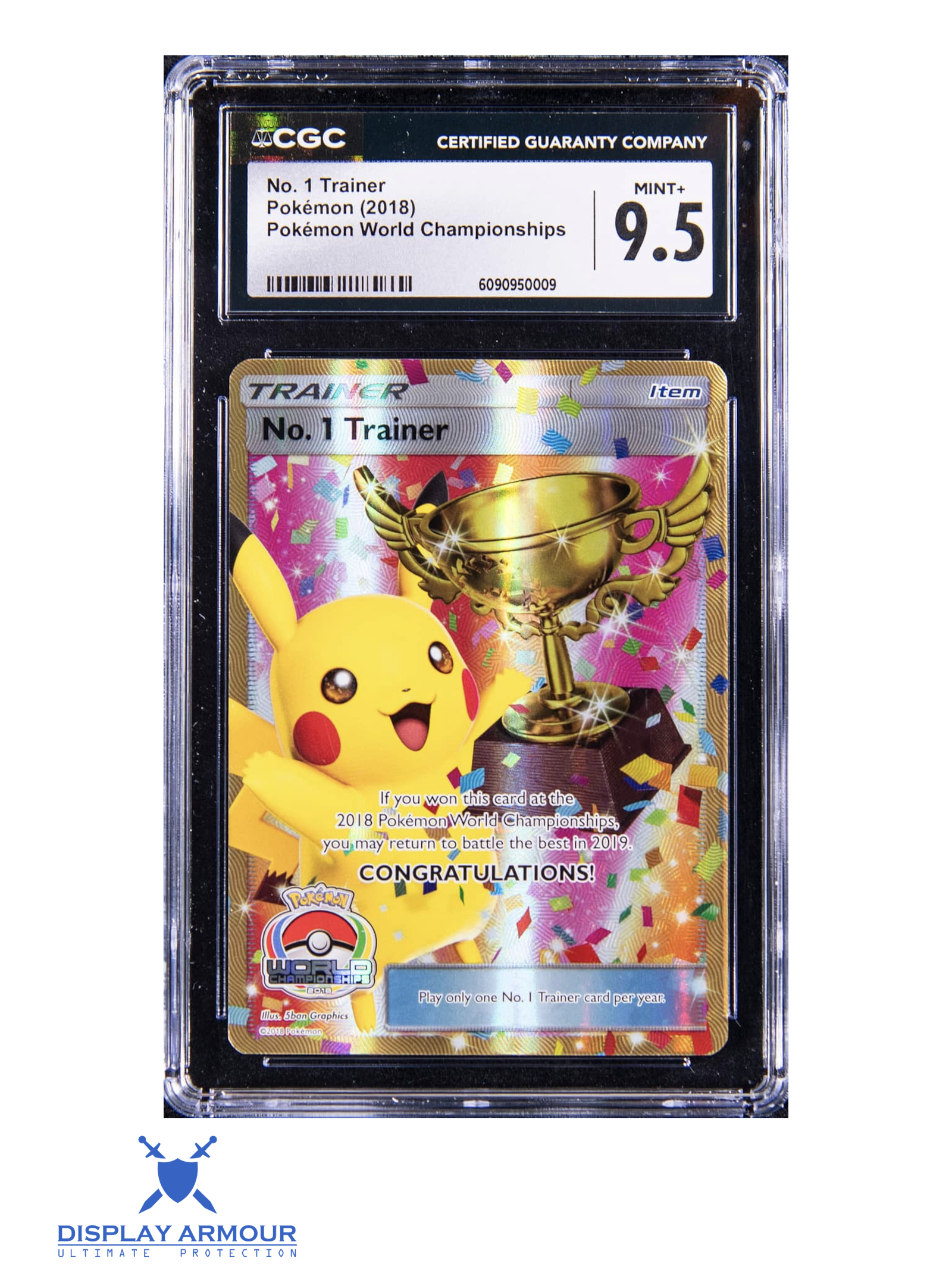
The 2018 No. 1 Trainer commemorates success at the World Championships, with its date and placement doing the identifying work. World Championship trophies span many years and designs. A buyer should record the precise issue and any recipient history before treating another first-place Trainer as a comparable.
$93,940 (approx. £71,200) is the documented CGC MINT+ 9.5 benchmark reported by Goldin on 18 May 2026. The CGC Mint+ 9.5 label is retained exactly; it is not described as a Pristine or Gem Mint 10. Primary sale evidence — Goldin.
74. No. 2 Trainer — 2024 World Championships — 2024 World Championships
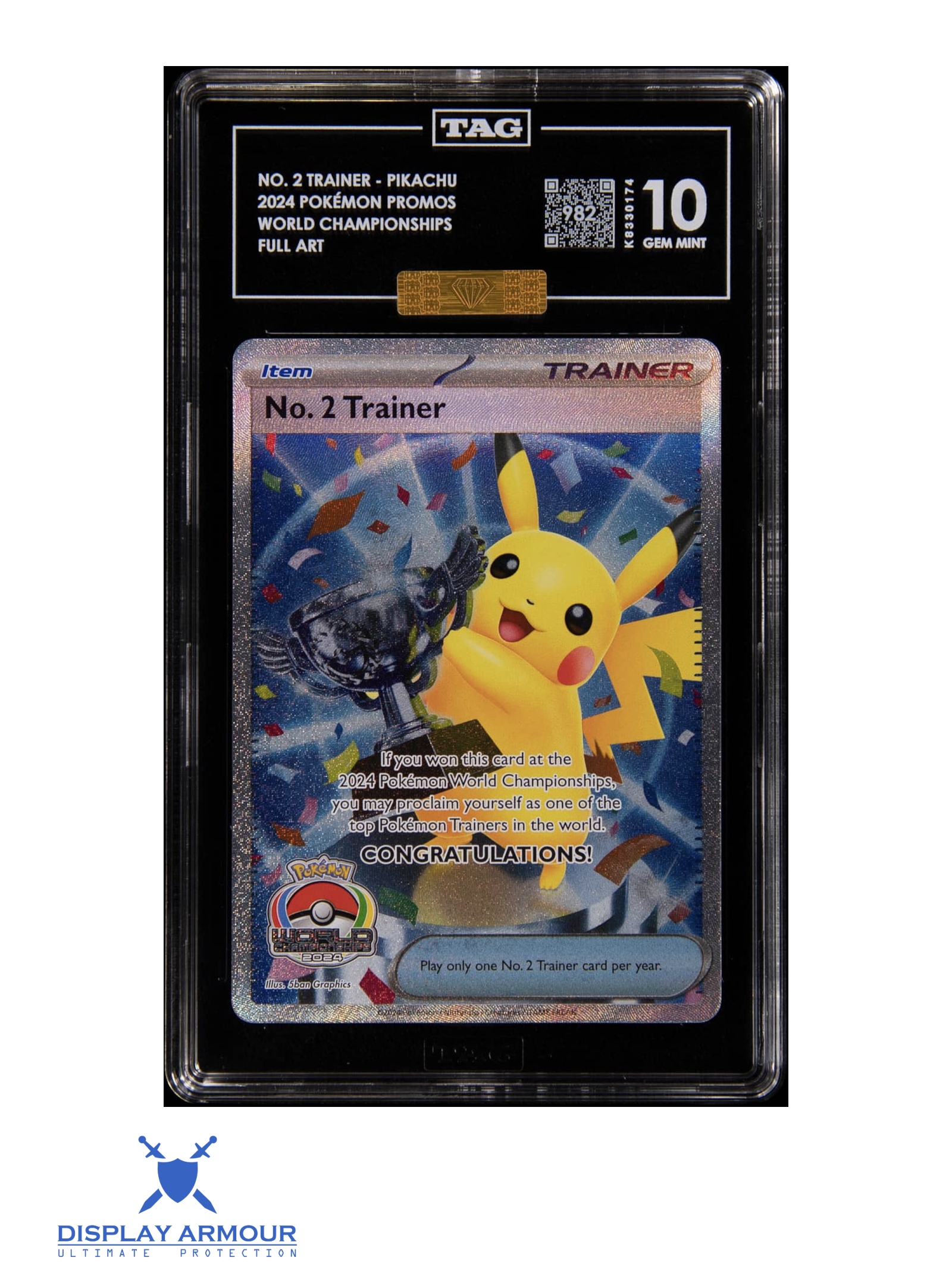
This full-art No. 2 Trainer belongs to the 2024 World Championships. Its modern presentation does not make it a retail chase: placement and event distribution still define the collectible. The premium copy combines a TAG grade with an additional eye-appeal designation, both recorded in the auction title.
$92,720 (approx. £70,200) is the documented TAG GEM MINT 10, MBA Gold Diamond Pristine 10+ benchmark reported by Goldin on 10 August 2026. TAG 10 and the MBA Gold Diamond Pristine 10+ assessment are separate labels, not a universal equivalence with PSA 10. Primary sale evidence — Goldin.
75. Espeon Gold Star — 2007 POP Series 5
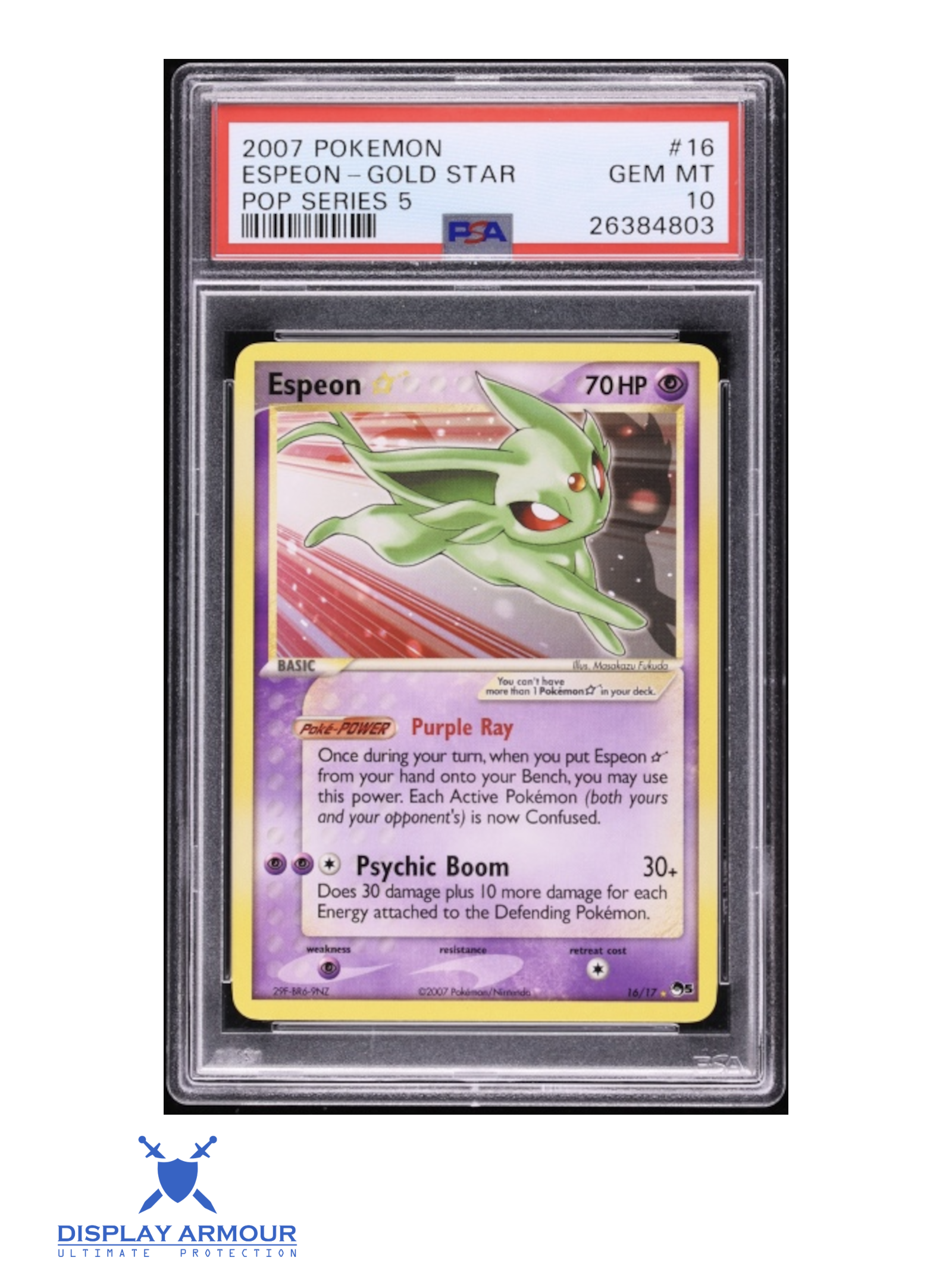
Illustration of this card; not verification of the cited sold copy or its grade.
Espeon Gold Star 16/17 is Umbreon’s companion card in POP Series 5. Its organised-play distribution, shiny artwork and Eeveelution demand make the English promo especially desirable in Gem Mint condition. The $90,000 (approx. £68,200) figure is a PSA 10 benchmark; edge whitening and surface wear can create a wide separation between otherwise similar-looking copies.
$90,000 (approx. £68,200) is the documented PSA 10 benchmark reported by Fanatics Collect on 29 June 2026. Primary sale evidence — Fanatics Collect.
76. Celebi ex — EX Unseen Forces — 2005 EX Unseen Forces — 117/115
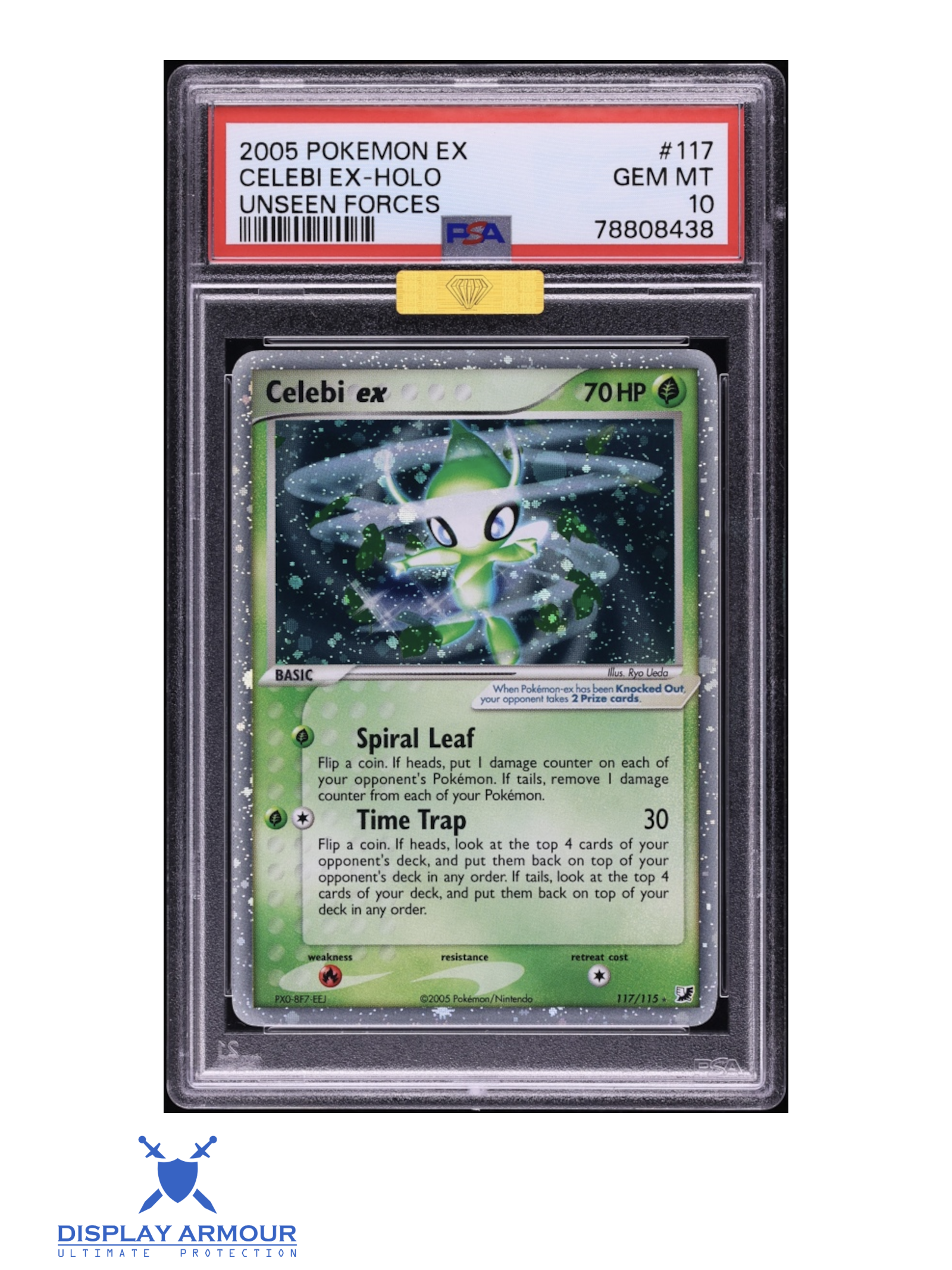
Celebi ex extends beyond EX Unseen Forces’ regular checklist and is distinct from Celebi Gold Star. The mythical subject and EX-era foil presentation give it a particular place in secret-rare collecting. Its printed number should come before any comparison with another Celebi featuring a gold star or a Shining design.
$78,000 (approx. £59,100) is the documented PSA 10; MBA-designated copy benchmark reported by Fanatics Collect on 6 July 2026. The PSA 10, MBA-designated sold copy is the reference; Celebi Gold Star is not the same issue. Primary sale evidence — Fanatics Collect.
77. Shining Gyarados 1st Edition — 2001 Neo Revelation
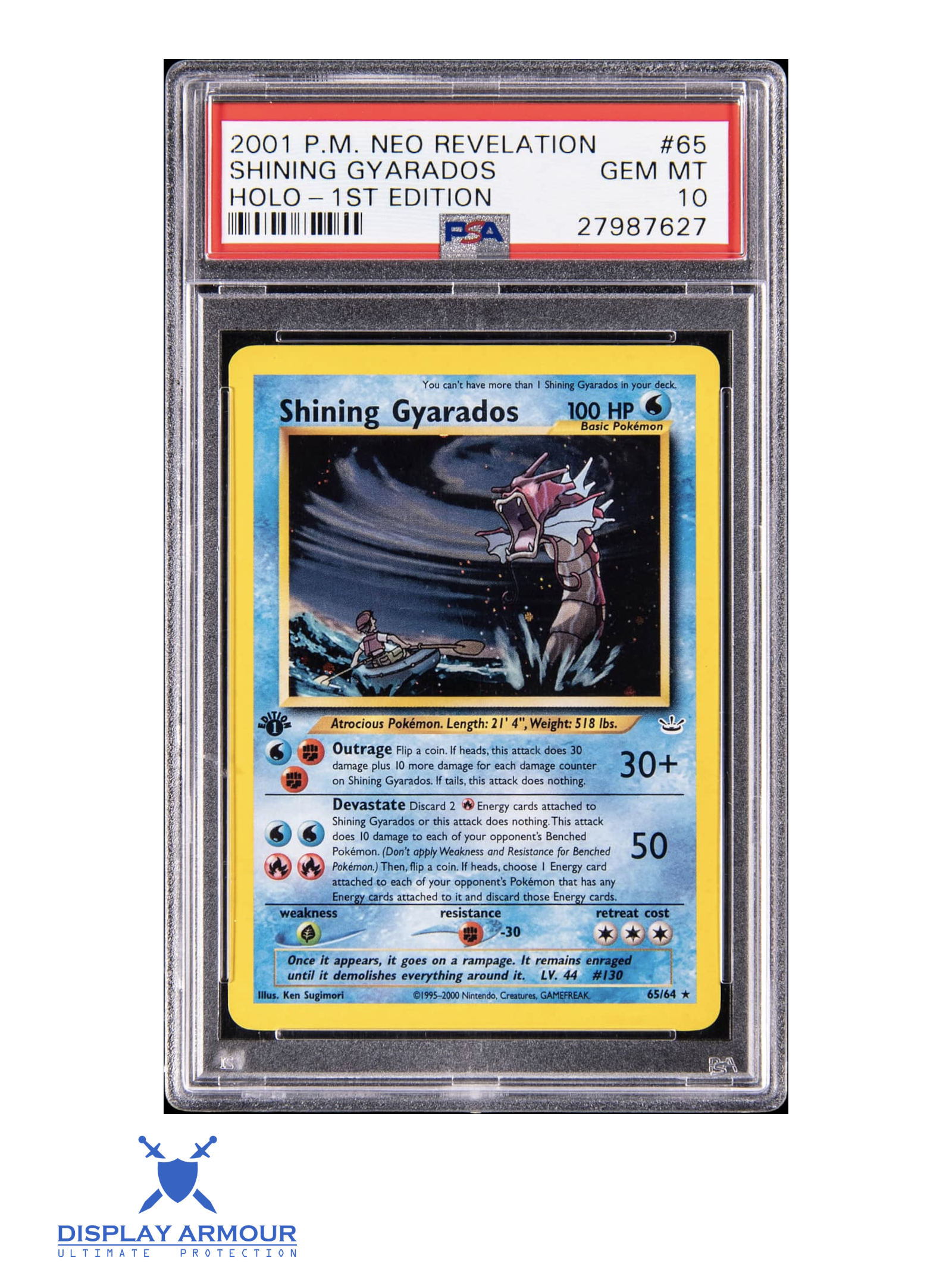
Illustration of this card; not verification of the cited sold copy or its grade.
Shining Gyarados 65/64 helped introduce shiny Pokémon to the English TCG alongside Shining Magikarp. Its red Gyarados towers over a stormy scene, while the Pokémon itself carries the textured foil treatment. The $73,200 (approx. £55,500) PSA 10 high benchmark applies to the First Edition secret rare; print quality and surface wear can make the jump between grades substantial.
$73,200 (approx. £55,500) is the documented PSA 10 benchmark reported by Goldin on 10 August 2026. Primary sale evidence — Goldin.
78. Shining Charizard 1st Edition — 2002 Neo Destiny
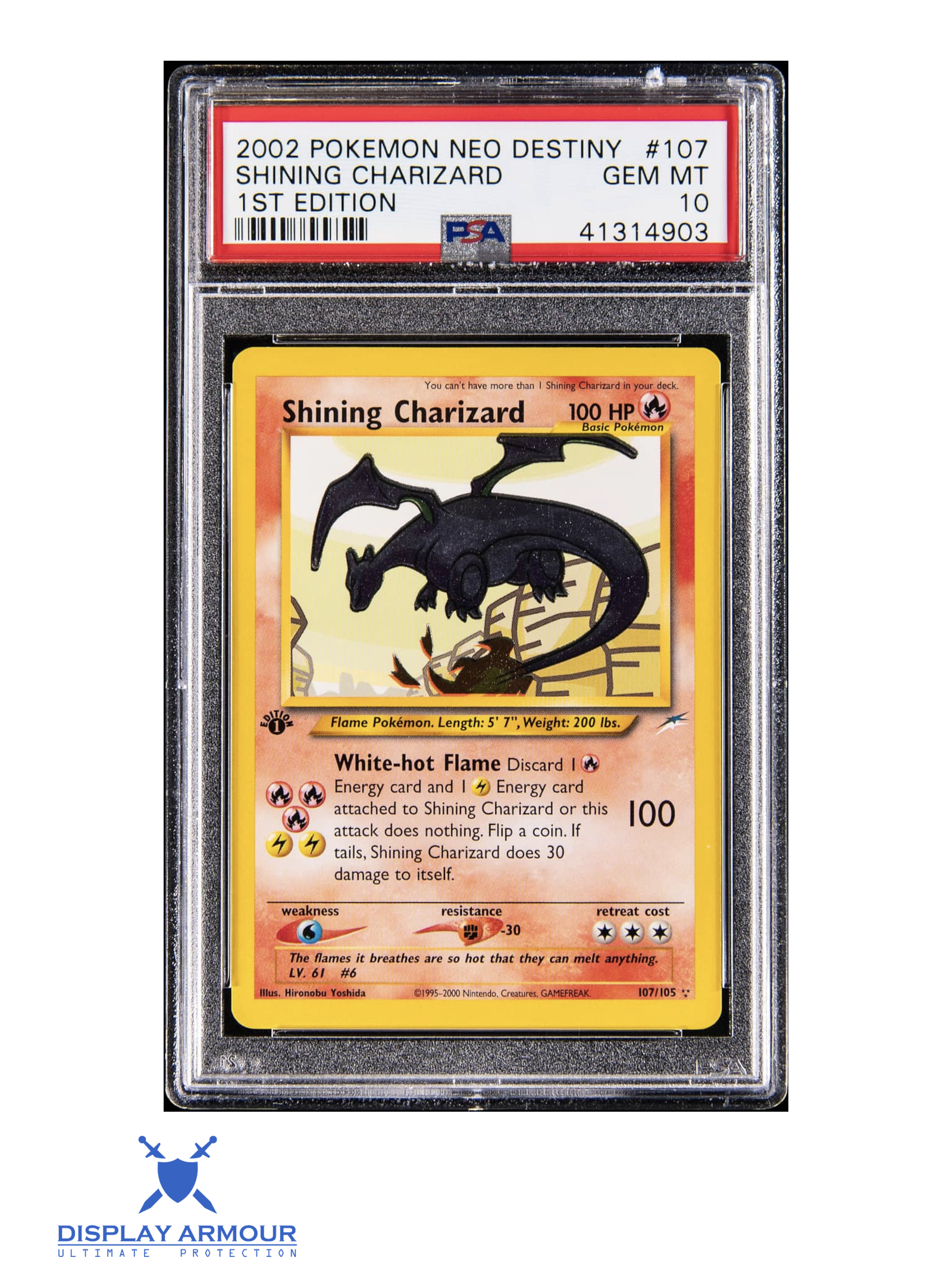
Illustration of this card; not verification of the cited sold copy or its grade.
Shining Charizard 107/105 is one of Neo Destiny’s defining secret rares. The card reverses the normal holo emphasis by applying foil to the Pokémon, while its First Edition stamp and dark Charizard artwork strengthen collector demand. The $69,541 (approx. £52,700) benchmark is for PSA 10; print lines, scratches and edge wear can materially change value.
$69,541 (approx. £52,700) is the documented PSA 10 benchmark reported by Goldin on 18 June 2026. Primary sale evidence — Goldin.
79. Slowking Holo — Southern Islands — 2001 English Southern Islands — 14/18
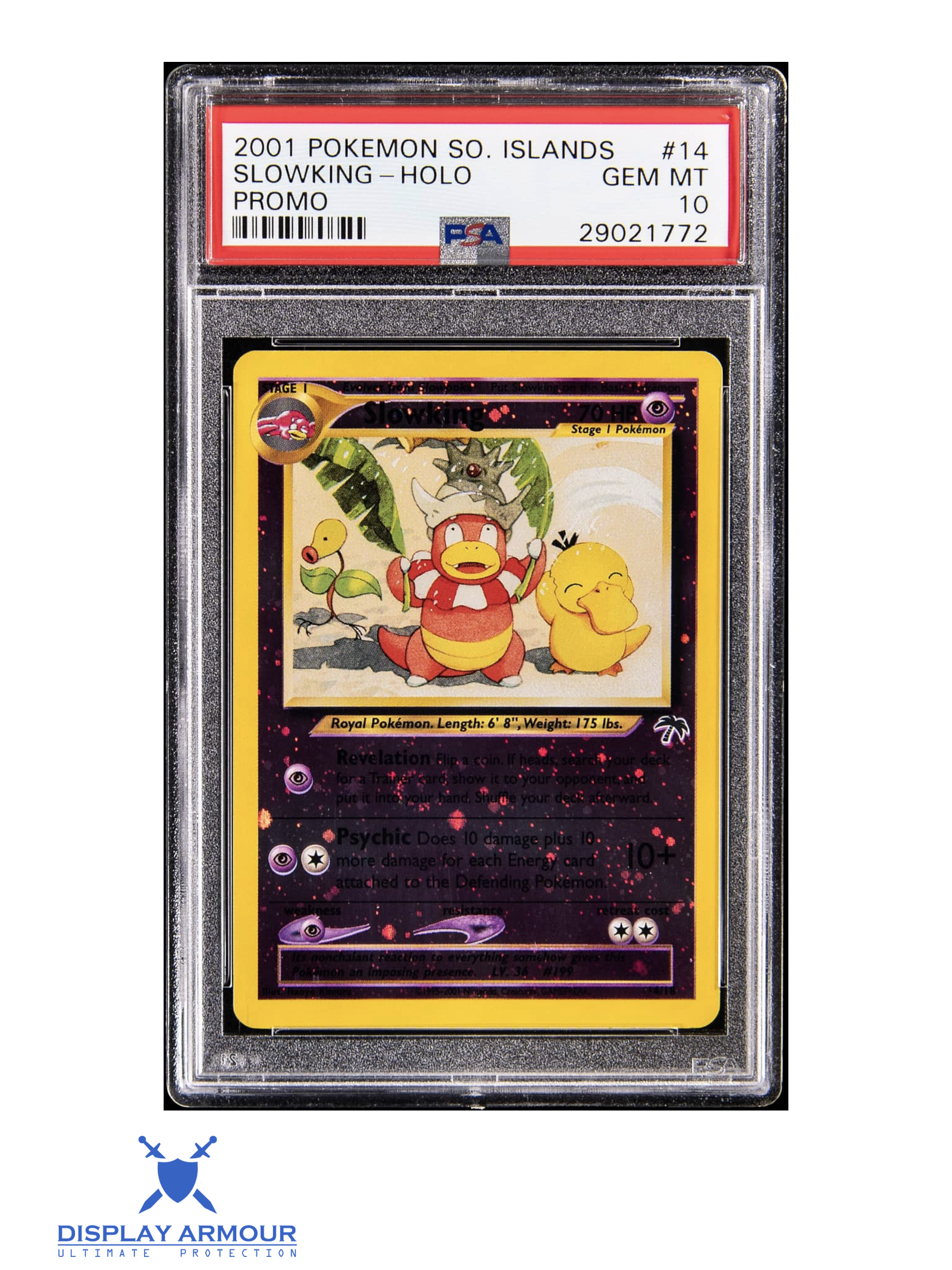
Southern Islands offers a compact illustrated collection outside the main expansion sequence. Slowking’s card belongs to that English release, rather than Neo Genesis. Collectors value the set’s connected presentation, while the holo surface makes the quality of an individual surviving card important.
$68,625 (approx. £52,000) is the documented PSA GEM MT 10 benchmark reported by Goldin on 14 September 2026. The PSA 10 result concerns the English Southern Islands holo; a Japanese edition or another Slowking issue has its own market. Primary sale evidence — Goldin.
80. No. 1 Trainer — 2011 World Championships — 2011 World Championships
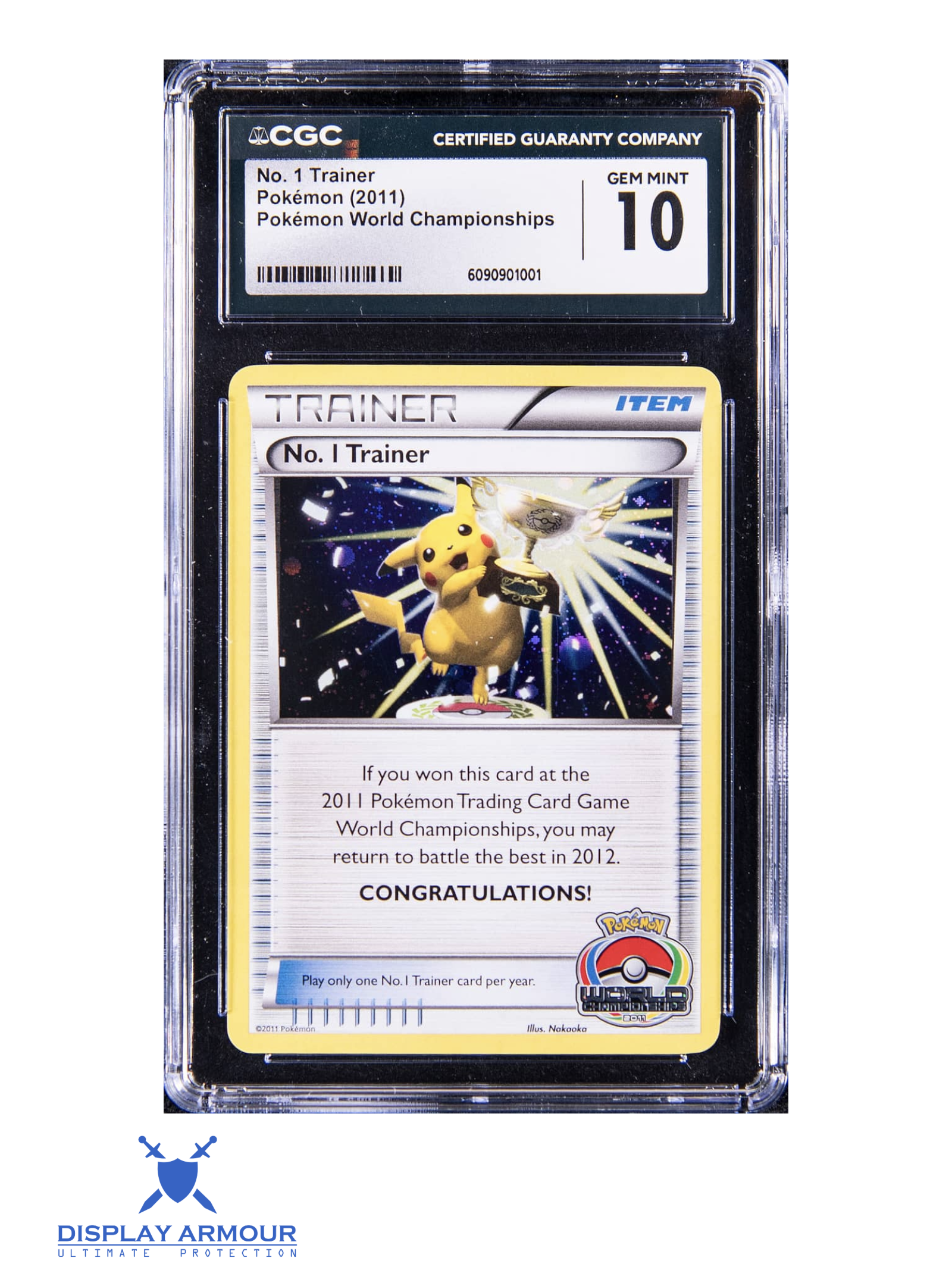
The 2011 No. 1 Trainer records a particular World Championships season and placing. Its value comes from competitive distribution and event identity, rather than booster rarity. The dated issue should stay separate from later first-place trophies, even where auction shorthand reduces them all to “No. 1 Trainer”.
$63,240 (approx. £47,900) is the documented CGC GEM MINT 10 benchmark reported by Goldin on 16 February 2026. The CGC Gem Mint 10 sold copy is the benchmark; another label or another tournament year is a different comparison. Primary sale evidence — Goldin.
81. Poncho-Wearing Pikachu — Mega Charizard Y — 2016 Japanese promo — 208/XY-P
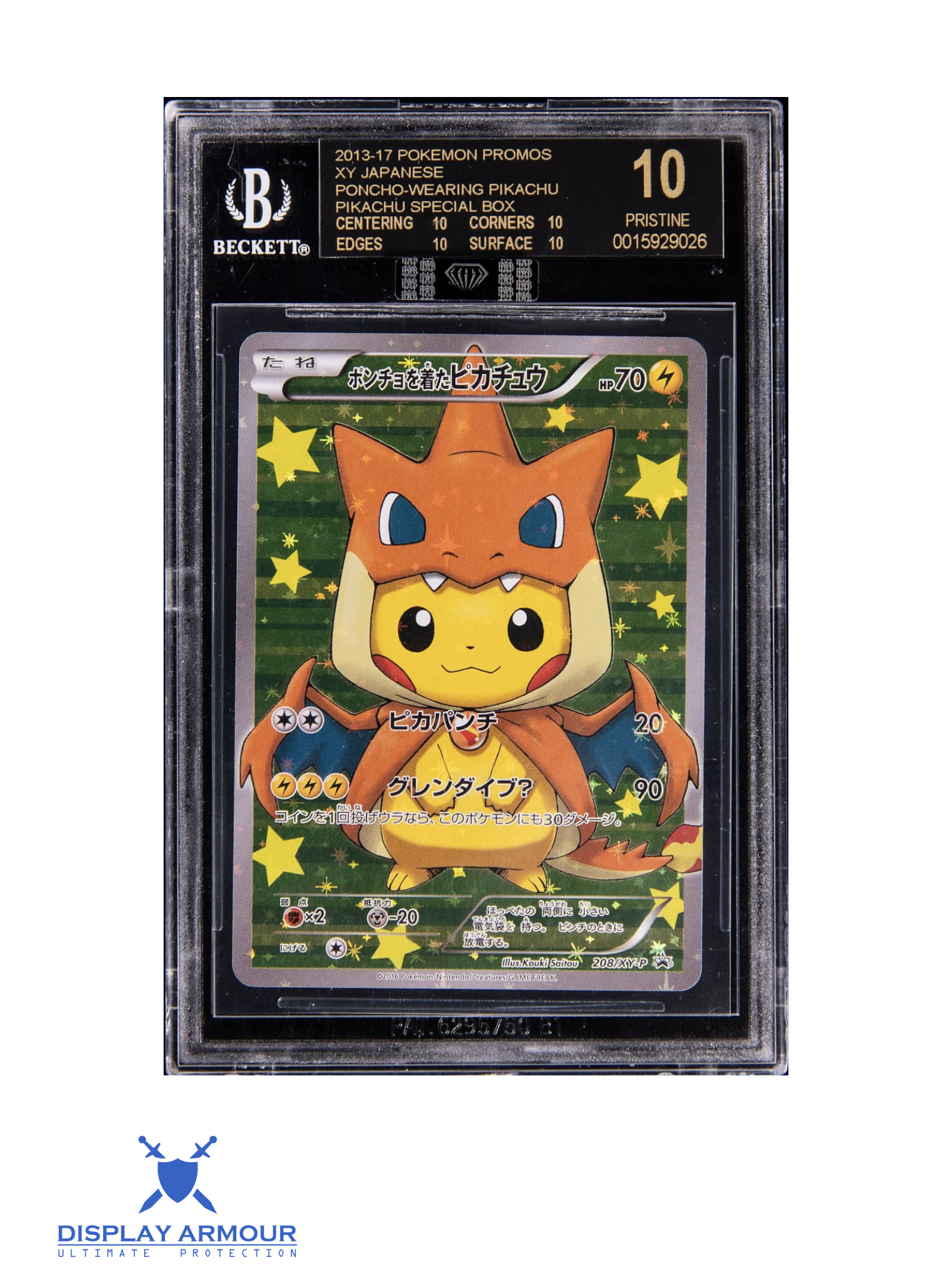
Illustration of this card; not verification of the cited sold copy or its grade.
The Mega Charizard Y version forms a natural pair with the Mega Charizard X promo but remains independently collected. Its bright full-art treatment is vulnerable to whitening and surface marks, making grade central to comparison. The $63,240 (approx. £47,900) figure is a high-end documented high-grade benchmark rather than a fixed market price; sealed provenance and individual eye appeal also affect transactions.
$63,240 (approx. £47,900) is the documented BGS 10 Black Label benchmark reported by Goldin on 16 February 2026. Primary sale evidence — Goldin.
82. Shining Mewtwo — Japanese Darkness, and to Light — 2001 Japanese Neo 4 — 150
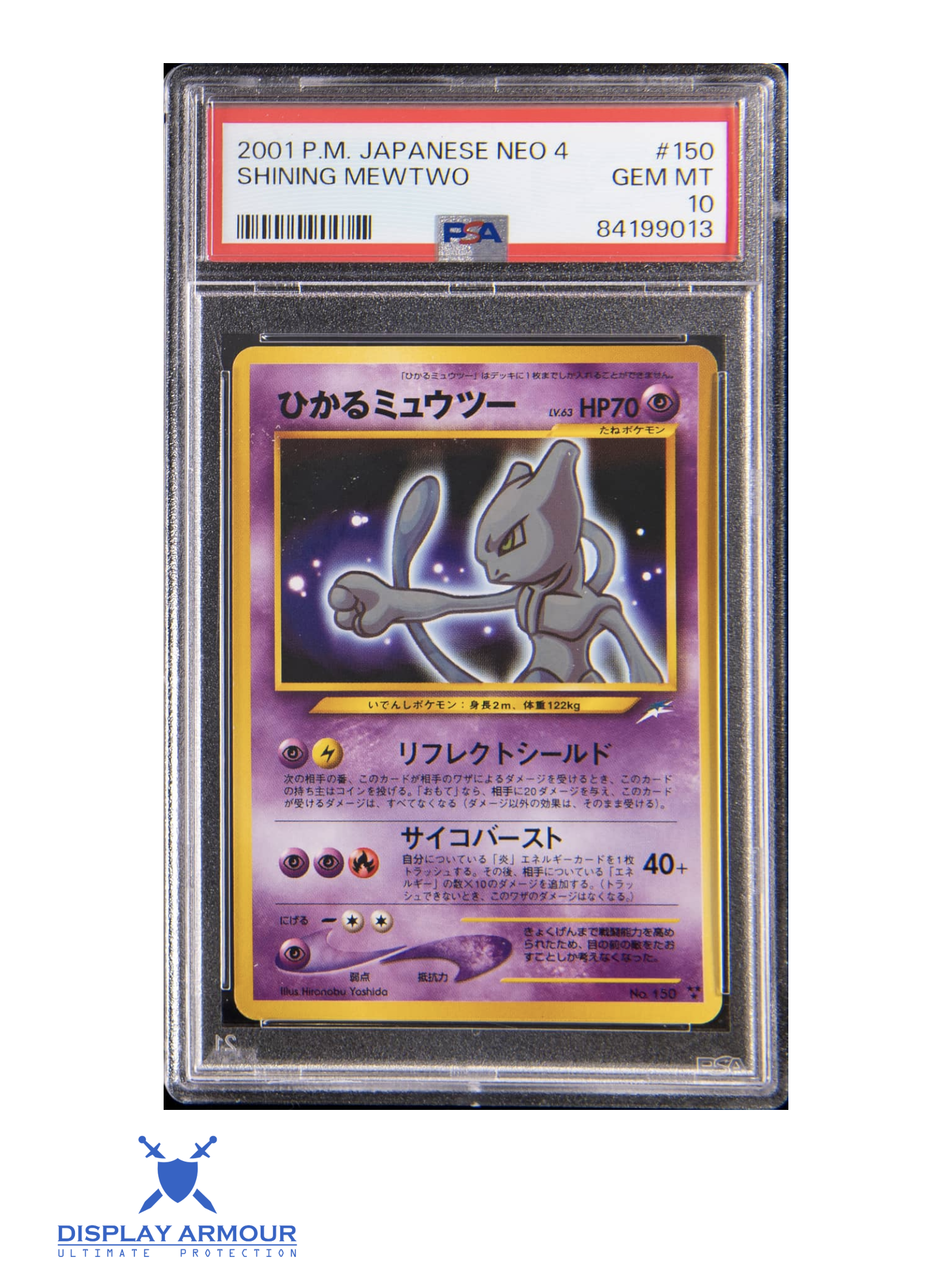
The Japanese Shining Mewtwo uses the Neo-era shiny Pokémon treatment in Darkness, and to Light. It is not the English First Edition Neo Destiny card elsewhere in the ranking. Language, printed numbering and the foil Pokémon distinguish the Japanese issue before the familiar artwork encourages a misleading comparison.
$62,220 (approx. £47,100) is the documented PSA GEM MT 10 benchmark reported by Goldin on 18 June 2026. This PSA 10 sale is for the Japanese card; the English First Edition price is listed separately. Primary sale evidence — Goldin.
83. Doug Ferguson GX — TPCi Farewell Promo — 2019 TPCi promo — TPCi01
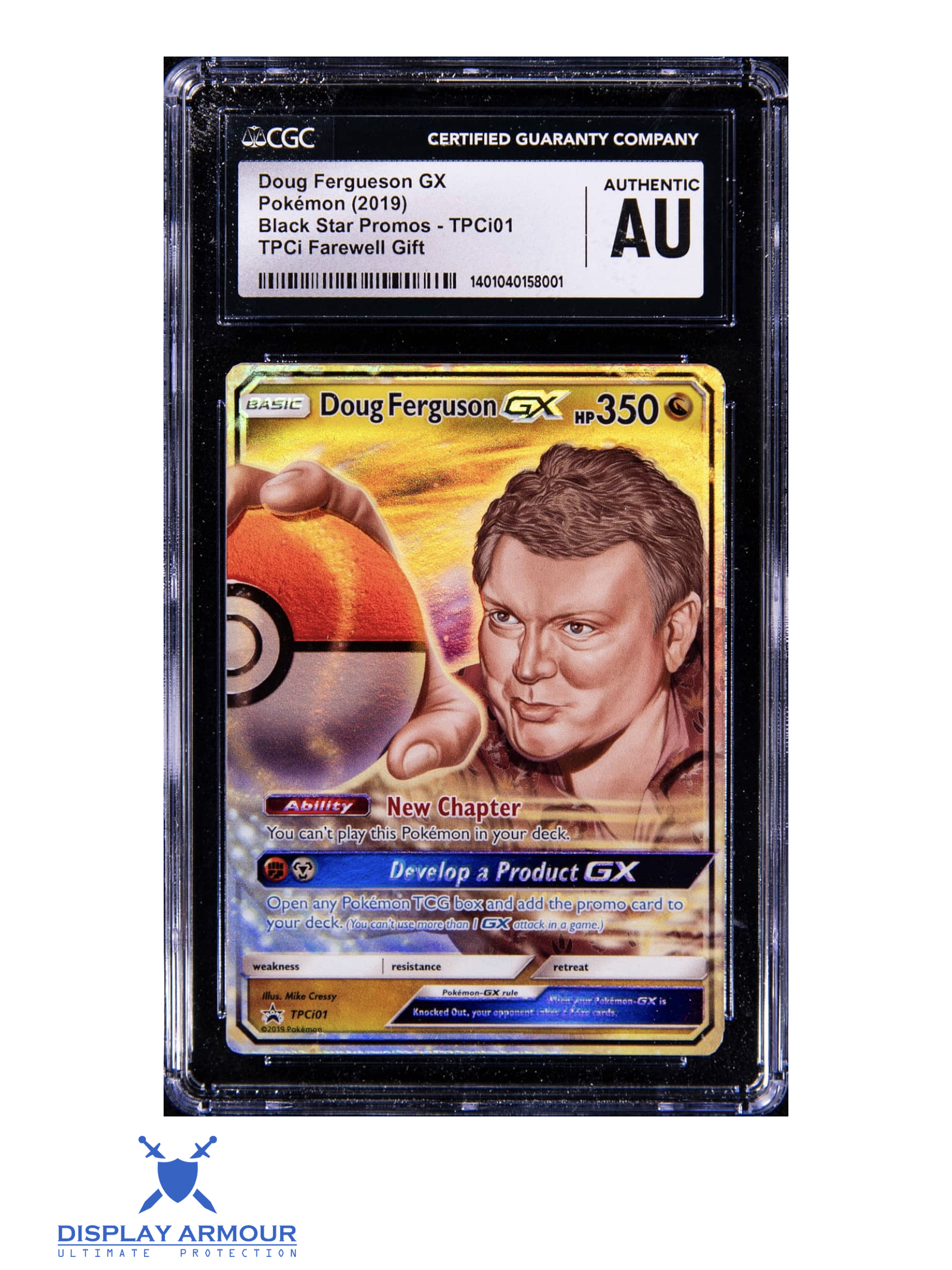
Doug Ferguson GX belongs to the personalised company-promo category rather than the ordinary Pokémon expansion checklist. Its named subject and farewell context distinguish it from Ishihara GX. Collectors approaching such material need the distribution story and authentication, because the usual pull-rate explanation does not apply.
$61,000 (approx. £46,200) is the documented CGC Authentic benchmark reported by Goldin on 1 December 2024. CGC Authentic is an authentication designation, not a numerical Mint grade; the company keepsake’s provenance is central. Primary sale evidence — Goldin.
84. Shining Mew — CoroCoro Promo — 2001 Japanese CoroCoro promo — 151
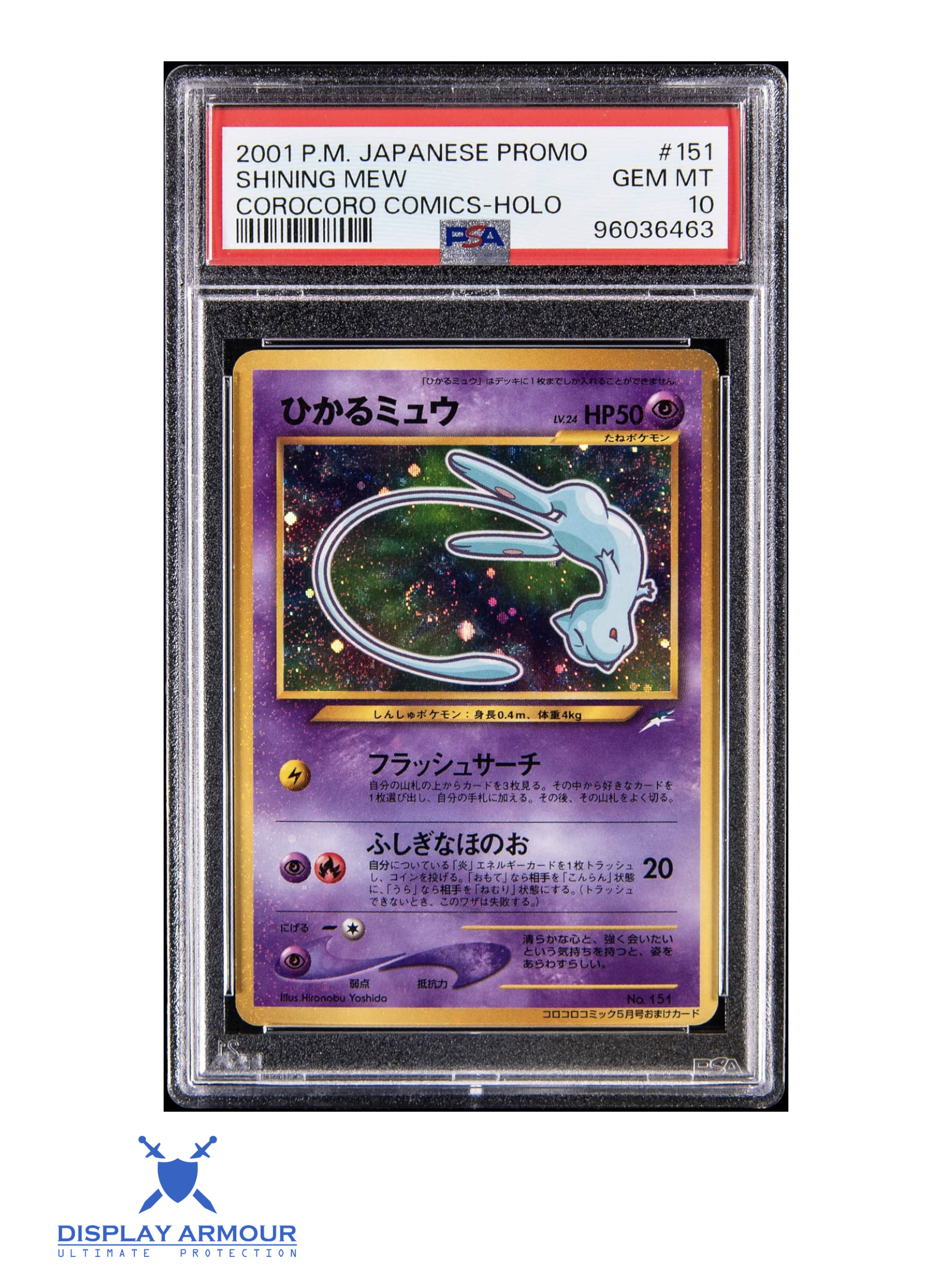
CoroCoro Shining Mew is a magazine-linked Japanese promo rather than a Neo Destiny set card. Its luminous Mew artwork gives the issue a distinct identity among early shiny Pokémon. Surface wear and print quality matter on the foil, so a recognisable image alone does not establish a top-grade example.
$61,000 (approx. £46,200) is the documented PSA GEM MT 10 benchmark reported by Goldin on 10 August 2026. The PSA 10 sale relates to the original CoroCoro issue, not a later Shining Mew printing. Primary sale evidence — Goldin.
85. Suicune Holo — Neo Revelation First Edition — 2001 Neo Revelation — 14/64
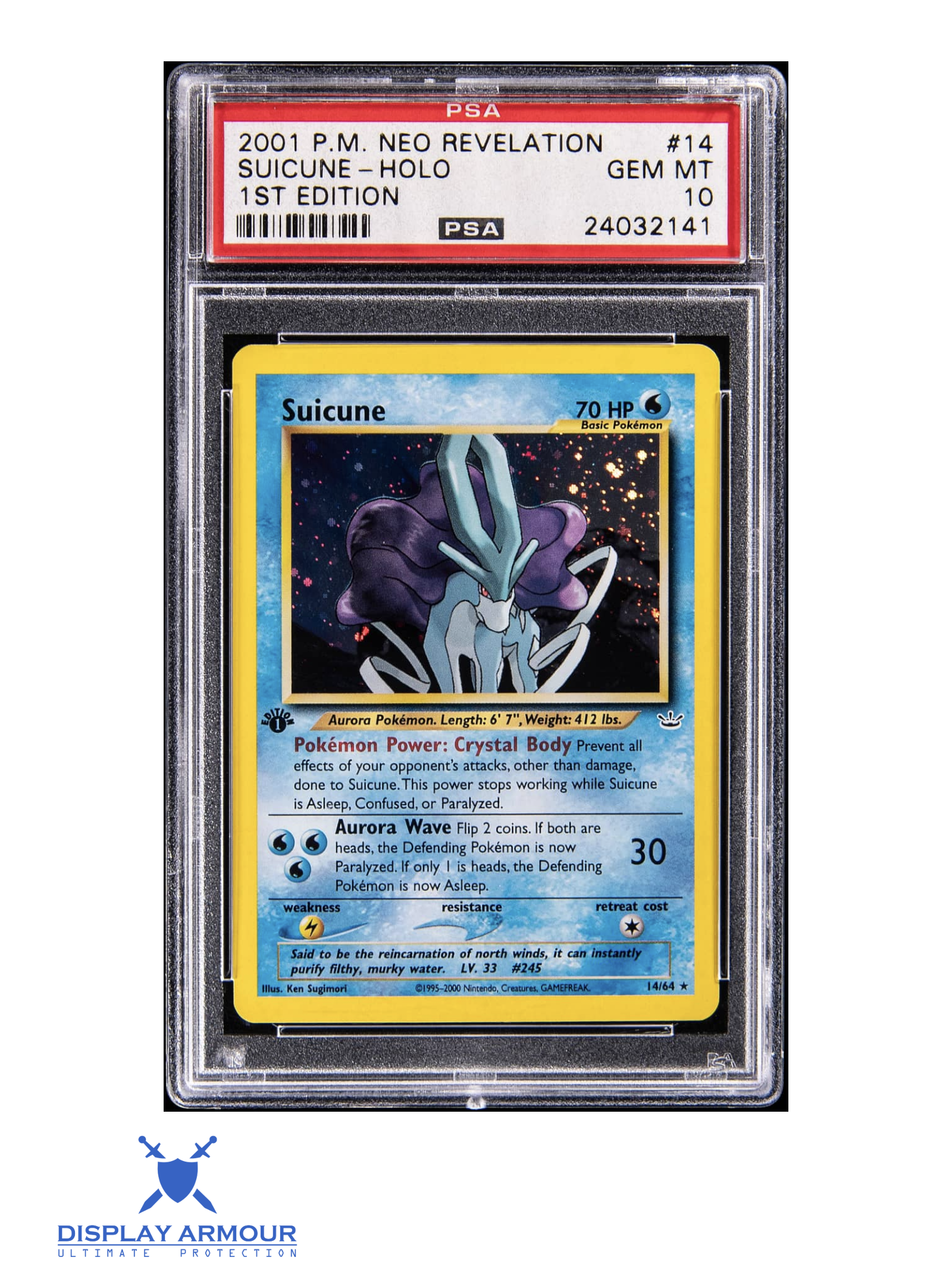
Suicune’s Neo Revelation holo is separate from the later Crystal, Gold Star and shiny promotional versions of the legendary Pokémon. The First Edition stamp identifies the early English printing. Its expansive pale foil and borders invite close inspection for scratching and whitening that a straight-on photograph can hide.
$60,173 (approx. £45,600) is the documented PSA GEM MT 10 benchmark reported by Goldin on 10 August 2026. The PSA 10 First Edition sale should not be used to price an unlimited or reverse variant. Primary sale evidence — Goldin.
86. Flareon Gold Star — Japanese PLAY Promo — 2005 Japanese PLAY Promo — 024/PLAY
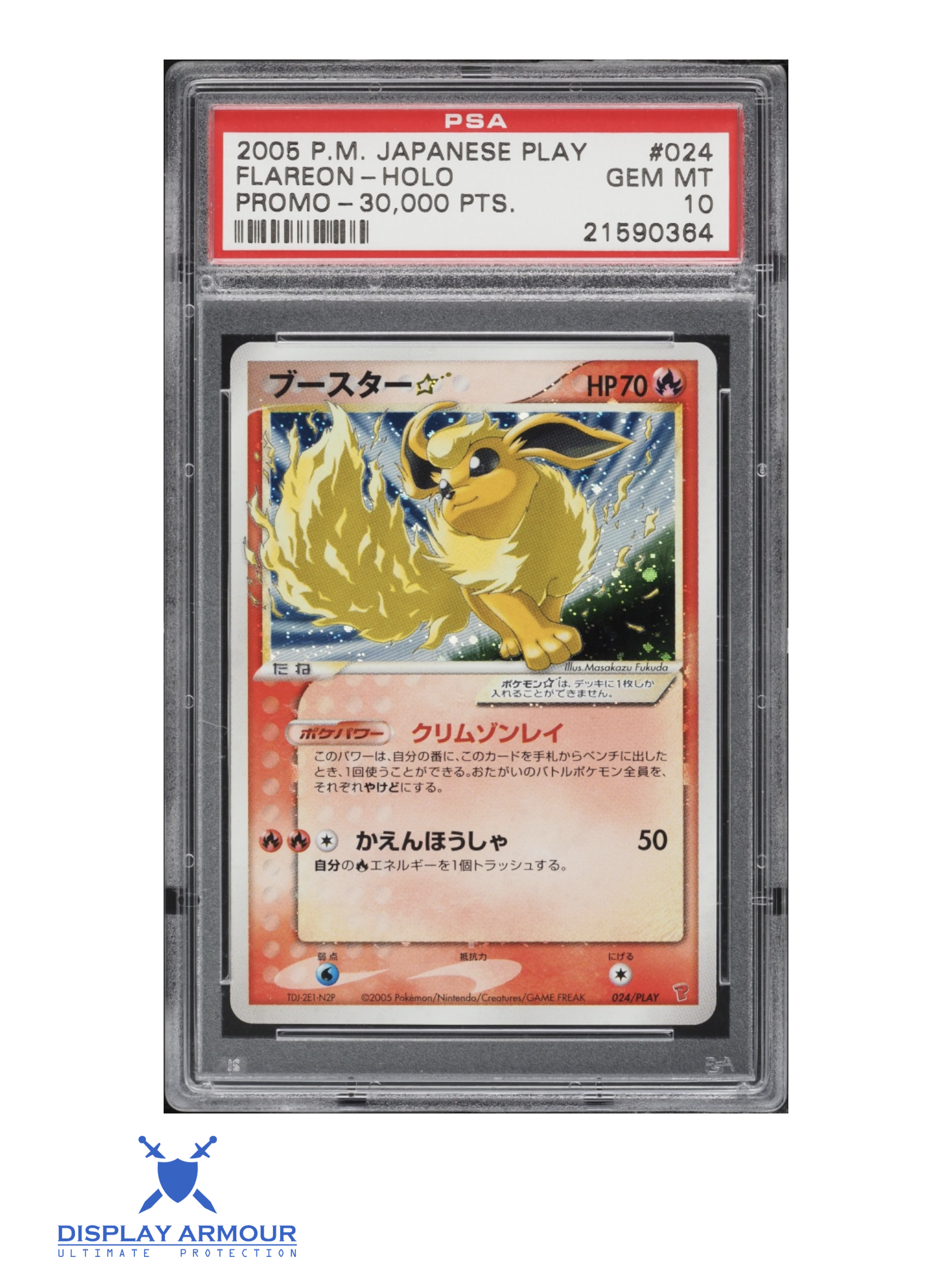
The Japanese PLAY Flareon Gold Star was a points-programme reward rather than an English EX Power Keepers pull. The 30,000-point designation and promo number identify its acquisition route. Eeveelution collectors may want both languages, but that collecting connection does not make them a single price comparison.
$60,000 (approx. £45,500) is the documented PSA 10 benchmark reported by Fanatics Collect on 17 August 2026. The PSA 10 reward issue is separate from the English Flareon Gold Star. Primary sale evidence — Fanatics Collect.
87. Exeggutor — Tropical Mega Battle Bilingual Promo — 1999 Tropical Mega Battle
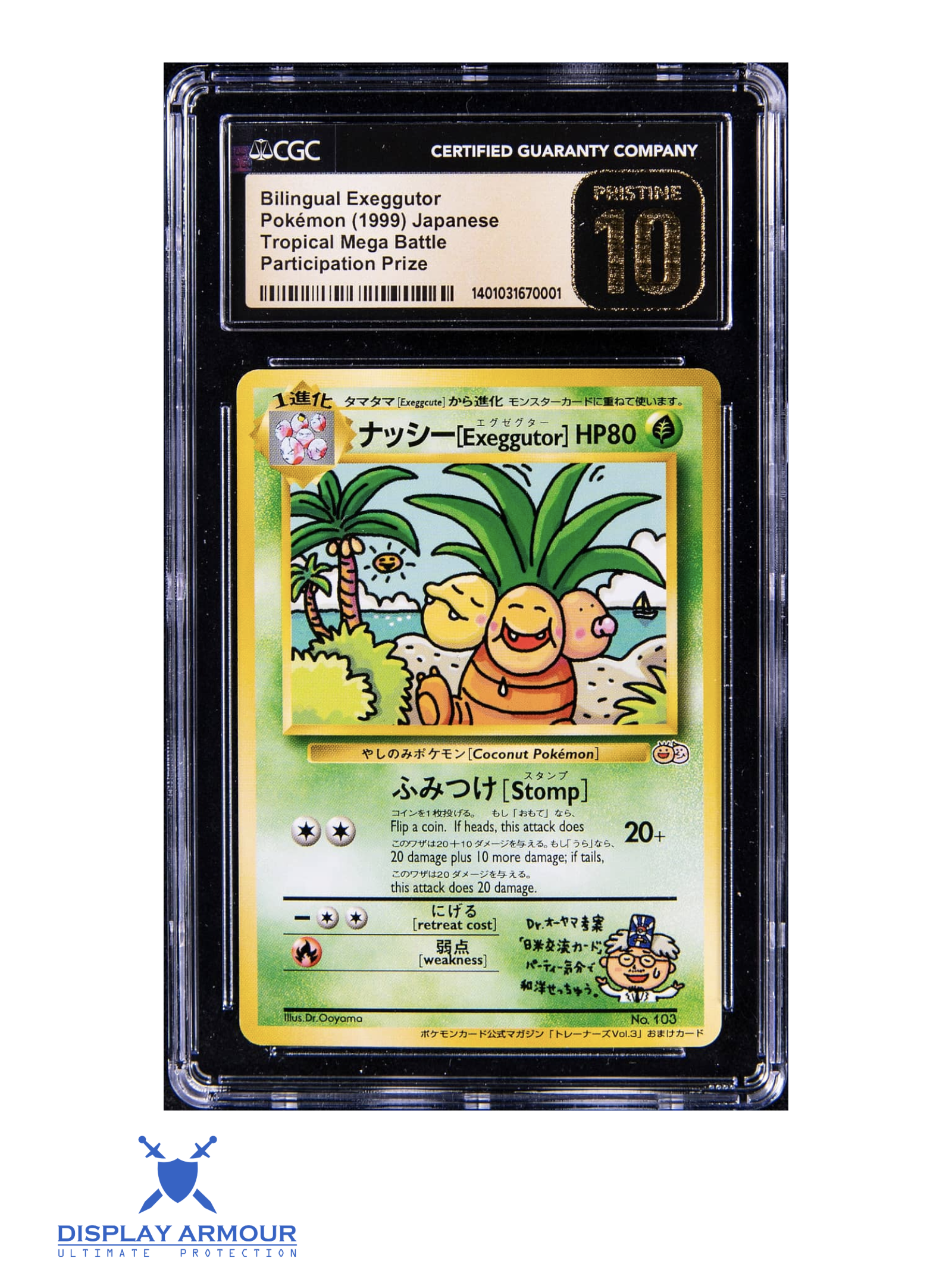
The bilingual Exeggutor connects card collecting with the international Tropical Mega Battle programme. It was event material rather than a standard expansion pull. Its language treatment and participation origin are essential to identification, particularly when an auction title uses the Japanese name or a different transliteration.
$59,780 (approx. £45,300) is the documented CGC PRISTINE 10 benchmark reported by Goldin on 21 July 2024. The CGC Pristine 10 result belongs to this bilingual event card, not any retail Exeggutor sharing the subject. Primary sale evidence — Goldin.
88. Charizard Holo — English Shadowless Unlimited — 1999 English Base Set — 4/102
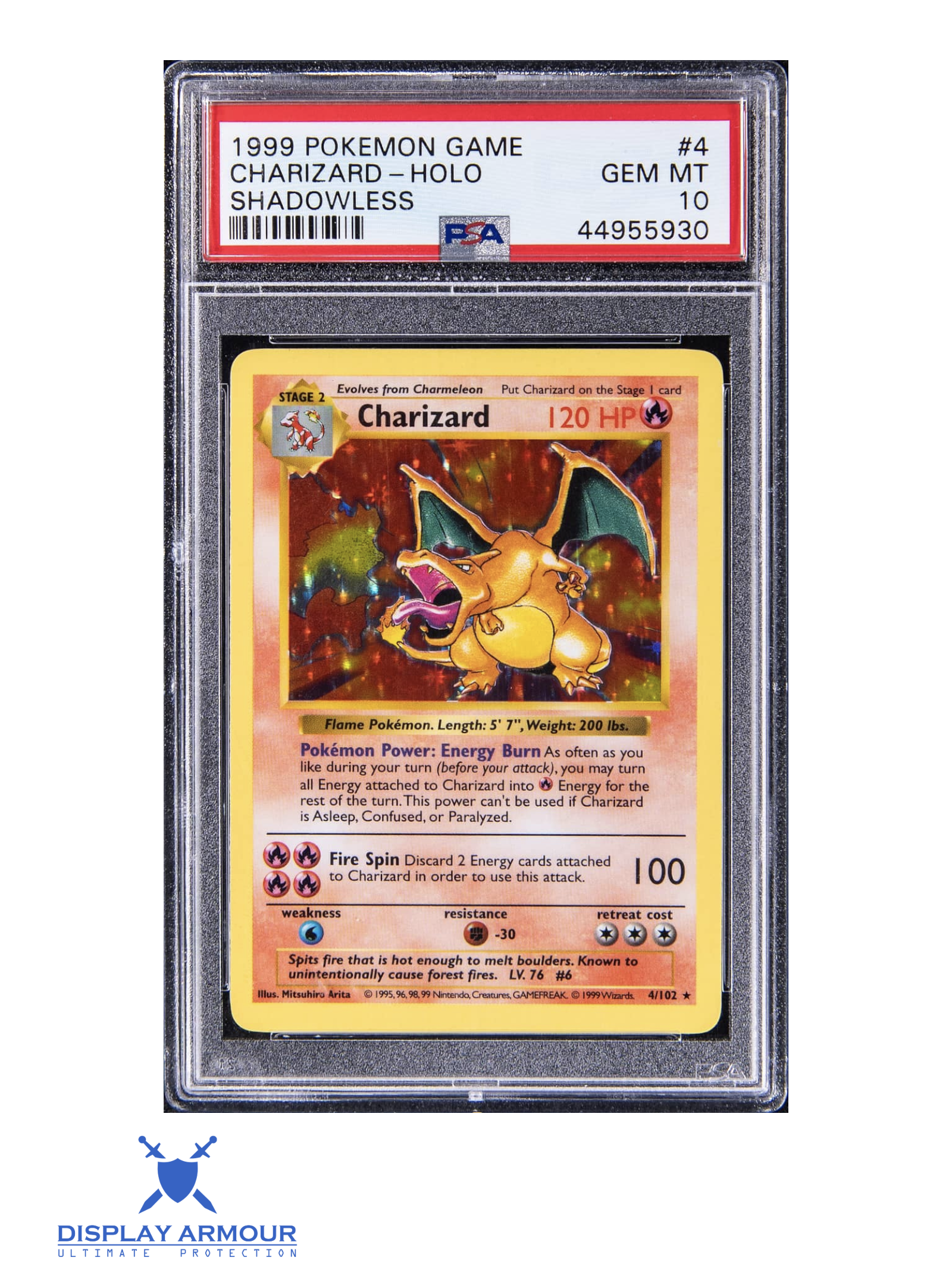
Shadowless unlimited Charizard retains the early English Base Set layout without carrying the First Edition stamp. It therefore has its own collecting identity between First Edition and the later shadowed printing. The same iconic picture appears across those releases, so inspecting the stamp area and frame is essential.
$55,293 (approx. £41,900) is the documented PSA GEM MT 10 benchmark reported by Goldin on 23 February 2025. The PSA 10 sold copy is the unstamped shadowless variant; it is not an additional grade-only entry for First Edition Charizard. Primary sale evidence — Goldin.
89. Dragonite Holo — Expedition — 2002 Expedition — 9/165
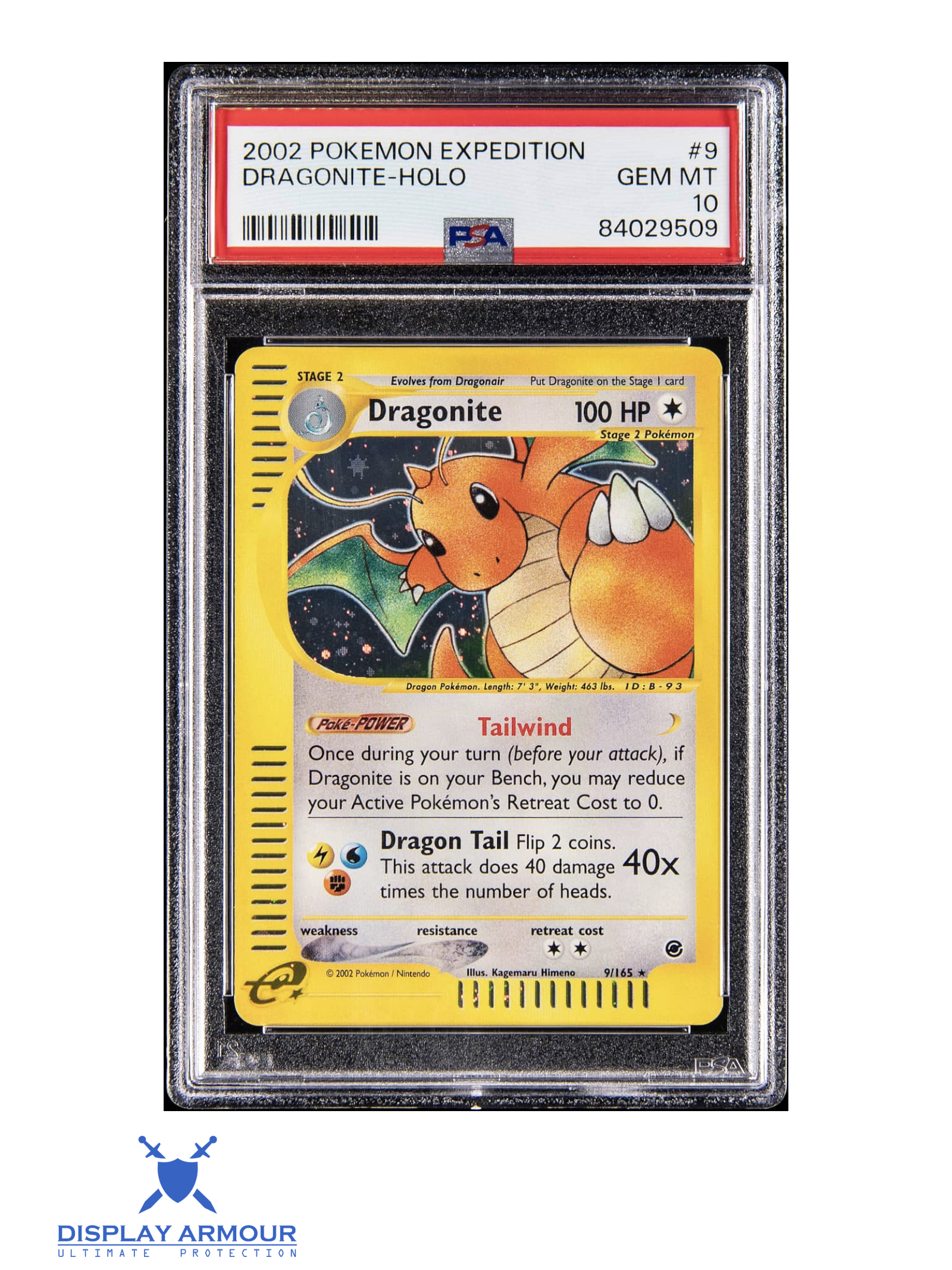
Expedition Dragonite pairs a popular original Pokémon with the e-Reader border and the expansion’s separately numbered holo checklist. The large artwork area makes presentation a strong part of its appeal. The foil version must be distinguished from a reverse holo or a non-holo card with related artwork.
$55,244 (approx. £41,800) is the documented PSA GEM MT 10 benchmark reported by Goldin on 18 June 2026. The PSA 10 holo result is tied to number 9/165 and should not be applied to another Expedition Dragonite variant. Primary sale evidence — Goldin.
90. Crystal Lugia — Japanese Wind from the Sea First Edition — 2002 Wind from the Sea — 090/087
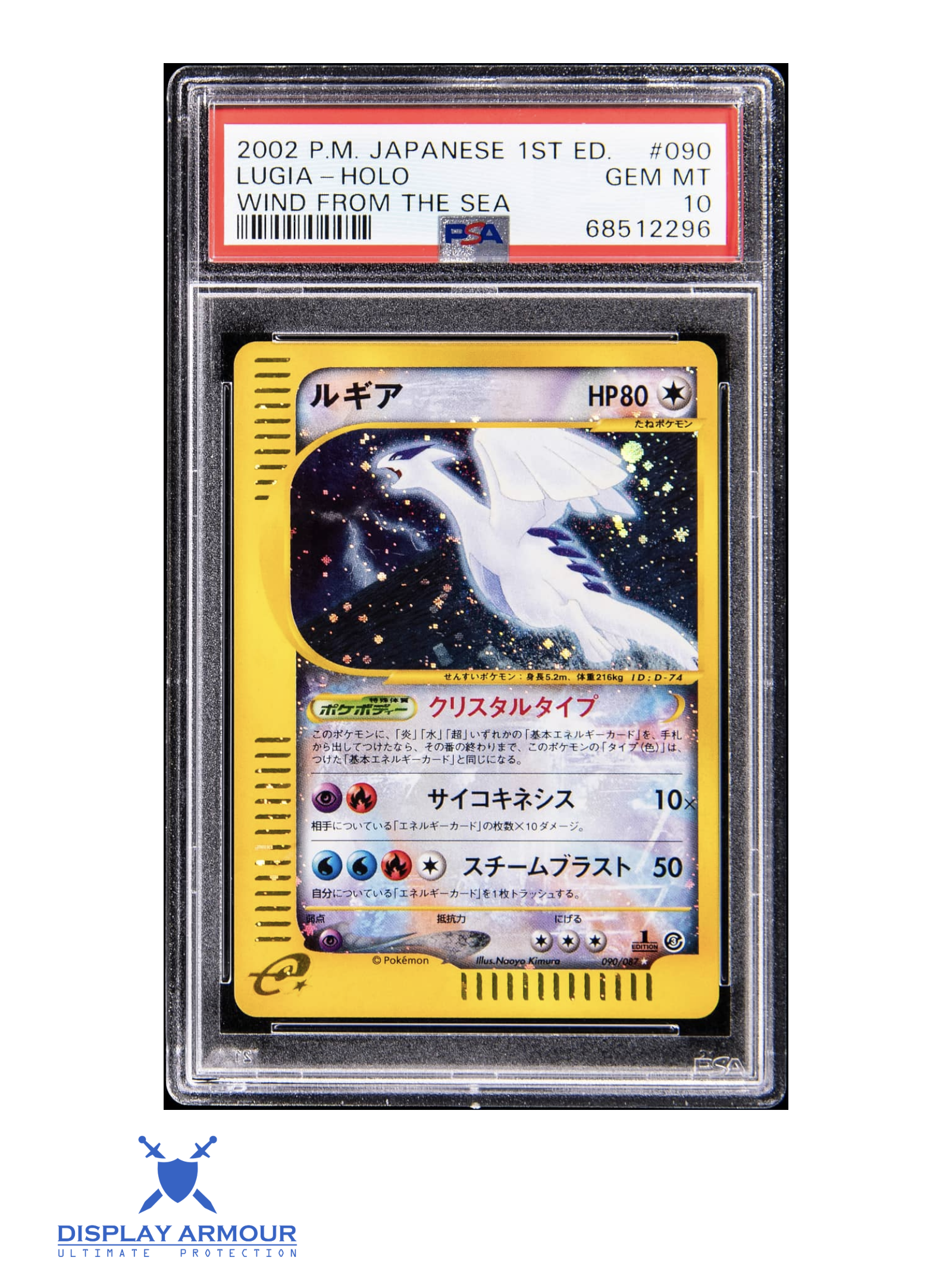
This Japanese Crystal Lugia belongs to Wind from the Sea, rather than the English Aquapolis release. The secret-rare numbering and First Edition designation identify the printing. Crystal Type collecting often crosses languages, but identical artwork does not erase the different production and distribution histories.
$54,290 (approx. £41,100) is the documented PSA GEM MT 10 benchmark reported by Goldin on 10 August 2026. The PSA 10 Japanese First Edition benchmark stays separate from English Aquapolis Lugia and the Japanese unlimited issue. Primary sale evidence — Goldin.
91. Umbreon Holo — 2003 Skyridge
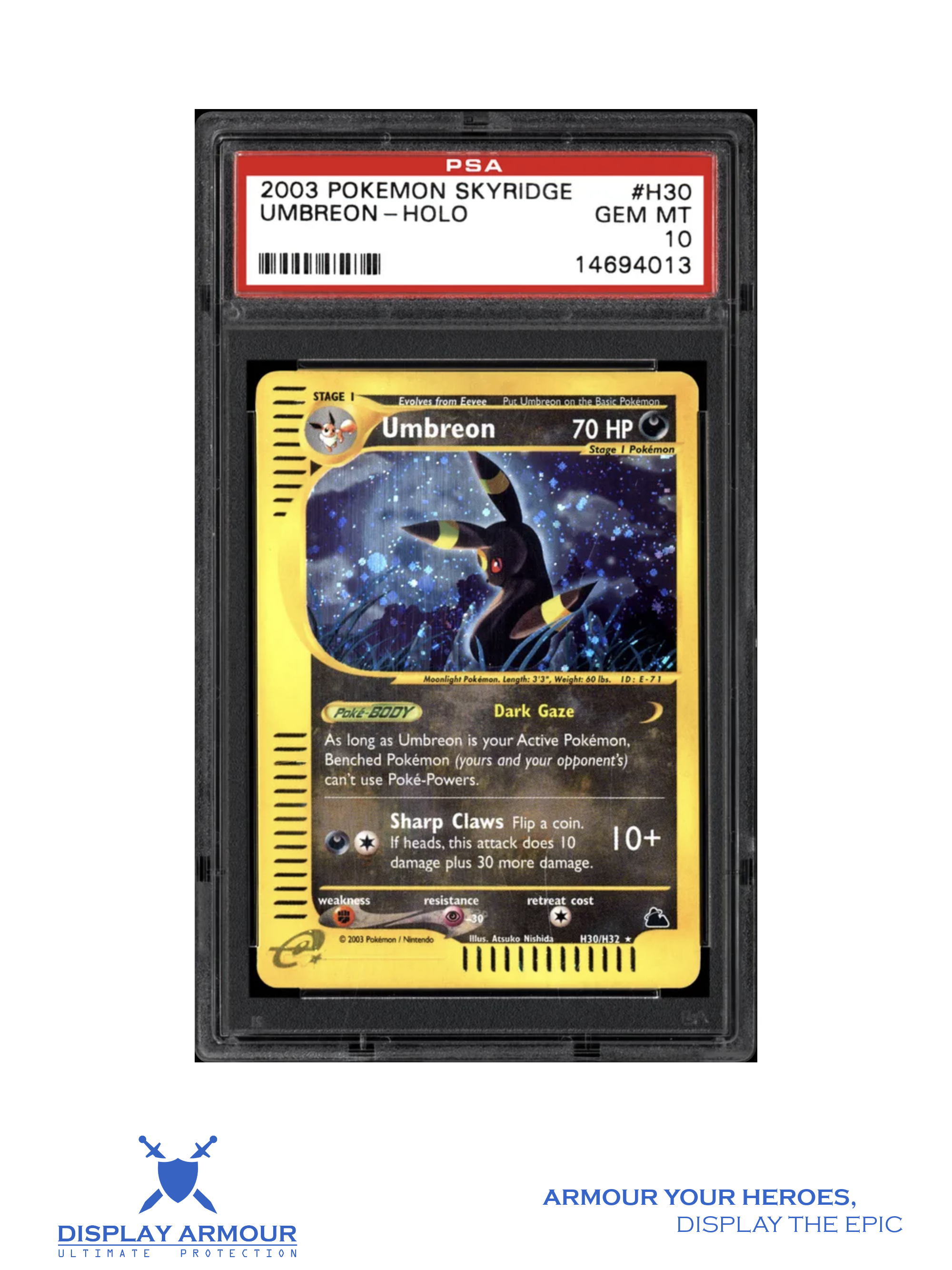
Illustration of this card; not verification of the cited sold copy or its grade.
Skyridge Umbreon H30/H32 belongs to the set’s separate H-series holo run. The e-Reader layout, low availability of Skyridge product and Umbreon’s enduring popularity combine with a condition-sensitive holo surface. Its $51,240 (approx. £38,800) benchmark is PSA 10-specific; reverse-holo and non-holo variants use different numbering and should be identified separately. Confirm the H30/H32 designation before comparing sales.
$51,240 (approx. £38,800) is the documented PSA 10 benchmark reported by Goldin on 18 May 2026. Primary sale evidence — Goldin.
92. Pokémon Snap Gyarados — 1999 Snap Promo

Illustration of this card; not verification of the cited sold copy or its grade.
Snap Gyarados combines the photographic contest format with one of Pokémon’s most dramatic creatures. The winning in-game image was printed as a prize card, placing it outside normal set collecting. Its $51,113 (approx. £38,700) award-copy benchmark is highly copy-specific. Provenance and authentication are essential because public transactions are sparse and every Snap subject has an independent supply story.
$51,113 (approx. £38,700) is the documented PSA 7 benchmark reported by Goldin on 4 May 2025. Primary sale evidence — Goldin.
93. Pikachu ex Special Illustration Rare — Ascended Heroes — 2026 Ascended Heroes — 276
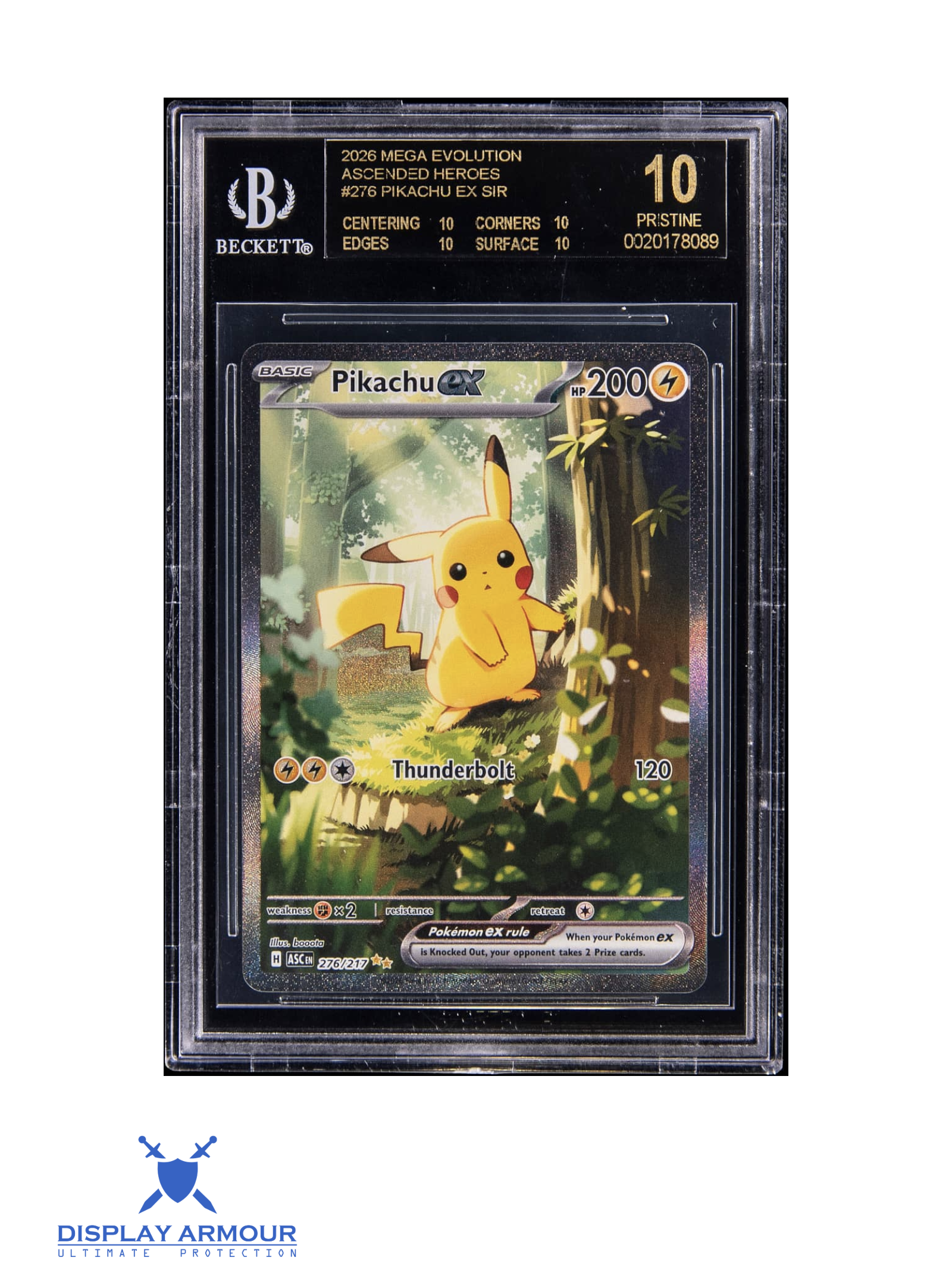
Ascended Heroes Pikachu ex represents the modern high-grade end of mascot collecting. The special illustration rare is identified by its number and textured full-card presentation, rather than simply the name Pikachu ex. Retail distribution means its supply story differs fundamentally from contest Pikachu prizes.
$50,020 (approx. £37,900) is the documented BGS PRISTINE/Black Label 10 benchmark reported by Goldin on 18 June 2026. The BGS Black Label sale is an exceptional grade benchmark; current raw-card supply should be assessed independently. Primary sale evidence — Goldin.
94. Rocket’s Snorlax ex — EX Team Rocket Returns — 2004 EX Team Rocket Returns — 104/109
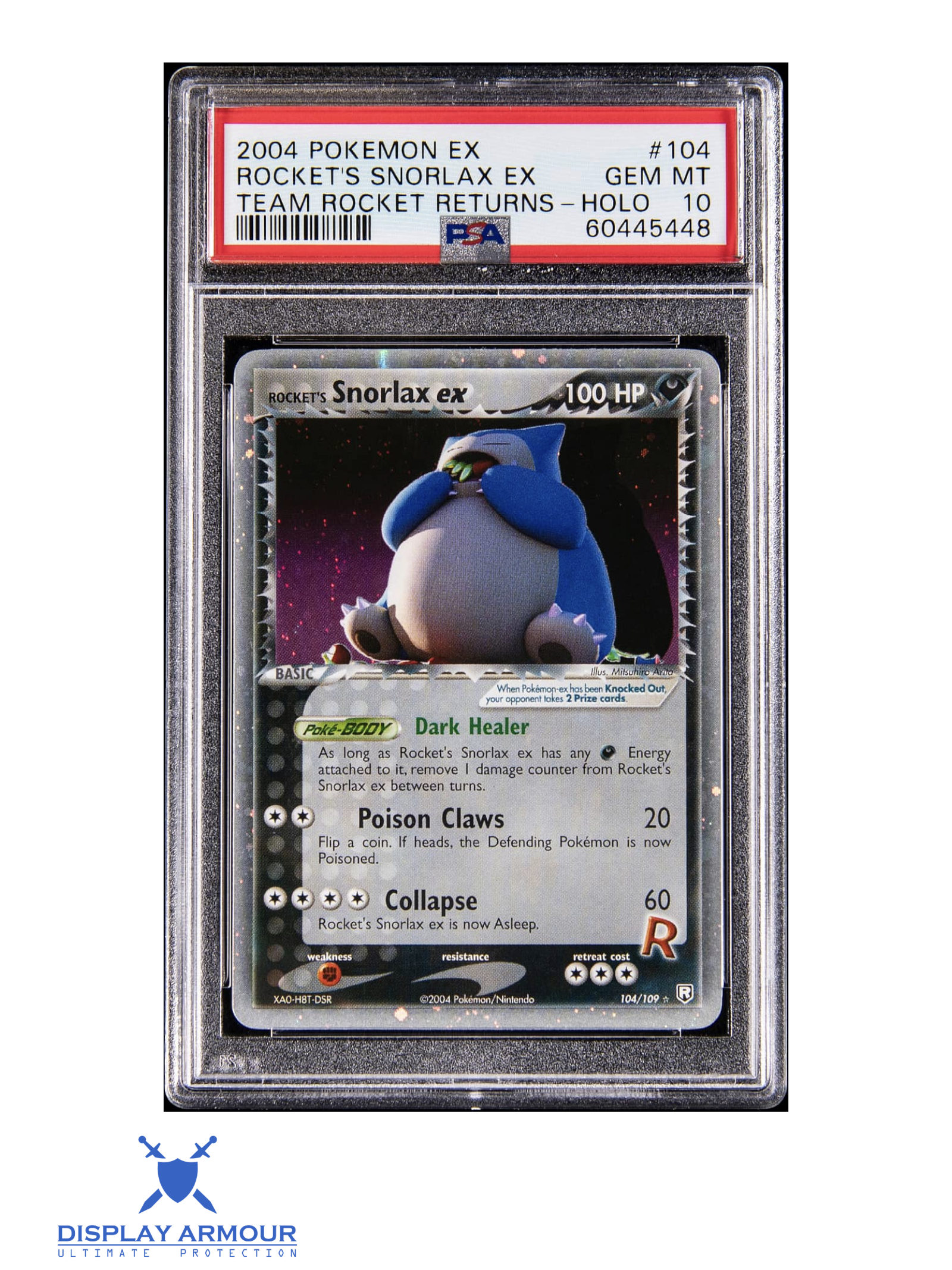
Rocket’s Snorlax ex belongs to Team Rocket Returns’ Pokémon-ex group, rather than its Gold Stars. The Rocket affiliation and Snorlax’s distinctive subject give it a collecting identity of its own. The EX-era foil and edges need careful examination before comparing an appealing raw copy with a Gem Mint sale.
$49,694 (approx. £37,600) is the documented PSA GEM MT 10 benchmark reported by Goldin on 10 August 2026. The PSA 10 result is specific to this English Pokémon-ex card, not Snorlax LV.X or another Rocket issue. Primary sale evidence — Goldin.
95. Mega Gengar ex Special Illustration Rare — Ascended Heroes — 2026 Ascended Heroes — 284
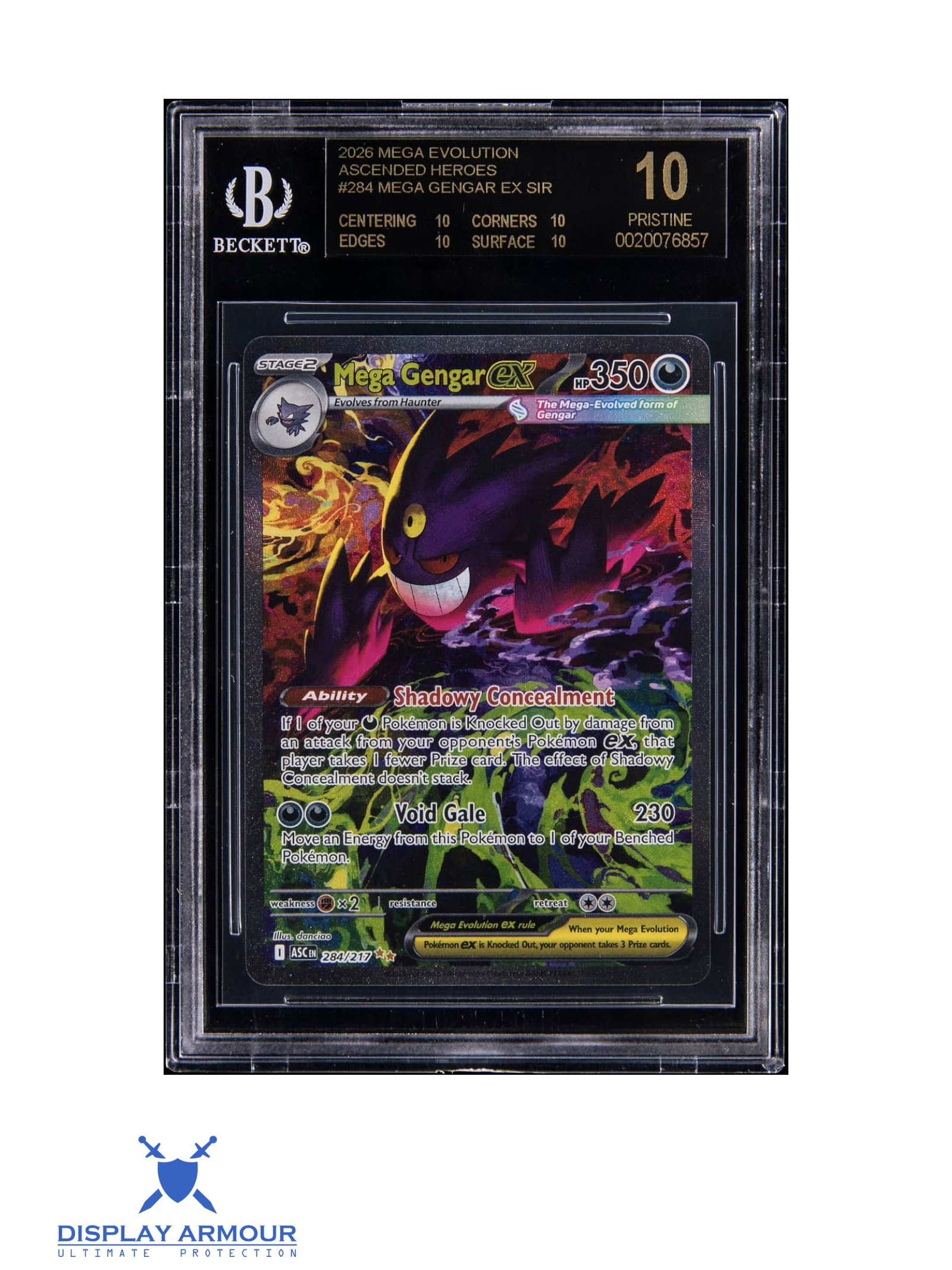
Mega Gengar ex brings Gengar collecting into the 2026 special-illustration-rare market. The exact expansion and card number separate it from earlier Gengar EX, GX and VMAX designs. Collectors should look at the textured surface and reverse, because modern full-art appearance can conceal small grading defects.
$49,460 (approx. £37,500) is the documented BGS PRISTINE/Black Label 10 benchmark reported by Goldin on 11 May 2026. This BGS Black Label total should not be mistaken for a stable average for all Mega Gengar ex copies. Primary sale evidence — Goldin.
96. Pikachu Gold Star — Japanese Gift Box Mew — 2005 Japanese Gift Box Mew — 001
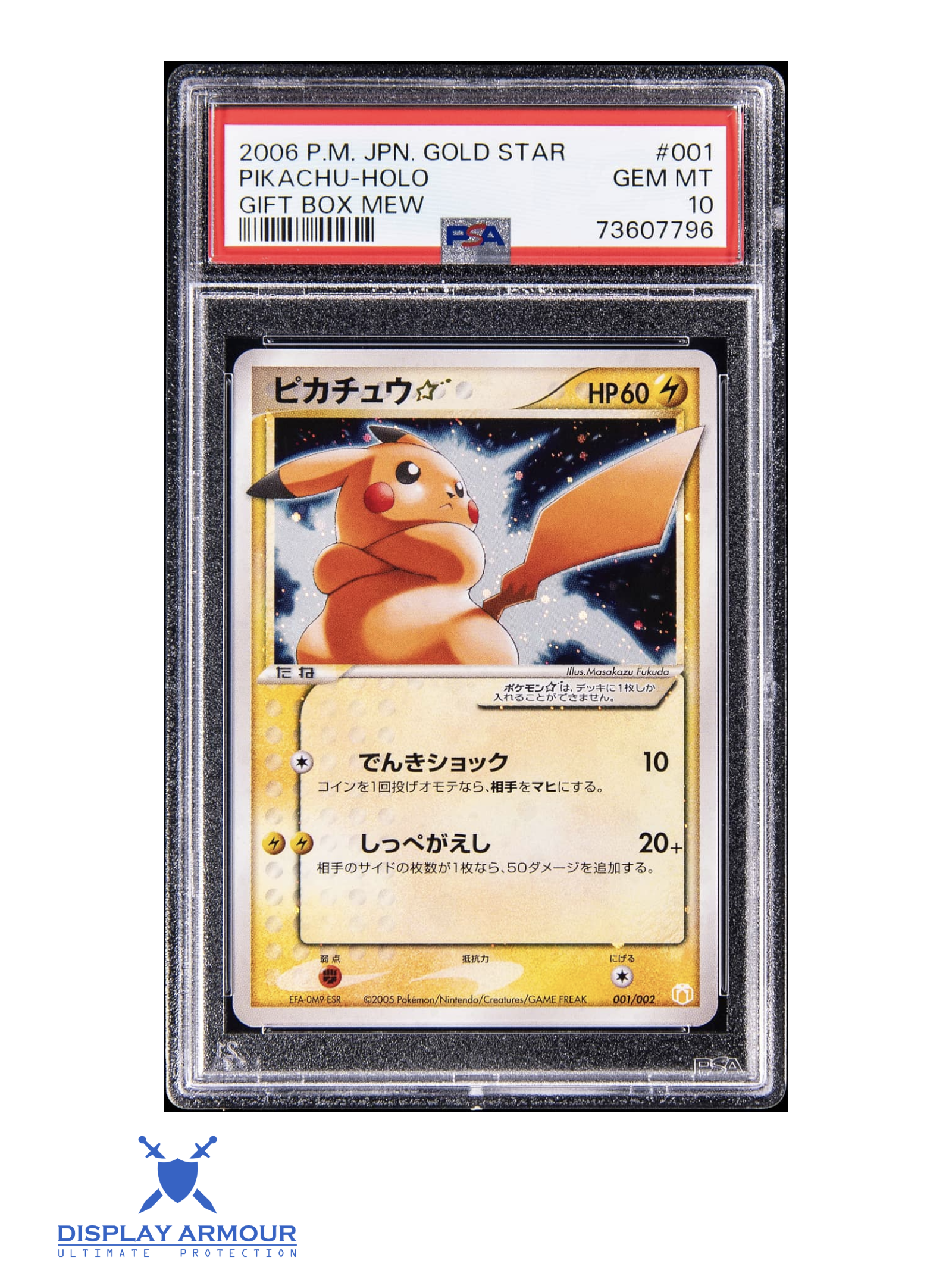
The Japanese Gift Box Mew Pikachu Gold Star has a promotional route different from the English Holon Phantoms card. The familiar Gold Star artwork encourages pair collecting across languages, but the Japanese promo number is its own identifier. Language and distribution must stay attached to the price.
$49,410 (approx. £37,400) is the documented PSA GEM MT 10 benchmark reported by Goldin on 10 August 2026. The PSA 10 Japanese gift-box copy is distinct from the English retail Gold Star ranked elsewhere. Primary sale evidence — Goldin.
97. Metagross Gold Star — 2005 EX Delta Species — 113/113
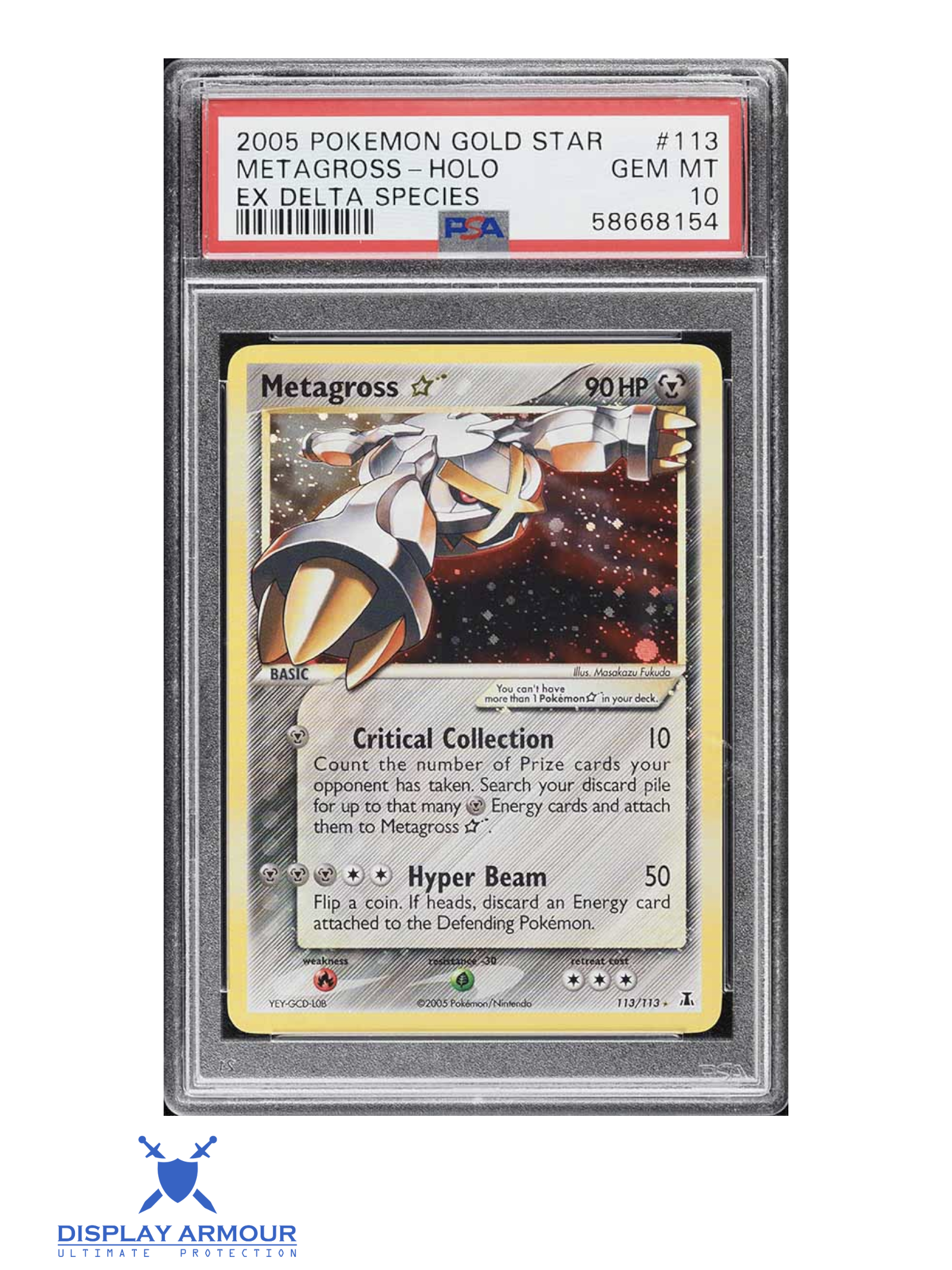
Illustration of this card; not verification of the cited sold copy or its grade.
Metagross Gold Star 113/113 closes the numbered EX Delta Species set and depicts the silver shiny form breaking through the frame. It is scarcer in Gem Mint condition than its clean geometry may suggest. The $48,000 (approx. £36,400) benchmark is attached to PSA 10 examples; inspect foil scratches, corners and back-edge whitening before comparing an ungraded copy.
$48,000 (approx. £36,400) is the documented PSA 10 benchmark reported by Fanatics Collect on 29 June 2026. Platform historical sold amount; current listing figure is not used. Primary sale evidence — Fanatics Collect.
98. Feraligatr Holo — Neo Genesis First Edition — 2000 Neo Genesis — 5/111
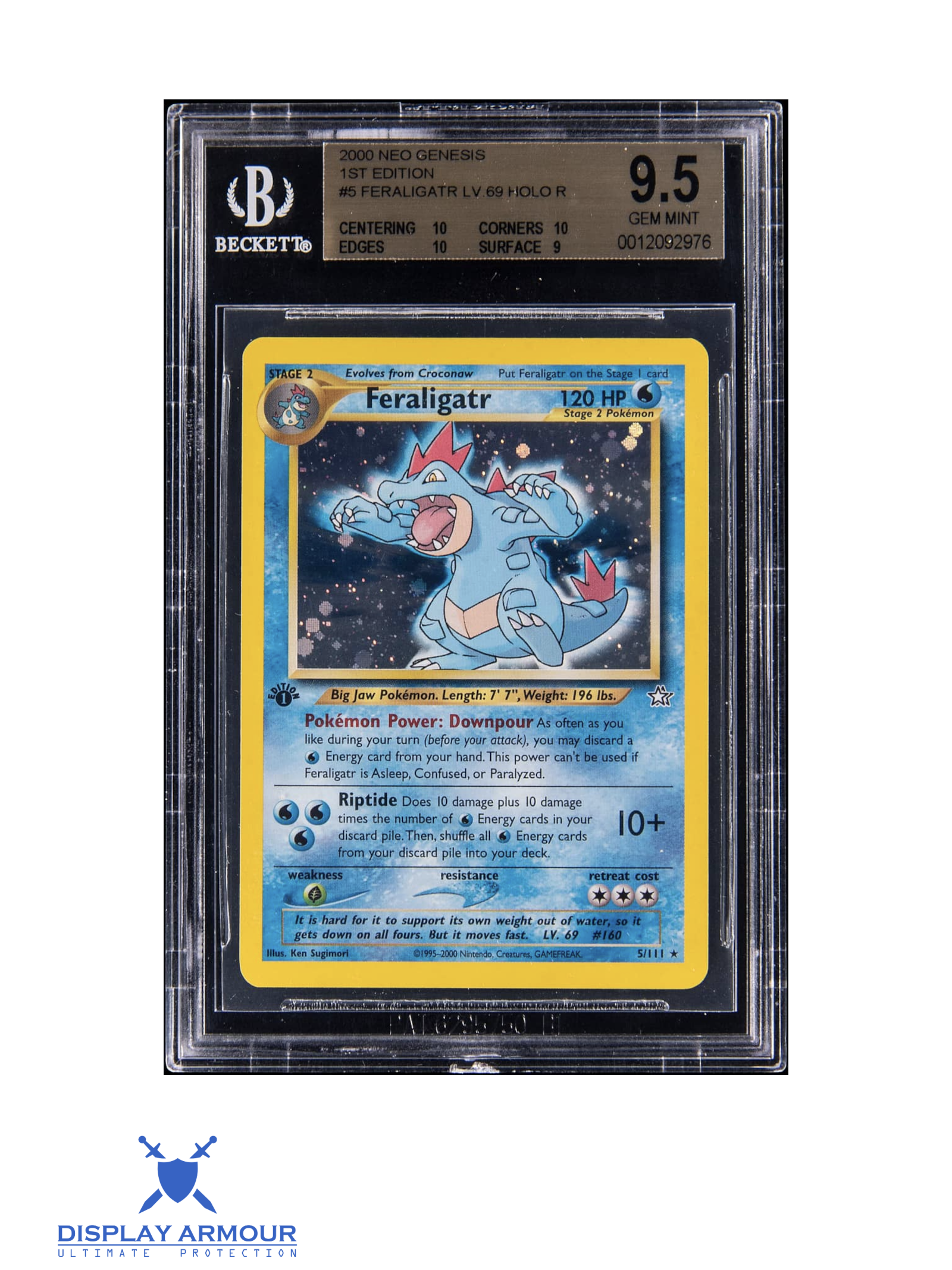
Neo Genesis includes more than one Feraligatr holo. Number 5/111 and the First Edition stamp identify this example, rather than the Pokémon name alone. Its foil, printed borders and reverse need close inspection, especially when comparing different grading companies’ top-condition labels.
$38,003 (approx. £28,800) is the documented BGS GEM MINT 9.5 benchmark reported by Goldin on 21 September 2026. The BGS 9.5 sale is retained as graded; a PSA 10 or the other Feraligatr artwork is not an interchangeable comparable. Primary sale evidence — Goldin.
99. No. 1 Trainer — 2013 World Championships — 2013 World Championships
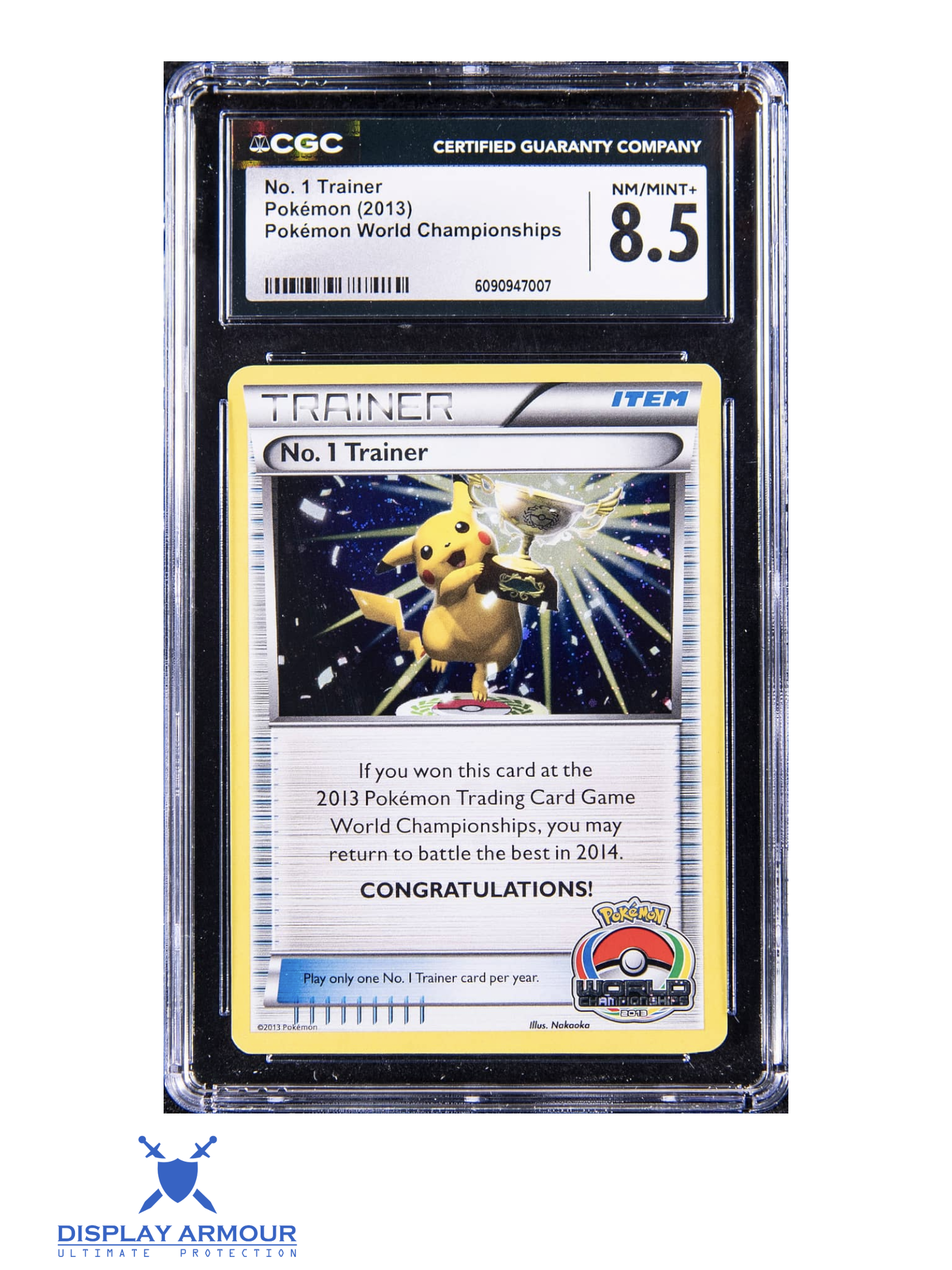
The 2013 World Championships first-place Trainer is a dated achievement prize. A trophy collection can include many No. 1 Trainers without containing duplicates, provided each year and event is recorded. Its collecting story lies in the competition and recipient history rather than mass-market scarcity.
$37,824 (approx. £28,700) is the documented CGC NM-MT+ 8.5 benchmark reported by Goldin on 6 April 2026. This CGC 8.5 event copy supplies the benchmark; condition and provenance still matter even when distribution is restricted. Primary sale evidence — Goldin.
100. Gengar Holo — Skyridge — 2003 Skyridge — H9/H32
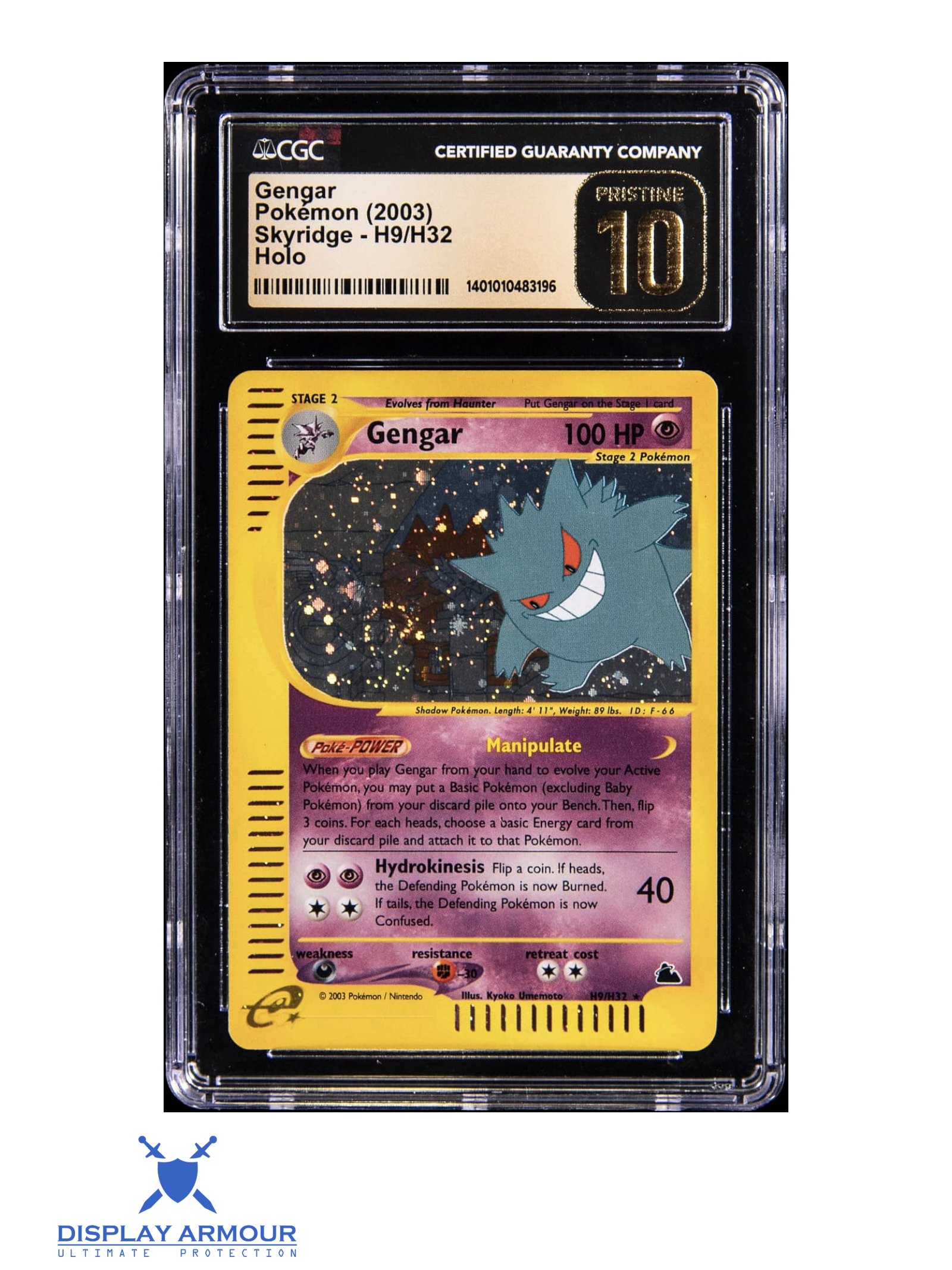
Skyridge Gengar belongs to the expansion’s H-series holo checklist. That is distinct from Expedition Gengar and from Skyridge’s reverse-holo or non-holo treatments. The e-Reader frame, dark artwork and foil make condition inspection important, but the H9 identifier must be established before comparing prices.
$37,820 (approx. £28,600) is the documented CGC PRISTINE 10 benchmark reported by Goldin on 18 June 2026. The CGC Pristine 10 result is for H9/H32; it is not a second entry for Legendary Collection Gengar. Primary sale evidence — Goldin.
Quick collector answers
What makes a Pokémon card valuable?
What is the rarest and most valuable Pokémon card?
Pikachu Illustrator leads this 2026 ranking at the $16,492,000 Goldin auction-lot total, including necklace and personal-delivery extras. “Rarest” can mean fewest produced, fewest surviving or fewest authenticated, so a scarcer trophy or test print need not have the highest completed sale.
Which Pokémon cards are worth money?
Early tournament trophies, contest prizes, authenticated prototypes, First Edition vintage holos, Gold Stars, Crystal cards, Neo Shinings and selected modern alternate arts can all command substantial prices. The exact card number, language, edition, variant, condition, grade and provenance determine whether a similar-looking card belongs in the same market.
Why are old Pokémon cards valuable?
Age alone does not create value. The strongest vintage cards combine constrained original distribution, heavy childhood handling, important artwork or characters and sustained collector demand. Many old cards are common, while a carefully preserved event prize can be exceptionally scarce.
Are modern Pokémon cards valuable?
Yes. Verified high-grade modern results can enter this ranking, including Mew ex and recent special illustration rares. Their growing grading populations make recent sold evidence particularly important.
Does grading increase a Pokémon card’s value?
Grading can authenticate a card, document its condition and make comparisons easier, but it does not guarantee profit or a specific selling price. The card must justify the grading cost, and collectors should compare the exact company, label, grade and certification details.
Frequently asked questions
Most valuable Pokémon cards: FAQs
Are these values guaranteed selling prices?
No. They are high-end benchmarks attached to the grade or basis shown. Auction timing, buyer demand, provenance, eye appeal, fees and market conditions can all produce different results.
Why does the list use auction records rather than market averages?
Trophy and contest cards often trade too rarely for a meaningful average. This edition uses completed-sale benchmarks, grading-company auction records and clearly labelled auction-platform sale announcements. Competitor current-market values help discover candidates but do not set our ranking.
Why is grade so important?
Small differences in centering, surface, corners and edges can sharply affect the supply of top-grade copies. A PSA 10, PSA 9, CGC 10, BGS 10 and raw card are not interchangeable comparisons.
How can I identify a valuable Pokémon card?
Start with the card name and number, language, set symbol, edition stamp, foil type and promo origin. Then compare the exact variant with reputable grading databases and completed public sales rather than relying on asking prices.
Are First Edition Pokémon cards always valuable?
No. First Edition can increase demand for certain vintage releases, but character popularity, set, rarity and condition still matter. Some First Edition cards remain inexpensive, and not every Pokémon release used that designation.
What is a trophy Pokémon card?
A trophy card was awarded through a specific competition or event rather than pulled from ordinary retail packs. Placement, year, venue and distribution history are essential because similarly named Trainer cards may be separate issues.
What are Pokémon Snap cards?
These Japanese promos reproduce winning photographs submitted through contests connected with the Pokémon Snap video game. Each subject has its own tiny award-copy history, making authentication and provenance especially important.
What are Gold Star Pokémon cards?
Gold Stars are EX-era cards marked with a gold star beside the Pokémon’s name and usually depict a shiny colourway breaking through the artwork frame. They were difficult pulls or limited promos and are particularly condition-sensitive.
What are Crystal Pokémon cards?
Crystal Pokémon appeared in Aquapolis and Skyridge during the e-Reader era. They use the Crystal Type mechanic and include major chase cards such as Lugia, Ho-Oh and Charizard.
Should I use listed prices to insure a collection?
Not by themselves. Insurance requirements vary, and a current professional appraisal or a documented schedule of comparable sales may be more appropriate for high-value cards. Keep receipts, certification details and clear photographs.
How should valuable cards be stored or displayed?
Use an archival card sleeve and an appropriate rigid holder, avoid direct sunlight and unstable heat or humidity, and choose a display solution compatible with the holder’s exact dimensions. UV-protected acrylic helps reduce fading caused by display-light exposure but cannot eliminate all risk.
How often should a value guide be updated?
Modern cards may need frequent review because supply and demand move quickly. Unique trophies trade far less often, but a single verified auction can reset the public benchmark. This guide is dated so readers can judge the evidence in context.
Research notes
Sources and valuation basis
Each ranked entry links to its exact sale evidence. Auction-platform historical sales are separated from current listings and modelled values. PSA-hosted records and platform company announcements are labelled when they supply the evidence. The recorded grade and any unusual provenance belong to the sold copy; no figure is a guaranteed price for another card.
- Goldin — completed auction lots
- Heritage Auctions — completed lots and primary auction reports
- Fanatics Collect — completed auctions and historical sales
- Alt — completed auctions and platform sale announcements
- PSA — certification and historical auction records
- ECB — the stated GBP conversion basis
- TCG Stacked — candidate discovery only; current-market prices not used in this ranking
- Guinness — historical private-sale context, not this edition’s public auction benchmark
CONTINUE THE RESEARCH
More collector guides.


COLLECTOR DISCUSSION
I have the third one and I am selling all of my cards! and I am only 9
i have most of the cards the only one i don’t have is illistrator pikachu